Wednesday, November 14, 2012

Midnight in Paris


It's midnight in the United States of America, and I only feel like writing about trivia just now. It's hard to get more trivial than Woody Allen's Midnight in Paris.

Why did I drop this gobbler in my Netflix queue? It got good reviews. Said to be romantic. Nostalgic. Cooked in Allen's brain, it would have at least a few good lines of dialogue, I figured. Wrong.

This is such a silly, ultra-"high concept" script that no producer would have taken a pitch meeting for it had anyone but Woody Allen put it on the table. He can recruit name actors and probably brings his films in on budget, and I suppose they almost all make money. 


You're to lose your heart to the City of Light, bask in the glamour of it all, and pat yourself on the back for recognizing famous literary and artistic characters from Paris's past while Allen sticks his Concept up your nose.


Concept: Goofy Hollywood screenwriter (Owen Wilson), engaged to crass socialite (Rachel McAdams), wants to prove he's a real artiste by writing a "serious" novel. On a trip to Paris with his fiancée and her stiff parents, screenwriter finds himself in time warp bouncing back to the '20s. With no trouble at all (and no suspicions from anyone about his 21st century clothing and occasional modern expressions), he's swanning about with Scott, Zelda, Cole, Pablo, Salvador, etc.


Psst, look, he's talking lit'ry matters with Ernest Hemingway, who could talk of these things and could write about love and death because he knew love and death, and to know those was to pay out a sentence straight and true like a fishing line with a great flounder at the end, so great that he had never seen such a flounder.

Hey, there's Gertrude Stein and Alice B. Toklas! Nudge-nudge, T.S. Eliot! Belmonte the Bool-Fighter who wrote poems in blood on the sand and was graceful under pressure! Few of these luminaries do or say much, but as noted, they are a form of cinematic name dropping so audiences can tell themselves how cultured they are.

The setting bounces back and forth like a tennis ball between past and present; fiancée and troglodyte parents get ever more obnoxious; screenwriter meets charming (present-day) antique gallery owner. Back in the '20s, he flirts with Picasso's (I think) abused mistress.


Not only has Picasso (I think) done her wrong, but she's nostalgic for Paris's Golden Age. The '20s, what a drag. She longs for the Belle Epoque, and through some further bit of time origami, she and the screenwriter travel back a further generation. They're in Maxim's, with can-can girls and Toulouse-Lautrec and Gauguin and Degas. But only for a brief stopover, and our poor Hollywood sap is back in today's Paris.

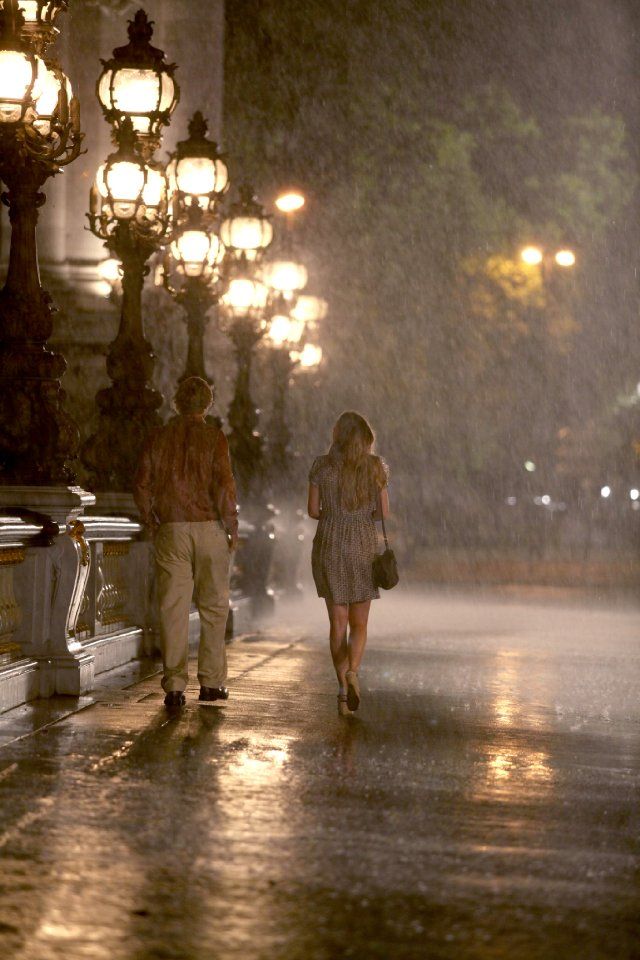
Well, not really. It's a fantasy too, cleaned up the better to swoon over. Other than a few graffiti here and there (surprising the film crew didn't paint them over), this is the Paris of TV perfume commercials. No veiled women, traffic jams, loud storefronts. You'd never dream the city is ringed with high-rise projects occupied by North African gangs, "no-go" areas even for the police and where the local sport is setting cars on fire.

To give Allen credit, he does have a talent for creating lovely images of vanished days. Even while you're conscious of the manipulative artifice and aware of the clichés (including the repetitive Django Reinhardt-ish riffs on the soundtrack), it's possible to captivated by the ambience, costumes, and some lovely ladies including the exquisite Marion Cotillard. 

But Allen won't even let us keep our innocent pleasure. In the end we're told by the wised-up screenwriter that all that Golden Age stuff is a crock. Every generation imagines a previous era to have been better, he says. He and Picasso's mistress (I think) were fooling themselves. We were suckers for letting Allen take us in with his nostalgic finery.


There's no point in commenting on the acting, since all anyone was asked to do was play a caricature. I'd never seen Owen Wilson before, probably because I never want to see the kind of movies he's starred in, and nothing he does here leaves me eager to re-make his acquaintance.


Saturday, November 10, 2012

Nothing to declare

I must ask the reader's indulgence if days go by before I imagine I might have something worth saying in this space.

This isn't "writer's block" (whatever that may be); more like existential dread, a hollowness inside. We have collectively entered terra incognita, sailed off the edge. Heere there bee monstyres.

Lawrence Auster chided me a little for writing that the republic is "torn and bleeding." No, he said
I disagree that it’s only torn and bleeding. In my view, it is gone and is not coming back (which I began saying a year ago). A country that accepts open homosexuality in the military, homosexual “marriage,” federal dictatorial control over health care insurance (e.g. the contraceptive mandate), a government that lawlessly topples a foreign government, kills its leader who was no threat to us, and replaces him by our mortal enemies, a government that appropriates the wealth of the orderly and productive part of the population in order to sustain and empower an alien and resentful population of parasites whose problems it blames on the orderly and productive; and, finally, a country in which a growing half of the population will never vote for a political party even half-heartedly opposing these things, is no longer the republic that was bequeathed to us by the founders.
Lawrence might be exactly right. Maybe I was doing exactly what I counseled against, taking refuge in denial, unwilling to recognize the snapping of the cord that, however frayed, seemed until last Tuesday to bind us to the vision of a constitutional republic with the national government's powers ring fenced.

I've read a lot of commentary by the Resistance in the past few days and see that many people have feelings similar to mine -- but that's a cold comfort. The impression is that lots of us are stunned, almost in the literal sense of that abused word. We have taken a knockout punch.


Again and again, commenters convey the shocked recognition of something worse than a disappointing election result. It's as if a disease that has ravished the world community for over a century, but to which we have been largely immune, has entered the household. The contagion of statism is in our national bloodstream. The country that believed fundamentally in the individual and voluntary associations of individuals has ceded the locus of control to Washington bosses.

New tactics for Resistance are already being discussed. Far be it from me to discourage anyone even further, but the first step is to fully admit to ourselves that the USA is now a country like most others, where government at every level -- federal, state, and local; executive, legislative, bureaucratic, and perhaps above all judicial -- tells us how to act, what to do, the limits to what we can say, even what we must buy (under Obamacare).


The old tactics no longer matter. Don't lose your time writing your congressman. Perhaps even demonstrations are meaningless.

What to do, then?

I don't know.

While I'm trying to get a grip, I remind myself that most people in this world live under governments of varying degrees of badness and life goes on. So it has been throughout history, and even during long bleak stretches of time, there have also been renaissances of the arts, sciences, and human achievement.

For me, there is consolation in remembering that politics, while inescapable, is not the alpha and omega of existence. The spiritual life can be -- has been -- practiced under the most difficult, even extreme, conditions. We are not here by accident, the mere product of material forces. As far as I'm concerned, we're here to lift our consciousness toward the ineffable perfection that our gross senses hide from us. Even when lost to ourselves, we are not lost to God.


Wednesday, November 07, 2012

Aftermath


Life after death has now been scientifically proven. When you die, you go to a polling place and vote for Obama.

Sorry, sometimes humor is therapeutic. Just my little joke -- it remains to be seen (or may never be known) how much of the vote counting was fraudulent. I don't doubt some was, but it probably didn't change the result.


So where are we now? We're going to have a lot to think and talk about and try to prepare for.

For me at least, it is not yet time to strategize. We must first absorb this loss, intellectually and emotionally.


We need to turn away the natural tendency to denial. American traditions, the Constitution, loyalty to any constituency beyond racial and ethnic tribes, the odds of soon rebuilding the economy, lost yesterday. Big time. This is what we have to come to terms with before anything else.


Don't look for silver linings; not to say there aren't any (although they sure are hard to spot at the moment), but right now the republic that was bequeathed to us by the greatest assembly of political philosophers in history is torn and bleeding. Deal with it.


Monday, November 05, 2012

Reward Barack Obama


The sun rises on good people and evil, rain falls on the just and the unjust. Surely we must look in our hearts for compassion toward even the present tenant of the White House.

I propose that Barack Obama be given the thanks of a grateful nation -- grateful that he will no longer guide the fortunes of wounded America.


Clearly the man does not enjoy the actual work of being president. The adulation of the mainstream media, certainly; the fantasy that he is central to a complete transformation of a country with a despicable history and a present tarnished by swamp dwellers clinging to their guns and religion; the rides on Air Force One; all the trappings of the office.
  
But the responsibility of having to make decisions with sometimes life-or-death consequences; of trying to understand how wealth is created -- as opposed to figuring out ways of siphoning it from those who have more to buy the votes of those who have less; of associating with different kinds of people, not just the Commies, Muslims, Chicago political crooks, and race-racketeers he's hung with since he was knee-high to a statue of Karl Marx; this he does not care for.


We should not insist that he carry on with such unsuitable labor.

A post-presidential career will be just the thing to restore his vanished joie de vivre. Nothing will distract him from his golf. He can enjoy his second, third, fourth, fifth homes in scenic locales. Deliver teleprompted banalities in cardboard temples, swan around with celebrities, enjoy his status as the second coming of Tutankhamun, enroll his horse in the Senate.


I, for one, am feeling generous toward ex-president Obama. He has earned his retirement benefits.


Sunday, November 04, 2012

Home again, and a bouw to the Concertgebouw


This may seem a diversion, given that we in the Formerly United States have a fateful presidential (and congressional) election in two days. I will have more to say about that in a subsequent posting. Or not.

And I understand that you may be tired of my banging on about Amsterdam, from which I belatedly got back Friday. Well, as a professional writer-editor (a genteel way of saying an employer pays me for it) and a blogger, it's down to me to make the subject interesting. Bear with me -- will somebody please get that bloody bear out of here?

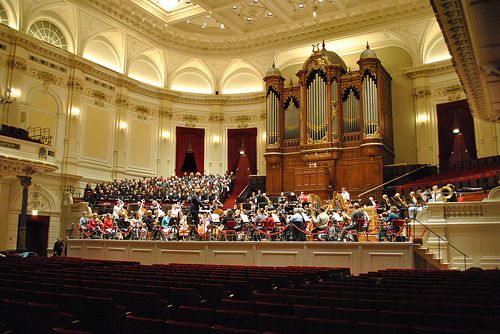
Concertgebouw

The Concertgebouw is as beautiful as any concert hall I've ever seen ... inside, at least. It will celebrate its 125th anniversary next year. Today's marketing mentality can never leave well enough alone, so the building now has an electronic sign on its Victorian facade to promote the next or current show. They've added a cafe and ticket area -- glass enclosed, don't you know -- but so far have not otherwise buggered with the noble edifice.

And, to be fair, the hall where you hear music has been splendidly maintained or restored. Its decor is a kind of hybrid Victorian-Baroque, which according to current taste shouldn't be tolerated, except the original designers didn't believe in that kind of academic piffle so it works a treat.


It was not, you understand, the Royal Concertgebouw Orchestra that was playing -- "Royal" added in 1998, as if it wasn't an aristocrat among orchestras before that, including under its longtime principal conductor, the great Bernard Haitink. (The more crass and demotic our popular culture, the more ritzy institutions insert "Royal" into their names -- the Scottish National Orchestra now bills itself as the Royal Scottish National Orchestra, while Scotland is busy divesting itself of any connection to the Formerly United Kingdom and its Queen. Maybe "Royal" refers to King James VI  (1566-1525), the last Scottish king, who became James I of England.

Our orchestra for this evening was the Freiburger Barockorchester, which sounds about as appealing as the Hoboken Pops, but Europe has lots of "provincial" orchestras that can give the Big Name outfits a run for their money.

It was an all-Beethoven program. I don't normally care for single-composer concerts, but I can generously find it in my heart to make an exception for Beethoven.


The Piano Concerto no. 5 was the kickoff and it was, how you say, kind of weird. The soloist, whose name I could hardly spell let alone pronounce, played a pianoforte -- the earlier version of the piano, probably similar in sound to what Beethoven himself played. Hey, no problem. I've come to accept original-instrument, "authentic"-style performances once every few years now that some  musicians have learned to play early instruments without sounding like hogs grunting and wet disk brakes. The thing is, the rest of the Freiburg group were grooving on what, as far as I could tell, were modern instruments -- "modern" in classical music meaning late 19th century.

[Side note: In my earlier life as a so-called salesman at Santa Fe Sight & Sound, I had a colleague who was the most musically knowledgeable person I've ever known: not just classical but jazz, pop, "world," you-name-it. He said that one instrument (I have long since forgotten which) in Mahler's scoring has since been updated, so that technically it would be possible to do an "original instruments" Mahler symphony. Was he pulling my leg?]

In principle I have no objection to mixing artistic styles -- see the comment about the hall's design above -- but musically I thought it was a problem in this case. A pianoforte produces nowhere near the volume of a concert grand, hence the orchestra had to curb its own sound so as not to cover the soloist. The players seemed a little uncomfortable with this watercolor Beethoven, sounding inhibited and shy of the proper grandeur.


Things picked up after the interval. Next on the program was the Triple Concerto for violin, cello, and keyboard. Critics tend to be dismissive of this piece, and I'm not sure why. Admittedly it's not in the Olympian category of the piano concertos three through five or the violin concerto, but it still has that majesty we depend on with middle-period Beethoven. Some of the greatest soloists in history have felt it worth their time -- for instance, Sviatsolav Richter, David Oistrakh, and Mstislav Rostropovich, who recorded it with Karajan and the Berlin Philharmonic.

The orchestra, perhaps tired of being musical furniture, whipped up a right frenzy. One of the advantages of hearing music played at a concert is that you get a sense of the instrumental placement that can be lost in even excellent recordings. I had never realized how much of this concerto is like a duet for the violin and cello soloists. (Are they always positioned right next to each other?) But Anne Katharina Schreiber (violin) and Jean-Guihen Queras (cello) knew it. They paid more attention to each other as they played their roles than they did to the score, clearly determined to be in perfect rapport, and they succeeded. I don't know what their relationship, if any, is offstage, but they seemed to be musically in love.

Last up was a fine Fifth Symphony.

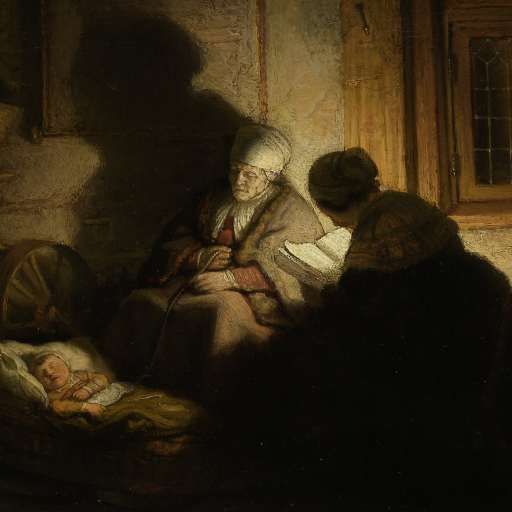
Rembrandt, "The Holy Family"

The Rijksmuseum

The temple of Dutch art was undergoing a thorough restoration four or five years ago when I was previously in Amsterdam, and so it remains. Like the Concertgebouw, this is a stately 19th century building, a Gothic Revival-Renaissance Revival work of art in itself. I worry what they will do to the interior in this big-time rewrite ... please, please no glass elevators, video monitors, paintings arranged by some cool-school curator's notion of "themes."

The Rijksmuseum has assembled some of the highlights of its vast collection in a dozen rooms on two floors, still open to the public. Fortunately, what is currently on view includes a selection of Rembrandt masterpieces. The concepts, the designs, the variety of brush and palette knife techniques of the paintings are staggering. The artist could convey scenes of quiet intimacy as well as glorious display, sometimes in the same picture -- for instance in "The Jewish Bride," which scholars now tell us involves neither a Jewish woman nor a bride; it's been retitled "Portrait of a Pair of Old Testament Figures."  ... "By any other name."


Also present are several of Jacob van Ruisdael's landscapes of somber beauty. Much as I admire Ruisdael, I have to admit that even in landscape Rembrandt could overtop him. A small Rembrandt painting, scarcely larger than the cover of a hardbound book, shows a rural scene almost uninhabited by human figures. Like so many Ruisdaels, the Rembrandt is a study in lighting contrasts: around the periphery is a dank gloom, but in the center a magnificently imposing tree, spotlit from a break in the cloud cover, glows like a lamp, every leaf radiant with the power of suns and moons.

I could have knelt before the picture in worship: not (only) of the painting, not (only) of Rembrandt, but of God. Nothing less could have guided Rembrandt's mind and hand as he transformed a piece of canvas into Elysian Fields, cold and northern and saturated with Eternity.


Thursday, November 01, 2012

Is the Washington Post the world's most corrupt "news" paper?


You decide. Two examples to consider.

The trash can liner published an article earlier headed, "OP-ED| Dream Act: Best policy for Maryland." Written by -- you won't be surprised -- Curtis Valentine and Gustavo Torres ("Curtis Valentine is executive director of MarylandCAN. Gustavo Torres is executive director of CASA de Maryland") with a photo by Juana Arias, it argues why taxpayers should eat the bill to send children of illegals (who should also be illegal, were it not for our country's insane anchor baby citizenship) to college.

This is an opinion piece, and as outrageous as it may be, the Post has every right to publish it. When I read it earlier, though, the editors apparently had a problem on their hands -- thousands of comments expressing disgust with the paper toadying to illegals. Now, you can hardly read the comments, let alone publish one, since the section (as of this writing) makes you wait endlessly while it loads.

You want to tell me the main paper in the nation's capital, long owned by millionaires (plus a few small-time investors dumb enough to put any of their capital into the money-losing company), can't afford the bandwidth to permit readers to respond or read the responses conveniently? Yeah, right.

Item the second: "In Petersburg, black voters just as focused — if not as vocal — as in ’08."
For the past four years, black voters have talked among themselves about waning optimism amid financial struggles, concern about the need to energize African Americans and the feeling that President Obama has not gotten the credit he deserves.

Here in Petersburg, which sits on the Appomattox River, there also is a steely determination that Obama must be reelected to prove that his 2008 victory was not a historic fluke. ...

Since 2008, optimism among black and Latino voters has fallen as those populations have faced high unemployment, said University of Chicago political science Professor Michael C. Dawson, who studies race and politics.
Let's not dwell on the awful writing ("steely determination" -- no editor on a weekly rag would have allowed that 50 years ago, before the age of affirmative action reporters). But turn the thing around. Imagine any paper in culturally Marxist America running this:

"In Paulsburg, white voters just as focused -- if not as vocal -- as in '08"
For the past four years, white voters have talked among themselves about waning optimism amid financial struggles, concern about the need to energize white Americans and the feeling that Mitt Romney has not gotten the credit he deserves.

Here in Paulsburg, which sits on the Appomattox River, there also is a steely determination that Obama must be defeated to prove that his 2008 victory was a historic fluke. ...

Since 2008, optimism among white voters has fallen as that population has faced high unemployment, said University of Chicago affirmative action political science Professor C. Dawson Michael, who studies race and politics.
Racism! Racism! Racism! But it's only racism if whites do it. When the Post writes obviously slanted "news" like this, it's because the Post exists to promote black (as well as Hispanic) interests.

If there remain any whites who read the Washington Post regularly to get "news," they must be as brainwashed and masochistic as it is possible to be.

RD