 "Butterfly Mandala" by Ann Stretton
My award for Knockout Web Site of the Week goes to eyebalm, the fine art online boutique of Ann Stretton and Stan Starbuck.The site's 3-D look, glowing colors, and partial animation are remarkable. Be sure to mouse over the "Home" icon, the buttons underneath it, and the corners — including the @ symbol in the lower left — and see how they change.The various galleries, for posters, digital imagery, jewelry, and more, display a good deal of fascinating work.
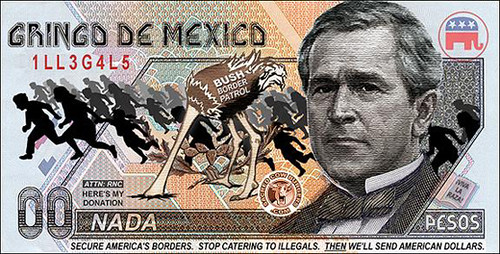
The Border Patrol is on the alert. No, not for illegals. For the Minutemen. (Tip of the hat: Michelle Malkin)According to three documents on the Mexican Secretary of Foreign Relations Web site, the U.S. Border Patrol is to notify the Mexican government as to the location of Minutemen and other civilian border patrol groups when they participate in apprehending illegal immigrants -- and if and when violence is used against border crossers.
You can figure Generalissimo Jorge W. Bush-Gonzales and his ruling junta have passed the word down for the Border Patrol to salute the Mexican flag.
The Bush administration's strategy for the Iraq occupation has been disastrous, but that is a political issue, to be decided at the ballot box. The borders question, however, is of a different order. The President of the United States is actively subverting his country's laws. He is colluding with another nation that has declared war on the United States, and against a group of American citizens.
Bush is a traitor or afflicted with folie de grandeur or both. Either way, he has gone beyond merely taking an unpopular stand. The country must reject him as the body rejects a disease. He should be impeached and removed from office. The U.S. cannot live with another two and a half years of this.
Bill Bonner and Addison Wiggin have written a book, Empire of Debt: The Rise of an Epic Financial Crisis, to warn that the United States's delusions of grandeur, a national debt so large that it must be financed by selling U.S. Treasury bonds to other countries -- China, they say, lends the U.S. $300 billion per year -- and inflationary funny money are leading us to ruin.Bonner is president and CEO of Agora Inc. ("one of the world's largest financial newsletter companies") and the "creator" (the book flap says) of the free online letter The Daily Reckoning. The Daily Reckoning's message is much the same as the book's, and it appears to be supported by paid links to other newsletters touting unorthodox money making strategies for building your own private ark against the imminent rain, er, ruin.(Wiggin is bio'd on the flap as the "editorial director and publisher" of The Daily Reckoning; curiously, although the book's byline is "Bill Bonner and Addison Wiggin," Bonner's name is in larger type, something I have never before seen with an "and" double authorship. We can presumably take it that Bonner was the primary writer, and for the sake of simplicity I'll refer to him as the author.)Empire of Debt has two main arguments: (1) that the United States has evolved from a republic that used to mind its own business into a worldwide empire that is minding everyone else's business, out of hubris and vanity; and (2) that it is financially rotten to the core. Bonner believes the two ideas are inextricably linked. I don't, and I think he undercuts his case for the second theme by writing a lot of of silly, if clever, cant about the first.To hear Bonner tell it, the U.S. was chugging along nicely except for an occasional inconvenience like the Civil War until Congress passed an amendment permitting an income tax in 1913. That, he says, let the dogs out. The modest republic quickly took on the role of a power-drunken empire. First up, America's entry into World War I: "[President Woodrow] Wilson longed to get us into it and imagined that he could transform the war -- and the world that came out of it -- in his own image. ... The reasons were just fluff. The real reasons were the same sordid, complex instincts that always lure people to war and ruin."You can argue, with the sharp vision of hindsight, that helping Britain and France win the '14-'18 war didn't accomplish much, since it failed to prevent the reprise that began in 1939. But who could have known that at the time? Now hear him on the second world war:Few would argue that World War II was a case of needless intervention, since the U.S. fleet was attacked at Pearl Harbor. Still, had America wanted to stay out of it, she could have done so. Pearl Harbor was attacked because the U.S. Navy posed a threat to Japanese imperial ambitions. If the United States had not displayed imperial ambitions of her own and had no satellite state in the Philippines, she would have presented no danger to the Japanese imperial forces. Nor was there any particular reason to go to war against Germany. Though allied to Japan, there was no question of Germany intervening in the Pacific War.
As a summary of the United States's reasons for engaging in World War II, this is so egregiously ignorant and morally obtuse that it is tempting to think Bonner is just joking, but if so, I don't get the joke. He offers a similar judgment on the Cold War: "During the period of the Cold War -- from 1950 to 1989, including the hot periods in Korea and Vietnam -- the United States spent a total of $5 trillion protecting the free world from the Evil Empire. If it had not spent a dime, the outcome might have been exactly the same -- but we cannot know that." Oh, please.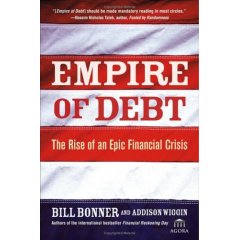 Bonner's ideas about the U.S. role in global politics are dopey, but in compensation, delivered with style and genuine wit. A sample (about Woodrow Wilson again, whom he holds in utmost contempt): "In the private sphere, a delusional man is soon impoverished, friendless, powerless, and hopeless. All he can do at that point is run for public office: Because in public life, foolish arguments have fewer and less immediate consequences."In turning to the economic side of his screed, Bonner can be just as acidly humorous. His diatribe against Thomas Friedman, an economics writer for The New York Times, occupies five pages (pp. 261-266, if you want to look it up) and is a classic of invective, worthy of Mencken. I'm reluctant to quote from it, because you really should savor the thing in its entirety, but here's a taste: "You might criticize the man by saying his work is without merit, but, too, that would be flattery. His work has negative merit. Every column subtracts from the sum of human knowledge in the way a broken pipe drains the town's water tower."Almost every president in the past 80 years gets a share of the blame for the country's financial downfall. He especially puts the boot in Roosevelt, for what Bonner sees as the flim-flam of the New Deal and for prohibiting private citizens from owning gold; Nixon, for removing the gold standard from the dollar, allowing the Treasury to print a Niagara of paper money to finance "imperial" adventures (the "Pax Dollarium") and service the ever-growing national debt; and perhaps most of all, that conservative saint, Reagan:"Reagan cut nominal tax rates, but government consumed more and more resources. The leech grew. Lower tax rates gave citizens the impression that they had more money to spend. Individually, they did. Collectively, they did not. The program was merely a monumental legerdemain. For every tax-cut dollar that a citizen spent, the federal government had to borrow as much as $1.18 (with interest)."And when we look at the story today, it's much worse. At last, Bonner starts making considerable sense, and he's far from the only one in the financial press who's seriously worried about year after year of government deficits, a staggering national debt, and an economy that runs on credit. I think he's right that the United States is becoming a country that makes less and less that anyone in the world wants to buy, and that practically all we know how to do anymore is sell things made in places like Indonesia and China to Americans who buy them by borrowing and siphoning funds from their home equity. At some point, the house of (credit) cards has got to fall down.Earlier generations of Americans took pride in planning and saving for the future. But then, as Bonner says, "people switched their attention from assets to cash flow, from balance sheets to monthly operating statements, from long-term wealth-building to paycheck-to-paycheck financing, from saving to spending, and from 'just in case' to 'just in time.'"I recommend Empire of Debt as grand entertainment, and the chapters from number 13 on for their observations about our poisoned prosperity. Bonner writes, "The citizens of Squanderville, as Warren Buffett calls the United States, are a happy bunch. They believe happy things; it doesn't bother them that the things they believe are impossible. After 20 years of mostly falling interest rates, mostly falling inflation rates, and mostly rising asset prices (stocks and real estate), people have come to believe that this is the way the world works: Interest rates mostly go down, and house prices mostly go up; it goes on forever."By borrowing and spending rather than saving and investing, Americans are creating a boom. The trouble is, the boom is elsewhere, for the people who make the things Americans don't and countries that buy our debt. Bonner has a worthwhile point to make: if those countries ever decide to unload all that debt rather than hold it, look out below.Note to John Wiley & Sons, publisher of Empire of Debt: Hire yourself a copyeditor or two. The repetitiousness, poor syntax, and typos in this book are disgraceful.
UPDATE 11/7/08
Considering that their book was written two or three years before the present financial debacle, you have to give Bonner and Wiggins credit for prescience. What they said then has become conventional wisdom now.
My first reaction on reading that Zacarias Moussaoui had been given a life sentence instead of death was the same as yours probably was. To wit, that justice was not served, that he has earned the Big Ticket and his head should be stuck on a pike at Ground Zero. Moussaoui, one of the 9/11 plotters, continued to express pride in his actions, insulted the surviving families of those murdered, and used his trial to give the finger to the United States.After due reflection, and while I empathize with everyone who is feeling outraged, I have to conclude (reserving the right to change my mind completely) that the life sentence is, all told, probably for the best.Not, mind you, because "we have to show we're better than them." Our sensibilities weren't so delicate at the Nuremberg trials, after a war that had cost more than 400,000 American lives and many additional injuries; when the world was still reeling from the shock of what had gone on in the German death camps. A dozen of those found responsible were soon dangling from the end of a rope.And not on any Portia-like quality-of-mercy grounds ("It droppeth as the gentle rain from heaven upon the place beneath. It is twice blest: It blesseth him that gives and him that takes," etc.).Instead, the reasons involve both practicality and, yes, the desire for punishment.A death sentence would involve years of appeals, and during that time, Moussaoui would carry on being a center of attention. His courtroom antics and boasting would be widely reported and he could play the defiant martyr to his heart's content. He might well eventually win an reversal of the sentence, which would look to the jihadists like a victory and another sign of the Great Satan's weakness.Instead, he will now disappear into the prison system. No more the big mouth celebrity. No reporters hanging on his every word. He will become a nonentity. In a maximum security penitentiary, he will surely have to be isolated from other inmates: even the worst of our worst will not feel the love for this man, and some if given the chance might show him their disesteem in imaginative and quite unpleasant ways.So let him enjoy his own company year after year. I suppose they will let him have a copy of the Quran, which even he might tire of after the 200th reading or so, and a TV, to watch our decadent culture continuing despite his efforts. (I trust that not even our tender hearted and politically correct federal government will include Al-Jazeera on the channel menu.)Oh, he will look forward to a Mohammedan heaven, right enough. But at the age of 37, he may need to wait quite a bit for it — who knows, maybe another 40 years. The first few weeks or months might be a bit of a lark, but once the novelty wears off and he gets it that he will be confined in a few small spaces for as long as he stays in this world, with nobody to cook up plots with, no infidels to listen to his harangues, he'll discover that the thrill is gone. With bare bodkin his quietus make? Sorry, the warden looks down on that sort of thing and won't allow it. Hunger strike to relieve the boredom of waiting for the train to Allahland? Sorry again, old boy, but prison management has met that sort of thing before and knows the routine for coping with it.No, he'll just have to live with his soul, day. After. Day. After. Day. After …Welcome to hell, Zacarias. Living hell.
Update May 5
Gerard Van der Leun at American Digest makes a powerful case that the life sentence is yet another mini-surrender. My rationale above applies only so long as the conditions specified remain in place. If Zac is permitted to give interviews, publish a book, have conjugal visits by his favorite wife/waif/camel, order takeout from Dean & DeLuca, subscribe to Modern Suicide Bombing, send Happy Ramadan cards to his friends in Saudi Arabia, or act as technical advisor for "9/11: The Musical," then the deal is off. The entire federal subsidy for the Public Broadcasting System and National Public Radio should be redirected into an award fund for Zac's successful assassin, and 100 million duplicate keys to his cell mailed to random addresses in Sicily, Mexico City, and Russia.
Despite my best intentions, posts on spiritual themes have been running a deficit on this site. It's hard to find spiritual topics that lend themselves to the quick-and-short format of a blog. Frankly, it's easier and consumes less of my time-impoverished life to post about politics, where there's always some news to bounce off.Occasionally, though, I stumble across something on another blog to respond to — and having someone else lead with an argument saves much effort. Robert Speirs, who writes an entertaining blog called Conundrum — the Cosmic Pilgrim, recently offered his "Last word on God": "I don't think anyone who talks about Heaven really knows what it would be like to go there, in the words (approximately) of the old song. I don't think the concept 'God' and the concept 'exist' should be mentioned in the same breath."In connection with a discussion on another site, he asks, " ... Isn't it true that the concept 'belief' is as undefined and conveniently flexible as the concept 'God'? Isn't it true that one cannot 'disbelieve' any more than one can 'believe' in some concept if that concept is irrational and self-contradictory? So there are not atheists and believers. There are merely wise men and fools."He then concludes, "Then I realized I didn't want to talk about things that don't make any sense. Well, that simplifies life. Although I still may have to think about exactly why people say they believe or disbelieve in God."There may be as many reasons why people believe (or disbelieve) in God as there are people; but I'll try to offer one individual's, perhaps a fool's, answer.Do I know what "Heaven" is like? No. I have read quite a few reports said to be from people who have passed over ("died"), transmitted through mediums, and they are in general agreement that there are different levels of post-mortem existence. None of those levels have anything to do with being issued a pair of wings, a harp and a Cloud-a-Lounger. Depending on the state of one's soul development, the afterlife may include encounters with angel-like beings.So where does God come in? It seems, from the evidence of psychical research, that you don't meet Him just by dying. (God is not a "Him" or "He"; I'm just using conventional Christian terminology to avoid a digression.) The evidence for God comes from those who have experienced God. When that happens, it's in a very different state of consciousness from the ordinary. It's an opening to a nonmaterial reality.It isn't irrational to speak of God; it's nonrational. Reason is based on the objects of sense perception, and is rightly used as a tool to judge the truth or falsehood of statements about things that can be seen, heard, or measured. Reason is not a useful guide to what lies outside of sense perception — what can only be apprehended by a different faculty of the mind that remains undeveloped in most of us, most of the time.In a very literal way, Robert Speirs is right that God doesn't make any sense. He is not an object of sense. He exists outside of Time and Space. You can know Him, if you persist in certain spiritual exercises of which there are many varieties, but not in the way you can know an object or a human or a logical proposition. The knowing is by what might be described as direct intuitive perception.The last word on God? I doubt very much we have said it here, considering that people have been banging on about God (or the Gods) since at least the 5th century BC. But even if these were the last words anyone ever spoke about God, it wouldn't make any difference. People would still find their way to Him, with or without words. (Possibly, in some cases, more easily without them.) God is.
Yesterday brought lessons.
It was rough, very rough. The power of the assembled illegals was made very clear. Tens of thousands of man-hours of work were lost. Any remaining illusions about the survival of our society without imported Third World servant-class labor were shattered.For American citizens, though, it was a day pretty much like any other.