Thursday, February 07, 2008

Classical beauty

Photobucket
Hélène Grimaud

I don't want to write today about the United States or Britain going down in a graveyard spiral. Which is to say I don't want to get so cheerful that I look for a cell to hang myself in.

Let us turn to something much pleasanter: feminine beauty, in this instance beautiful women who are stars of classical music.

Even nowadays in our demotic age, there are stuffy people in the classical audience who would object to this as heresy. They would say connecting the performing tradition with the world of glamour publicity photos is vulgar. I say pooh to that. Why shouldn't musical artists be admired for their looks? Tell me one performing art where looks don't count. Seen any 200-pound ballet dancers lately? Oh, you say, but he or she couldn't dance well carrying that much weight. All right, how about film stars? (In leading roles, not character parts.) Notice how, questions of personal taste aside, they're all rather good looking? The actor who has a 30-second scene might be just as talented — maybe more talented — than the one whose name appears above the title. The difference is down to physical attractiveness.

Beauty is additive. A lovely woman (yes, ladies, or a good-looking man) enhances the aural pleasure of the music, on the same principle that a multi-hued sunset seen through a picture window can make a recording of a symphonic performance seem more rarefied. Nobody, of course, is suggesting that glamour is a substitute for ability, or that plain artists aren't worth listening to. Just that when you get both physical allure and musical talent in the same package, it's extra-special. So, on to our gallery.

Leading off, above, is pianist
Hélène Grimaud. I have only heard one or two recordings of her and have no opinion as to her playing, except that she is obviously technically accomplished.

Photobucket
Hilary Hahn

I'll admit to being a Hilary Hahn groupie (metaphorically, naturally; I've never even been to hear her in a concert, alas). Her artistry needs no endorsement from me, as she's widely acknowledged to be one of today's finest violinists, and I can understand why. But I also love her looks: long wavy hair, Mona Lisa smile, a kind of vulnerable or hurt aura. (I know people aren't necessarily anything like how their publicity photos make them appear, and maybe she's really a fire-breathing dragon; in all the examples in this gallery, I'm just commenting on what I can see.)

Photobucket
Did I mention I like Hilary Hahn?

They don't come much cuter than the English pianist Margaret Fingerhut. She excels in late romantic repertory.
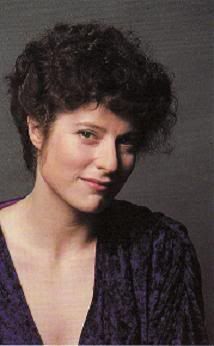
Photobucket

Margaret Fingerhut (above and below)

Photobucket

You'd never guess, just to look at her, that Seta Tanyel is quite the romantic, would you? The Turkish pianist also goes in for late romanticism, and has helped revive the works of nearly forgotten composers such as Scharwenka and Moszkowski.

Photobucket
Seta Tanyel

Although she's a Canadian raised in Southern California, violinist Leila Josephowicz looks every bit the sophisticated, worldly, European femme fatale in this glam shot. I have her recording of the Prokofiev concertos, in which she plays with such a smoky, unearthly line and amazing tone colors that it's practically psychedelic. Too bad the recording engineers let her down; her string tone so dominates the orchestra that they're barely in the frame.
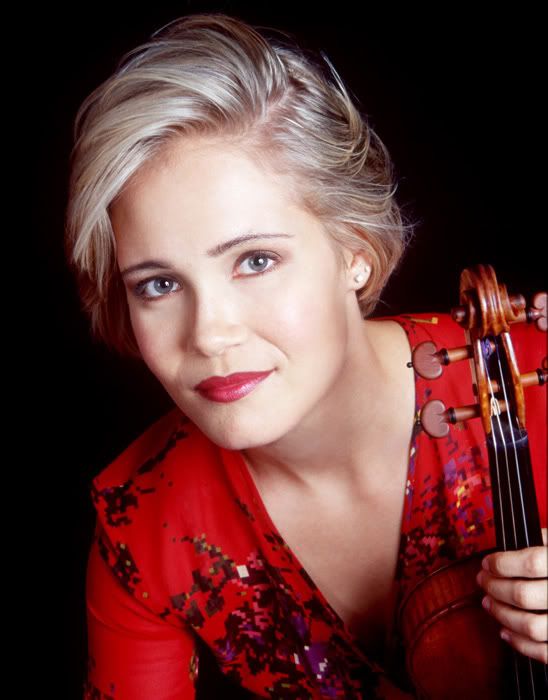
Photobucket
Leila Josephowicz

Czech mezzo Magdalena Kožená sounds fabulous singing Handel, and I don't much even like Handel.
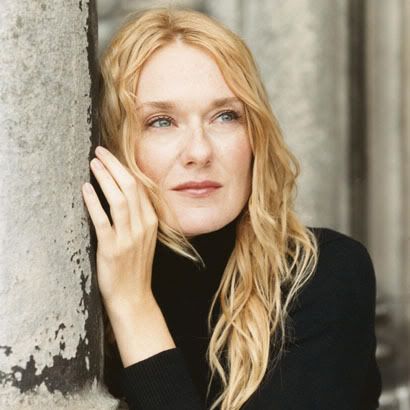
Photobucket
Magdalena Kožená

By the way, the classical artist as glowing object isn't entirely a product of modern hype. Elisabeth Schwartzkopf, the German soprano, was a prototype. My wife, who is more into opera than I am, told me that Schwartzkopf was the first famous singer to replace the "fat lady" stereotype with a normally proportioned and visually attractive stage presence. I looked on Google Images trying to find the famous movie-star-ish photo of her from the 1940s, but the only incarnation that came up was on a book cover:

Photobucket


It doesn't seem fair, does it, that these women should have both the looks and the big time talent? Maybe it is their payoff for karma earned in past lives. In any case, beauty is as beauty does: none of them attained their stardom by a "gift." They worked very hard to nurture their skills.

I don't know about you, but just putting together this set of photos has convinced me that life is worth the bother, even with civilizational debacle looming.

UPDATE FEBRUARY 8

How could I have forgotten Martha Argerich? Pastorius (see comments) has reminded me about the Argentine (?) virtuosa. The album cover below is probably from the mid-'60s.

Photobucket


Photobucket

Wednesday, February 06, 2008

Bury. Head. Sand.

Doctor, I have a problem. I keep hallucinating. No, not all the time; it happens mainly when I read articles in the British media. I bring up a news site to see what's happening in the U.K. and I go mental. These bizarre fantasies take the stage. And they're so real looking, as though they're actual news stores.

No, I'm not on drugs, Doctor. Other than the ones you've prescribed.

You want an example? Right then, how about this:

The Government has drawn up a controversial phrasebook on the language of terrorism and is insisting civil servants no longer blame fanatical extremism on Islam, for fear of upsetting the Muslim community.

The new counter-terrorism guidelines suggest that phrases such as "Islamic terrorist" and "jihadi fundamentalism" are too inflammatory and imply that all Muslims explicitly are responsible for extremism.

Photobucket

You see what I mean? I've got to be barking mad to hallucinate such an absurdity. I know that Britain stands for common sense and civility, courage -- you know, Winston Churchill, "Britain can take it" in the middle of the Blitz. But I also seemed to see this:

It also claims that the use of concepts like "the struggle for values" or "a battle of ideas" plays into the hands of those who wish to frame the issue in terms of a clash of civilisations between Islam and the West. A more productive approach is to stress the idea of shared values, it suggests. ... The guidelines make up part of a £45 million plan to tackle violent extremism in local communities and win the "hearts and minds" of Muslims.
"Hearts and minds." I've heard that somewhere before. Am I confusing past and present?

Photobucket

Why are you giving me a blank prescription form? Oh, excellent symbolism, got it. You want me to just ignore my disordered senses. Let my mind go empty, like I'm in one of those transcontinental meditation ashrooms or whatever you call 'em.

Or skip the U.K. news and focus on the American presidential campaign? Wait till I tell you what I'm hallucinating about that ...

Photobucket

Tuesday, February 05, 2008

A thought for super primary day

Probably the best line in any campaign flyer that will appear in 2008, from one on behalf of Ron Paul:

"Lobbyists don't bother to visit him in Congress. Why? Because he never supports any bill that violates the Constitution or gives handouts to their bosses, no matter who they are."

Photobucket

Monday, February 04, 2008

Equivocational training

Mark Steyn is one of two prominent journalists in hot water with some of Canada's Muslims, who have filed a complaint against him with the British Columbian Human Rights Tribunal and the Canadian Human Rights Commission for published excerpts from his book America Alone. Steyn has linked to an odd article by Lee Harris about the flap.

Harris begins with some historical notes intended to show that the idea of nearly unlimited freedom of speech is actually fairly new in British and American law, and was possible only after religious factions finally got polite enough not to rip one another's insides out. He then goes on to suggest that we are again back in a situation where the government may need to recognize limits on free speech for the original reason: because if it inflames a portion of the population, it puts the rest of the population at risk.
Today, because of Islam, the furor theologicus that we in the West thought we had put behind us is reemerging and can flare up in any part of the world. A cartoon or a film documentary that Muslims find offensive can set off a chain of reactions that lead to riots, bloodshed, the murder of innocents, and international crises. To continue to maintain, in the light of these troubling facts, that the state has no business watching what its citizens say is to indulge in a wistful anachronism. Even the most dedicated libertarian must surely realize that at some point the other members of his society may not be willing to pay the social costs of his freedom of expression. One may of course wish for a society to stand firmly behind those who have the courage to speak their minds; but it is simply naive to expect the general population to support them beyond a certain point.
Does Harris actually believe this — that one group should have the power, through threat of violence, to set certain kinds of criticism out of bounds? He says, "If speaking of Islam runs genuine risks of inciting violence, we cannot just pretend that it isn't so. We can be indignant about this and declaim loudly against it--but what good does such an approach really do? If criticizing Islam promotes bloodshed, then criticizing even more hardly seems like an attractive solution."

Photobucket

What to do? His answer, while superficially clever, is ultimately evasive.
Let offended Muslims file complaints to their heart's content. Make outraged imams fill out tedious forms. Require self-appointed mullahs, representing imaginary counsels and committees, to provide documentation of their grievances. Encourage them to vent through the intrinsically stifling bureaucratic channels provided by panels like the Alberta Human Rights Commission. Show them, nanny-like, that you care about their injured feelings. Patiently and silently listen to their indignant complaints, and let them, ideally, get it all out of their systems. Humoring, let us remember, is not appeasement, but often a clever way to coax troublesome children of all ages into behaving like civilized human beings.
If he isn't just showing off his sense of humor, then he is hoist by his own what-do-you-call-it. People can sometimes smile and shrug off criticism or even outright insults, but will never forgive being patronized.

Harris actually seems to realize how shallow his prescription is, and that the stakes are too high to be swept off the board with a little good natured clowning. He acknowledges that
it is the nature of the nanny state to bring up citizens who have been trained not to rock the boat. Under a nanny regime, the good citizen is one who is reluctant to speak his mind merely out of fear of what other people might think. For people already this cowed, even the threat of a minor bureaucratic hassle would be a powerful argument for keeping one's mouth shut, and for standing by while our hard-won liberty of discussion is steadily eroded.
Just as he seems to be about to take a stand for free speech and letting the chips fall where they may, he decides to go for the equivocation discreet.
Either we must clamp down on critics of Islam, mandating a uniform code of political correctness, or else we must let the critics say what they wish, regardless of the consequences, and in full knowledge that these consequences may include the death of innocents. This is not a choice that the West has had to face since the end of our own furor theologicus several centuries ago, but, like it or not, it is the choice that we are facing again today.
Well, Lee mon vieux, which is it to be? He comfortably dodges answering and leaves it up to us.

Photobucket

You will notice, if you read his whole essay, that he assumes it is impossible for a society to return, if that is what it takes, to the condition in which there is enough common ground that no one has to live in fear of violence or legal sanctions for speaking his mind. The diversity hook is in his gill. Harris can't imagine that Muslims could be separated from the rest of the world, so the rest of the world could get on with its business without endlessly worrying about being "sensitive" and inoffensive.

Since Harris won't make his own choice, I guess I have to. We should face reality and acknowledge that Muslims and the West have completely different assumptions about the purpose of society and how life is to be lived, and that it's futile and dangerous to keep trying to pretend otherwise. Only stopping and reversing Muslim incursion into the West can preserve both freedom and safety.

Harris must have put a lot of time and work into writing that article. Too bad he had to leave it to me to finish it for him.

Photobucket

E

Michael Tams at American Federalist Blog, one of my always-reads, has done me the honor of choosing Reflecting Light for one of his Excellent Blog Awards.

Photobucket
"The rules: By accepting this Excellent Blog Award, you have to award it to 10 more people whose blogs you find Excellent Award worthy. You can give it to as many people as you want but please award at least 10. Thank you out there for having such great blogs and being such great friends! You deserve this! Feel free to award people who have already been awarded."
I feel I can do no better than to cite the blogs among the names listed in the column to the right. (Not all the sites qualify as blogs.)

This is perhaps a good time to say something about my blogroll policy.I've noticed that many bloggers don't appear to update their blogrolls very often, but I would encourage them to do so. Otherwise they offer only an old snapshot and unfairly penalize newer blogs or ones discovered more recently. I've set out to revise my list a couple of times. but ended making only minor changes; the best tend to be consistently good. At the same time, there are many others that could reasonably be added.

This is a dilemma. I know many bloggers have no hesitation about adding names, sometimes running into the hundreds. But my take is that as the list lengthens, less attention is called to each link, and the blogroll begins to resemble the list of donors in tiny type at the back of an arts performance program booklet.


I'd like to emphasize again what I say in the disclaimer: I don't endorse everything said in the sites I've linked to. Sometimes I disagree outright. Now and then two bloggers on my list bash one another; fine. I like to think I don't have a rigid ideological position. My choices for the blogroll generally include authors who repeatedly demonstrate an ability to view subjects in such a light as they are not commonly seen in, stimulate my own thoughts, and write with style.

One more thing — I would give Michael Tams one of my Excellent Blog Awards, except it would look like a quid pro quo. I expect to add him to the blogroll after a suitable time has passed.

Photobucket

Friday, February 01, 2008

Save the Parthenon sculptures: get them out of Britain

Photobucket

I have changed my mind.

No kidding: I have changed my mind.

My rethink is about the heatedly debated question of whether the sculptures that once covered the pediments and frieze of the Parthenon, which are now housed in the British Museum in London, should be repatriated to Greece. I have said no before. Now I say yes.

Photobucket

The sculptures were formerly known as the Elgin Marbles, after Lord Elgin, British ambassador to the Ottoman empire — which then ruled Greece — who collected and shipped them home in 1801. The Parthenon had been severely damaged in an earlier war, and the site was unprotected, so it is quite possible that Lord Elgin saved them from destruction. But in today's climate of ethnocentrism and political correctness, he is reviled.

The sculptures now reside in a grand room built specially for the purpose, well displayed (except they necessarily face inward rather than outward as they would have on the Parthenon). I've been fortunate enough to visit them twice. Despite being considerably damaged, with portions missing — especially on the pediment carvings — they are still powerful and offer a fascinating glimpse into the civic and religious atmosphere of Attica's golden age.

Photobucket

While I can sympathize with the Greeks' (and many others') desire to return the artwork to its original site, especially now that a large modern museum has opened at the Parthenon, I can't buy it in principle. The argument from ethnicity is irrelevant: few of today's Greeks are descended from those who lived in fifth century B.C. Athens. That aside, to cater to the view that every work of art "belongs" to the country on whose territory it was made would wreck every major museum collection in the world. To take the land-of-origin idea to its logical conclusion, the Cincinnati Art Museum would contain only works created in Cincinnati. Or in the museum's own ZIP Code.

So why have I come around to the view that it's time to send the Parthenon sculptures back? Because that will help assure that they are preserved when the United Kingdom becomes a Muslim-dominated country, as it seems determined to do.

During the Blitz in World War II, the National Gallery in London wisely packed up its treasures and stored them for safekeeping far from the city (I believe they were sent to a cave in Wales). The Parthenon sculptures could be equally vulnerable in another 10 or 20 years — or today, for all I know.

Muslim fanatics haven't a drop of tolerance for religious art, or even art depicting human figures, from other cultures. Whether the Parthenon sculptures are religious art depends on definition; worship of the gods and the celebration of the polis were entwined in the age of Pericles. Regardless, Muslim iconoclasts don't make fine distinctions. Buddhism is not a theistic religion either, which didn't save the 1,50-year-old statues at Bamiyan in Afghanistan from the Taliban.

Photobucket
Before Taliban

Photobucket
After Taliban

The Parthenon sculptures belong to the world, not to Greece. But they will be safer in Athens. The Greeks lived under the Turkish-based Ottoman Empire for hundreds of years, and if resistance to an Islamic takeover succeeds anywhere in Europe, I think Greece will be one of those places.

Photobucket