Thursday, November 11, 2010

Armistice Day

Photobucket  
What passing-bells for these who die as cattle? 
Only the monstrous anger of the guns. 
Only the stuttering rifles' rapid rattle 
Can patter out their hasty orisons. 
No mockeries now for them; no prayers nor bells; 
Nor any voice of mourning save the choirs, 
The shrill, demented choirs of wailing shells; 
And bugles calling for them from sad shires. 
What candles may be held to speed them all? 
Not in the hands of boys, but in their eyes 
Shall shine the holy glimmers of good-byes. 
The pallor of girls' brows shall be their pall; 
Their flowers the tenderness of patient minds, 
And each slow dusk a drawing-down of blinds. 
 — Wilfred Owen, Anthem for Doomed Youth 

We call it Veterans Day now, but I prefer the old names.

Here's a story from the Great War. Can't vouch for its truth or remember where I read it. Maybe it means something.

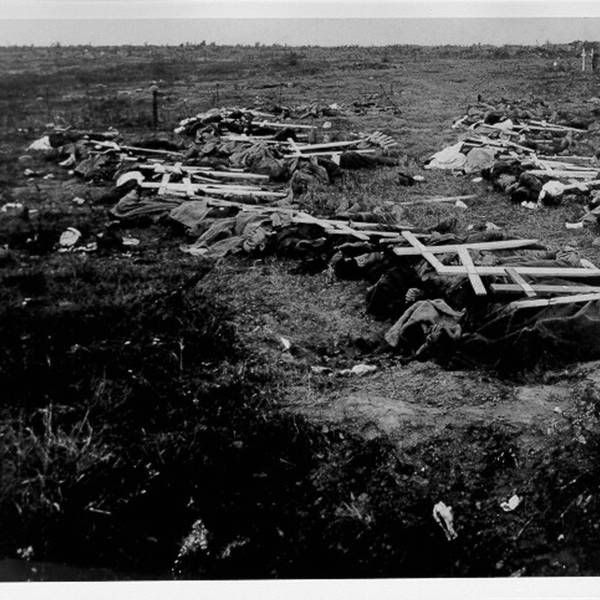
Before the Battle of the Somme in 1916, the French and British forces pounded the German lines with artillery fire for eight days. The theory, soon to be disproved, was that it would decimate the enemy even before the attack.

Eight days. Shells whizzed and detonated. The guns were reloaded. On and on it went, making one hell of a racket.

As zero hour, 7:30 am, approached the firing stopped. For a few minutes, before the deadliest single day of battle in history, quiet reigned.

In those minutes, all the armies in the field could hear birds singing.

Photobucket

Wednesday, November 10, 2010

Putting the ire back in Ireland


  Photobucket
Anybody have a spare leaf?

We Yanks could teach the Irish a few things about bank bailouts and mortgage pathology. Well, actually, it looks like we have.

I can't say I've been following the Irish economic debacle very closely — it's hard work just keeping up with our own — but an article in the Irish Times summarizes it. Apparently, the taxpayers of the Irish Republic are generously going to be picking up the tab, some 70 billion euros, for three big rupt-banks.

The writer, Morgan Kelly, has the traditional Irish gift for words. Some of his juicy observations:
SAD NEWS just in from Our Lady of the Eurozone Hospital: After a sudden worsening in her condition, the Irish Patient, formerly known as the Irish Republic, has been moved into intensive care and put on artificial ventilation.
Photobucket
… The true scandal in Irish banking is not what happened at Anglo and Nationwide (which, as specialised development lenders, would have suffered horrific losses even had they not been run by crooks or morons) but the breakdown of governance at AIB that allowed it to pursue the same suicidal path.
Once again we are having to sit through the same dreary and mendacious charade with AIB that we endured with Anglo: “AIB only needs €3.5 billion, sorry we meant to say €6.5 billion, sorry…” and so on until it is fully nationalised next year, and the true extent of its folly revealed.
Photobucket
Where the first round of the banking crisis centred on a few dozen large developers, the next round will involve hundreds of thousands of families with mortgages. Between negotiated repayment reductions and defaults, at least 100,000 mortgages (one in eight) are already under water, and things have barely started. 
 Photobucket
If one family defaults on its mortgage, they are pariahs: if 200,000 default they are a powerful political constituency. There is no shame in admitting that you too were mauled by the Celtic Tiger after being conned into taking out an unaffordable mortgage, when everyone around you is admitting the same.

The gathering mortgage crisis puts Ireland on the cusp of a social conflict on the scale of the Land War, but with one crucial difference. Whereas the Land War faced tenant farmers against a relative handful of mostly foreign landlords, the looming Mortgage War will pit recent house buyers against the majority of families who feel they worked hard and made sacrifices to pay off their mortgages, or else decided not to buy during the bubble, and who think those with mortgages should be made to pay them off. Any relief to struggling mortgage-holders will come not out of bank profits – there is no longer any such thing – but from the pockets of other taxpayers.
Can it be but five years since the Irish were swanking it up with real estate windfalls and foreign investment, buying each other rounds of drinks without counting the cost? Has the whole Western world's government and business Establishment forgotten whatever common sense it ever had?

Best of Irish luck to you, friends, and we'll accept the same from you. Heaven help us all.

Photobucket

Monday, November 08, 2010

National Symphony Orchestra: live

I don't know why I'm telling you this. But I could say that about every posting.

This past weekend, I attended a concert of the National Symphony Orchestra at Washington's Kennedy Center. On the program were Debussy's Prelude to the Afternoon of a Faun, the Prokofiev Violin Concerto no. 2, Stravinsky's The Song of the Nightingale, and Bartók’s Suite from the Miraculous Mandarin.

Photobucket

It's not often that I go to live orchestra concerts; I average about one a year. Besides the expense, there's the Hassle Factor. The term "Hassle Factor" was devised, I believe, by a San Francisco Chronicle entertainment writer in the '60s when I was a Berkeley freak. It stands for everything unpleasant you have to put up with surrounding the event you want to attend.

To fetch a concert in Washington, you have quite a Hassle Factor. Unless you live in the city, which I am happy to say I don't, you either take the Metro, a crumbling '70s legacy, or drive in congestion and crazy traffic patterns. The automobile and transportation engineers have long since destroyed L'Enfant's classic, rational street plan for D.C.

Then there is the venue, Kennedy Center. It has a nice location aside the Potomac River. That is the end of its virtues.

Photobucket

The K.C. is a design from the '60s, a real bad period for public architecture. It combines monumental grandiosity with sterility. It's hard to make polished white marble walls ugly, but the K.C. manages to. Now, trying to make the place "cool," the management has filled the red-carpeted corridors and foyers with video monitors hyping shows at the Center, shrines to John F. Kennedy, and bizarre temporary sculptures. The current display consists of lots of piles of rice, each grain representing the number of people in some category — population per square mile of various countries, number of psychiatrists per 10,000 inhabitants of Calgary, malnourished children in Botswana, that kind of thing. The displays take up a lot of the formerly generous space, so with three shows scheduled simultaneously at the K.C. you get airport-like crowds.

The concert hall itself was redesigned a few years ago. It no longer resembles a high school gym. Now it's got a little more warmth, like an oversized motel lobby.

Photobucket

Your reward for putting up with all that is the opportunity to hear a live concert by a fine orchestra with a world-class soloist. There's nothing quite like it. Audiophiles argue about how close even the best recordings and sound reproduction equipment can get to the real thing, but most acknowledge that there's a certain je ne sais quoi about being there with no electronics between you and the musicians.

Seats in the front of the ground level and the back are cheaper than those at a medium distance from the stage. I like to sit up front; I was in the fourth row this latest time. Orchestra seating cognoscenti love to tell you that the best seats for hearing the music are in something like Row XX of the third balcony ("you can really hear the blending of the instruments"). They're welcome to their eagle's nests. Cost considerations aside, I'd rather be up front where I can clearly see the conductor, soloists, and (some of) the musicians.

It's true that the sound isn't perfectly blended — the strings, placed in front, can drown out others such as wind instruments behind them, although a good conductor will see to it that the balances are "transparent." And I'll own that if you're close to the stage, you can't see what some of the musicians are doing; the price for seeing very well what the violinists, violists, cellists, bassists, soloist and conductor are up to.

But that sense of connection with at least some of the musicians is a large part of why some of us still (if we're lucky) go to concerts when there are note-perfect recordings of everything in the standard repertoire. We want a human dimension to go with the sound.

Photobucket

Eh? So how was the music, you ask?

The NSO doesn't have the reputation of being even one of the the top American orchestras, much less a great one by world standards. Well, I'm here to tell you that they can sound glorious, and did. I've heard the Amsterdam Concertgebouw and several of the London orchestras in concert, and they were cracking, but I can't honestly say they were a lot more impressive than the NSO this weekend.

The Prokofiev is perhaps my favorite modern violin concerto. Gil Shaham, the Israeli virtuoso, was the soloist. I don't know how a violinist or a case-hardened music critic would have rated his playing, but it was dazzling as far as I was concerned, fiery and refined as needed.

I've noticed in recent years that violin soloists are getting a lot more animated, using body language and gestures. The first time I was aware of this phenomenon was in a 1991 concert, when Nigel Kennedy (who now bills himself as just Kennedy — why not go all the way and call himself "The Kennedy"?) came out dressed like a rock musician and stamped his foot once in a while to emphasize a point while playing the Elgar concerto.

Shaham didn't wrap himself in flashy attire, quite the reverse, a gray suit and red tie like a Lexus salesman, but he hammed it up just enough to be fun to watch as well as wonderful to listen to. There seemed to be a lot of electricity between Shaham and the first violinist, Nurit Bar-Josef (a woman, and judging from her name, also of Israeli ancestry). Even while playing they often made eye contact. Were they flirting?

I would ascribe this purely to my imagination and think that they just shared a professional admiration for one another (Bar-Josef could probably be a soloist herself if she wanted that kind of life), or maybe a shared nationality had something to do with it. I probably wouldn't even mention it except that I overhead a woman seated nearby mention during intermission that she'd had the same impression.

That's one example of what I mean about the human dimension of concertgoing.

Photobucket

The conductor was Xian Zhang. Yes, she is a native of China. When classical music finally diminishes to obscurity in the West, the Asians will carry on the tradition. Lots of the younger generation of classical artists are from China, Japan, and Korea.

She seemed to know her business, and judging by how well the orchestra played, maybe Zhang inspired them. Or maybe an orchestra, tired of the mannerisms of their regular leader, perks up for a guest conductor. Or — unorthodox thought — maybe 90 percent of the time it makes no difference who is conducting.

After all, surely almost all these musicians had often played the Debussy and the Prokofiev previously. The chances are many had performed the other pieces, too. If any orchestra musician happens to be reading this, tell me, because I'm really curious: do you play your part differently in any significant way when Eugen Jaegermeister blows into town for a guest conducting gig and leads a couple of rehearsals?

Photobucket

The programming for the second half of the concert wasn't ideal. Either the Stravinsky or the Bartók would have been fine, but the two together were too much of a good thing, driven and intense. Nightingale was revised in 1917, when Stravinsky still had Petroushka, The Firebird, and The Rite of Spring in his bloodstream. It is bracing, thrilling music, with the composer's gift for orchestration much in evidence. 

Bartók's Miraculous Mandarin suite is also from his "mad scientist" period, a searing and grotesque piece that ends in a barbaric climax — I don't know how the players had enough energy left by that point to raise the roof, but they did.

Bravo.

Photobucket

Friday, November 05, 2010

Two dropped messages

Obama acknowledges his message didn't get through

WASHINGTON — President Barack Obama is acknowledging in the wake of this week's election rout that he hasn't been able to successfully promote his economic-rescue message to anxious Americans.
Obama says in an interview with CBS's "60 Minutes" that he "stopped paying attention" to the leadership style he displayed during his run for the presidency.
Obama also said he recognizes now that "leadership is not just legislation," and that "it's a matter of persuading people. And giving them confidence and bringing them together. And setting a tone. And making an argument that people can understand."
"And I think that — we haven't always been successful at that," he said. "And I take personal responsibility for that. And it's something that I've got to examine closely as I go forward."

Photobucket
I know just how you feel, King Barack. I have been unable to get my message through to a certain post-American president, anxious about all the retrograde citizens clinging to their guns and religion. For two years, off and on, I have promoted my rescue-the-country-from-its-government package, but said Barack "Big JuJu" Kenyatta was still campaigning for the office he had already conned himself into.

But bloggership is not legislation. It's a matter of talking sense to people, especially officeholders, including Attorneygeneral Holders, including presidents on a mission to turn the United States into a borderless EuroBureau dependency. I wanted to give you confidence, King Barack, to rise above yourself and set a tone other than skin color.

But I'm not too good at making arguments people can understand. Ask anyone who knows me. I take full responsibility for your failure, as well as the people who voted for you and your hard squad. None of you listened to me me me me me me me me … where was I I I I I? 

Oh, yes. As I go forward, ever forward, sweeping the world along with me, it's something I will examine as I go forward forward forward forward and pay attention to the bloggership style that has brought me where I am, wherever that is.

Photobucket

Wednesday, November 03, 2010

The state of the states

Photobucket
Andrew Jackson's return?

I'm glad to leave detailed analysis of the election results to others who are more hip to the specifics than I am. But what strikes me as especially significant is that, as Rosslyn Smith writes at American Thinker:
The GOP had enormous success is taking control of state legislatures last night. This new power will have an impact in redistricting efforts for U.S House seats, and  for state legislative districts. It also gives Republicans a bigger role in state fiscal issues- budgets, taxes, spending.  It appears that at least 15 State House or Senate chambers had a change in control to the GOP last night, giving the Party control of more chambers than the Democrats now hold. 
Regardless of who controls Congress -- and it looks like, for two years, the answer will be "nobody" -- two immensely powerful governments-within-the-government, to wit, the federal bureaucracy and the federal courts, will carry on heedless. Those institutions, more than the presidency or Congress, increasingly set policy with no outside checks or balances.

Photobucket

State governments, however, emboldened by the example of Arizona and their new (R)-heavy composition, will be in a stronger position to act as a counterweight to Washington. The most red-blooded states may well feel up to telling the federales, especially the agency mobs, to stick their regulations where other waste products go. As to the Supremes, history has never forgotten that Andrew Jackson said of the Chief Justice, "John Marshall has made his decision, now let him enforce it."

Photobucket

Did you notice that Oklahoma overwhelmingly passed the proposition banning its judges from using Muslim sharia law as precedents? "The law also banned judges referring to international law, as well as requiring all state business to be conducted in English," a news report says. Good on you, Sooners. Better Sooner than later. 

Photobucket

Tuesday, November 02, 2010

"Only the Tea Party can save us now" says a Brit

Photobucket

James Delingpole's bio note in The Telegraph says that he is "a writer, journalist and broadcaster who is right about everything." Why can't U.S. newspapers allow their pundits a little measure of humor? Maybe because they know they are right about everything, and are serious about it. It won't do for any individual opinion writer to make the claim, even in jest.

Anyway, while most of our newspapers and other mainstream media are unspeakably dull, earnest, and politically correct, Delingpole envies us Yanks because unlike in his country, the spirit of liberty lives.
Arriving back at Heathrow late on Sunday night I felt -  as you do on returning to Britain these days – as if I were entering a failed state. It’s not just the Third World shabbiness which is so dispiriting. It’s the knowledge that from its surveillance cameras to its tax regime, from its (mostly) EU-inspired regulations to its whole attitude to the role of government, Britain is a country which has forgotten what it means to be free.

God how I wish I were American right now. In the US they may not have the Cairngorms, the River Wye, cream teas, University Challenge, Cotswold villages or decent curries. But they do still understand the principles of “don’t tread on me” and “live free or die.” Not all of them, obviously – otherwise a socialist like Barack Obama would never have got into power. But enough of them to understand that in the last 80 or more years – and not just in the US but throughout the Western world – government has forgotten its purpose. It has now grown so arrogant and swollen as to believe its job is to shape and improve and generally interfere with our lives. And it’s not. Government’s job is to act as our humble servant.
Delingpole exaggerates and Photoshops his picture of the States; quite a few Americans ask nothing of their government except everything, want it to regulate away every ill. But maybe it takes an outsider to see the larger truth that it's easy to miss amid the shot and shell of daily political battles. I love being a citizen of a country were so many feel no embarrassment, but rather pride, in speaking such corny slogans as "Don't tread on me." 

Europeans tend to think they represent older and wiser civilizations, that we Americans are brash and immature. Well, in fact we have one of the longest continuous political systems on earth. But more to the point, the idea of limited government that gave rise to it is more than just stale, irrelevant history and myth. Despite a dysfunctional education system and loathsome pop culture, a surprising number of Americans still identify with George Washington, Thomas Jefferson, James Madison, and other figures present at the creation.

As Delingpole notes, we are sailing against the wind:
What’s terrifying is how few of us there are left anywhere in the supposedly free world who properly appreciate this. Sure, we may feel in our hearts that – as Dick Armey and Matt Kibbe put it in their Give Us Liberty: A Tea Party manifesto – “We just want to be free. Free to lead our lives as we please, so long as we do not infringe on the same freedom of others”. And we may even confide it to our friends after a few drinks. But look at Australia; look at Canada; look at New Zealand; look at anywhere in the EUSSR; look at America – at least until things begin to be improved by today’s glorious revolution. 

Wherever you go, even if it’s somewhere run by a notionally “conservative” administration, the malaise you will encounter is much the same: a system of governance predicated on the notion that the state’s function is not merely to uphold property rights, maintain equality before the law and defend borders, but perpetually to meddle with its citizens’ lives in order supposedly to make their existence more fair, more safe, more eco-friendly, more healthy. And always the result is the same: more taxation, more regulation, less freedom. Less “fairness” too, of course.
It remains to be seen how revolutionary the next stages of our national life will be, or how glorious the revolution if there is one. But the fact that it's widely believed to be possible to reduce government to its proper sphere sets us apart from places like Britain. Our over-taxed, over-regulated, socially engineered population can look its political ruling class in the eye and say, "Don't tread on me," and be heard.

Photobucket