Wednesday, January 22, 2014

Where's the outrage?


It's around somewhere, but I can't remember where I put it.

Not that I accept this government's ever-more-open contempt for the Constitution and the rule of law. It's obvious that the ruling elite of both parties are not afraid of us, don't care about opposition to their serial transgressions (the TSA, population replacement through legal and illegal immigration, Fast and Furious, using the IRS as a weapon against organized criticism, Benghazi, NSA surveillance of everybody, arming local police to act as paramilitary units, imposing an untested and conceptually unsound healthcare plan -- those and all the rest you know about if you've been paying attention).


For years I wrote political blog posts in the naive belief that they might be a small part of a peaceful uprising that would reverse the trend. Along with thousands of other commentators, many of them more dedicated and better informed than me, I expected we might have an effect.

From here it looks like we were all mistaken. The road to government tyranny is wide open.


The late Lawrence Auster wrote millions of words in resistance. They made no difference. I suspect toward the end of his time he realized the futility of his calling, but he persisted and I admire him for it.

But I won't emulate him. Longtime readers of Reflecting Light will have noticed that this blog has gradually, hesitatingly, evolved away from political issues except once in a while when something calls out for satire. I've no desire to discourage others from resistance in whatever way they see fit. But I'm tired of repeatedly pushing the rock up the damned hill.


As for outrage, we'd best get past that. It's necessary as a launch pad, but after a while it's just a diversion. The times call for strategy and tactics, for organizing a mass resistance movement broad enough to include people of varied shades of belief, even people who disagree on some things but agree that the metasticizing of central government power and subjugation of individual rights must be stopped.


Don't ask me how. I don't know. As for organizing, I can't even organize my life very well. But I retain some faith in the old American spirit of inventing, improvising, daring. We need that more than outrage.

Thursday, January 16, 2014

When gods collide


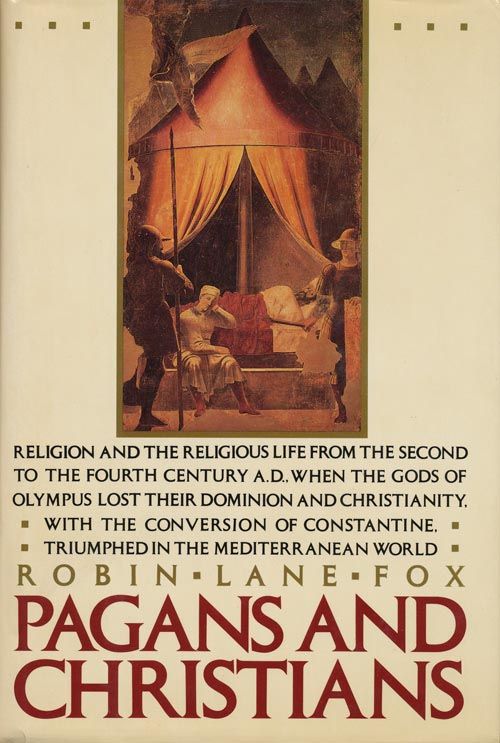
Robin Lane Fox's Pagans and Christians is a model of what a book of historical scholarship should be. Covering the greatest period of spiritual conversion that ever took place in the Western world, it is illuminating from cover to cover.

Lane Fox obviously put a prodigious amount of study into it, but his erudition is reader-friendly. He sets a middle course between the "literary" style of, say, Gilbert Murray and the objective, dessicated tone adopted by many of today's academics. There's no "fine writing" here, but our author has a gift for choosing the right words to say what he means concisely.


His observations are anchored by known facts, but so much of the documentation has been dissolved in time's workshop that there is no escaping the need for conjecture at many points.

Lane Fox frequently laments missing pieces of evidence, but is unafraid to advance his own views, citing an astonishing number of sources old and recent. The 104 pages of end notes include authors he praises and others he disagrees with. I never felt that he was pushing some grand theory, but rather trying to distinguish among what we can be reasonably sure of, what is probable, and what is legend or fiction.

The subject is the long period when Christianity became a serious alternative to the traditional gods that had served the leading Mediterranean civilizations since before the so-called Golden Age of Greece. Sometimes there was peaceful coexistence, although the new Christian sect lived with it under protest, never acknowledging the pagan pantheon. Now and then, however, the Roman government felt threatened and tried to punish a growing opposition from what they felt were nutcases with a weird Middle Eastern belief system.

Most people in the Roman Empire were casual about spiritual questions -- not one of their attractive traits -- although they revered the many gods who took up so much shelf space in their civilization, for the sake of tradition and politics. Christians were fiercely devoted to their one God and the savior, Jesus, he assigned to the human race. It seems inevitable that a culture with fanatical beliefs would gradually gain ascendance against those who were indifferent to higher truths and lived for money and power.

 
The story stretches through three centuries, and although Pagans and Christians is a large book it obviously could not be comprehensive in describing the entire period. Lane Fox chooses to concentrate on a manageable number of episodes that he believes give the flavor of their times. For instance, the pagan mindset is suggested in the most thorough account I've ever read of the oracles that were taken quite seriously from Greece to the eastern Mediterranean provinces. 

A long section describes the Great Persecution of Christians in Diocletian's reign, but not in terms of statistics or particular events; Lane Fox recounts the letters and behavior of Christians who were imprisoned, sometimes for months, before being martyred. (Not all the Roman authorities were vicious toward their captives -- many tried to convince the Christians to save their lives by what they considered a meaningless symbolic act of honoring the pagan gods.)


For another example, the author delves deeply into the meaning of a speech given by the Emperor Constantine after he had legalized and championed Christianity, showing all the influences that seem to have gone into his oration.

Despite its quality, I can't honestly recommend Pagans and Christians except to readers with a particular interest in its subject. For most it will be too much of a good thing. While I appreciated and enjoyed the book, there were some pages that told me more than I really wanted to know about certain aspects of those times.


Robin Lane Fox must be a genius at absorbing and notating information. It's hard to imagine how he could have read all the source material (including some that has not been translated from Latin or Greek) and had time to write the book, let alone others, including several about gardening, which he apparently pursues with a deep interest rather than as a hobby. He is a biographer of Alexander the Great, which led to his being involved with Oliver Stone's movie, and even playing a role as a cavalry leader.

He appears in this brief interview, speaking with a traditional "Oxbridge" accent which will probably soon be eliminated in cultural Marxist Britain as a purportedly distasteful survival of class distinctions. 

If I should happen to be given a long life, I would probably someday read Pagans and Christians again, all 681 pages not including the notes. I can hardly offer a greater compliment.


Saturday, January 11, 2014

Wind of the western sea


Recently, in a posting on past-life regression, I somewhat rashly concluded: "I will save for another occasion ... a description of what might be a fragmentary past-life memory firmly lodged in my mind." I am here keeping my word, and I think it's an interesting story.

As far back as childhood, I periodically recalled this phrase:

Low, low, breathe and blow,

 Wind of the western sea!

It didn't have the quality of just another old but ordinary memory, like something a grade-school teacher had once said. The words had a haunting quality. Although clear, they seemed to come from very far away in time, wrapped in an aura of strange significance.

Adding yet another coat of oddity, the words ringing in my mind were set to music. I could have, still can, hum the tune (no doubt off-pitch).


After I began studying psychical research, it occurred to me at some point that the phrase might be a legacy of a previous incarnation. Something about it suggested 19th century England, which has always exerted a special fascination for me.

A mystery that would never be solved in this life -- that was the state of play until not long ago. And then magical information technology arose. Not expecting any meaningful result, I Googled the phrase. And was properly astonished at what I learned.

The words are from a poem titled "The Princess: Sweet and Low" by Alfred, Lord Tennyson. You can read it here.


I am keen on Tennyson. It says a lot about the good taste of the Victorians, who are much abused in our day, that they recognized and honored his brilliance. But I have read only a fraction of his prolific output, and didn't remember "The Princess: Sweet and Low" at all.

Of course, when I learned the source of my wispy memory, I considered possible non-paranormal explanations. I might have read it in school or college, although I never took a class specific to Tennyson or his era. I doubt that my largely wasted education introduced me to any but his really famous poems, like "In Memorium" and "Ulysses."

I grew up in a house with lots of books, but I remembered no Tennyson anthology. Besides, from an early age I was hooked on science fiction (favorite authors: Robert A. Heinlein and Fredric Brown), which left little time for soaking up poetry -- which, like most kids, I didn't care for.


I asked my mother recently if we had had some volume when I was growing up that might have included the poem. She thought not, although there was a collection of English literature. But it seems unlikely it would have contained a relatively obscure piece like "The Princess: Sweet and Low," or that I would have run across it, or been taken by its mother-and-child theme.

So, locked on target: a probable past-life memory! I have had almost no paranormal experiences in my life, but this one seemed to be a cracker.

Until, that is, the next time I phoned my mother. She had looked up the poem, and remembered often singing it to me as a lullaby to soothe me into sleep. This began when I was perhaps six months old, she said.


My long-cherished theory suddenly fell apart. It was a case of cryptomnesia, wherein something once known is forgotten by the conscious mind, but much later emerges, usually under hypnosis. Skeptics maintain that all so-called past life regressions are based on the phenomenon -- a few facts or a story plot long hidden in the depths of the psyche, woven into a dramatic "earlier incarnation" when encouraged by the hypnotist.

But as I said, the fragment from Tennyson popped up many times throughout the years, and not while I was hypnotized. I now accept the cryptomnesia explanation, but it remains puzzling. Why did these particular words linger and recur when I have no conscious memories of other, and probably more significant, events of that period in my remote past? If my mother is right about the timing, I would not even have understood the words.


Many researchers say that children remember bits of past incarnations up to about the age of seven, the memories then fading out as they are replaced by new experiences in the present life. Did Tennyson's lines make such an impression because they reminded my then-little self of something remembered at the time from another life? 

Maybe that's another fantasy, ginned up to compensate for the loss of my previous paranormal explanation. Or a scrap of another time and place, carried in my soul through time, on the wind of an unknown western sea.


Sunday, January 05, 2014

U.K. innkeepers: Avoid fawlty behavior toward American guests!


Whenever I'm stuck for a subject, which seems to be often these days, I am comforted by the assurance that I can always turn to our trans-Atlantic crazy-uncle-in-the-attic for blue ribbon dementia to satirize. I know, I said I was going to knock that off as being too easy, but sometimes you have to take the path of least resistance.

In our latest sample of British folly, we learn that the tax-supported agency VisitBritain has distributed a list of ways to avoid offending visitors of various nationalities.
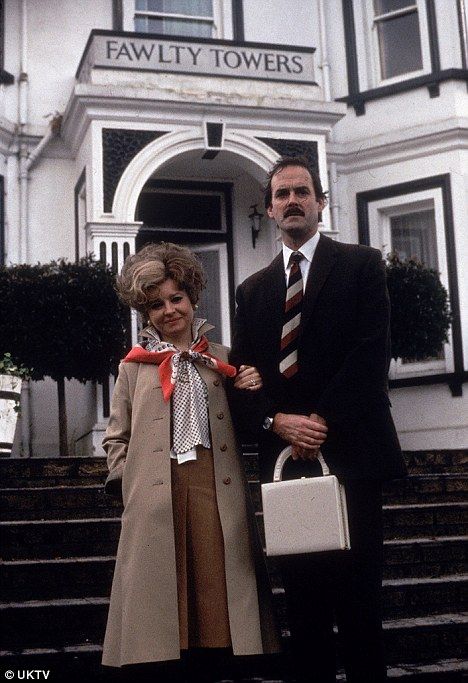
Mocking the accents of visitors from India and shouting at Japanese tourists is the kind of service you might only expect from the terminally tactless Basil Fawlty. But now tourism chiefs think Britain’s real-life hoteliers need to be taught how to avoid making such gaffes with foreign guests. ...

Some - such as the warning not to poke fun at Indian accents – border on the blindingly obvious. Others are downright bizarre, with tour operators instructed to avoid putting people from Hong Kong in historic houses or four-poster beds because they are superstitious and may fear ‘a ghostly encounter’.
Oh, and "anticipate the needs of a Japanese visitor -- even if they haven't told you what they are." Haven't told you their needs, or haven't told you they are Japanese visitors?

I read recently that when Fawlty Towers is rerun on U.K. television now, they bleep out all Basil Fawlty's offensive expressions, such as "wog." But wasn't Basil insulting his clientele the humorous point?

Oddly enough, the article mentions no points of etiquette in dealing with Americans. Surely we Yanks are funny-peculiar enough, as Brits see us, for VisitBritain to offer a few tips to hoteliers about staying in our good graces.

As a favor to VisitBritain, I will contribute a few suggestions in aid of mutual understanding.


ADDENDUM TO MEMO FOR PERSONS ENGAGED IN THE TOURISM TRADE
Please insert this additional material between pages 7 and 8. It has been conveniently numbered 7a through 7b.

Americans

Unless your facility is located in London or Bath, you will rarely encounter this species. Nevertheless, every so often one will fetch up, probably lost.

We understand your antipathy to these racist, sexist, homophobic, Islamophobic gun-twirling primitives. Bear in mind, however, that despite the best efforts of Imam Obama to redistribute income fairly, there remains a disreputable legion of Americans with more than enough money. You might as well take your share and then some.

Please observe the following rules: 

1. Do not laugh when an American tries to pronounce "Vauxhall" when speaking of his/her rental car.

2. Do not joke, "So you're from that place where they drive on the wrong side?" Similarly, if you are giving road directions, resist the temptation to include a witticism about "You'll have to take a roundabout route ... roundabout, get it?"

3. Do say, "Feel as comfortable as you like, we understand heterosexuals here, don't we, Mavis?" (if your wife or assistant is named Mavis).

4. If asked for recommendations for a local pub, remember that Americans want Traditional, with pipe-smoking, pullover-clad boozers consulting The Football News. Do not send them to a smart modern place with a name like "The Jerkin' Ferkin." In the likely event that you have no traditional pub within 75 kilometres, just explain that "The Duke of Wellington" is closed for six months while they polish the horse brasses. "If you're heading for London, try 'The Grenadier,' I reckon."

5. For a first offence, consider not calling the police if someone is gauche enough to ask why so many churches have been converted to mosques. Remember your guests are foreigners, with all that can imply of multiculturalism paranoia.

Keep calm and carry on making money!

Friday, December 27, 2013

U.K. scandal: Sexist locomotives, male train engineers


Thomas the Tank Engine. Hideously male,
 hideously white.

Once a country goes Hard Left, there are no limits to the possibilities for lunacy. Britain is not yet executing political prisoners for thought crimes, but the Labour opposition transport secretary is aghast that there are not enough women engines and drivers in the children's books and TV series featuring Thomas the Tank Engine.
Thomas the Tank Engine is setting a poor example to children and needs more female engines to encourage girls to become train drivers, Labour's shadow transport secretary has said. Mary Creagh described the lack of female train drivers in Britain as a "national scandal" and said that children's television shows and "negative stereotypes" are partly to blame.
Not, you understand, that the U.K. has laws prohibiting women from working as railroad engineers. Nor specifying that all engines must be masculine in appearance. (How would a female engine be indicated? Eye shadow? Earrings dangling on the boiler? High [w]heels?)
Aslef, the train drivers union, is campaigning for more women and ethnic minority train drivers. Just 1,000 women, equivalent to about 4.2 per cent, of train drivers are women. Mike Whelan, the union's general secretary, said: "These figures show that there is plainly something wrong in this era of professed quality [sic]".
For authoritarians like Mary Creagh, it's the government's job to enforce equality, regardless of individuals' choice of work. Sounds familiar, what? Not enough welders in Petropavlovsk? Round up some bookkeepers in Moscow and put 'em on the next train -- with a woman in charge, of course.

I suggest Creagh turn her attention to department store perfume and cosmetic counters. She would doubtless discover -- well, except in London maybe -- an acute shortage of men salespersons. What kind of message does that send to young boypersons dreaming of swimming the English Chanel at Selfridges?

Tuesday, December 24, 2013

The evidence of things not seen


"Faith is the substance of things hoped for;
the evidence of things not seen."
-- St. Paul

Peace on Earth. Goodwill. Brotherhood. How remote they are to our mortal eyes.

But even in this shattered life, we glimpse something greater.

Faith may be the substance of that "something greater" hoped for, although it seems to me not the substance but the lifeline that keeps us connected, however tenuously, to Spirit. Evidence? Not the kind of evidence presented in a courtroom or academia; but evidence that something lifts us out of our thin perceptions and our fixations in time.

We can draw on another kind of evidence. Beauty, of sight, sound, or intellect -- along with love -- is also a signal path from realms that have no beginning or end, no limitations other than those we cling to.

My wish for you this holiday season is beauty. Beauty never lies. Even in this world of appearances, it is evidence that the higher ideals we seek are real.