Thursday, November 29, 2007

Jacques Barzun is 100

Jacques Barzun was born a century ago today: November 30, 1907.

If you haven't read him, I recommend that you do. He's written more than a dozen books, but his magnum opus is
From Dawn to Decadence: 500 Years of Western Cultural Life, 1500 to the Present. It was published when he was 92.

Barzun, primarily a social historian, is the archetype of a humanist sch
olar: interested in ideas but dubious about theories and ideologies that purport to explain everything; a cosmopolitan who dislikes cant and political correctness; possessor of an enormous store of facts who wants to find meaning in them. Reading From Dawn to Decadence, you get the impression that you could bring up any year within that half-millennium and he could, if you wanted, talk for an hour about what was going down at the time — in literature, arts, politics, religion — everywhere in Europe (and the United States, if it existed at that point).

He's very readable, too, which you can't say about that many people in the academic world today (Barzun spent most of his teaching career at Columbia University). No jargon, but also no pretentious writing that shouts, "Hey, sailor, how you like my metaphor in your face, big boy?" His style is fitting: he uses the right words to say what he wants to say, with just the right shadings. That may sound easy, but as someone who writes for a living, I promise you it isn't.
Photo Sharing and Video Hosting at Photobucket
A hundred years is a long time to live. It's strange to think about. He's written a book covering a 500 year period, and he's lived through almost one-fifth of that time! He can remember how things looked, how people dressed and talked, in the 1920s and '30s, which you and I (unless you're very old) can know only second-hand. I'm not sure, but I expect he's met some of the "historical" figures of the 20th century.

I met Jacques Barzun — well, sort of. It was about 1986, in Santa Fe, and he was giving a public talk at St. John's College, the "Great Books" school for trust-fund kids. (I wasn't a student there; I worked as a radio announcer at the time.)

Most of what he said has drained from my conscious memory, although I recall being impressed, but two incidents have stuck with me.

I'm one of those who like to sit near the front of the hall at concerts and lectures, and I happened to take a seat in the first row at his talk. I must have been a sorry sight: though a minor local celebrity because of being on the radio, I was very poor and probably looked it; I definitely remember that I was wearing sandals. At one point Barzun paused during his talk, glanced around for a moment, and happened to make eye contact with me. I was ready to be uncomfortable at looking a proper slob while in his immaculately suited presence, but he gave me a warm smile. I really appreciated the gesture.
Photo Sharing and Video Hosting at Photobucket
Here's the other thing I remember. During the question period, a young man in the audience who had a serious speech impediment — I tried but couldn't understand much of what he was saying — went on and on with what was presumably a very complicated question. There was also something aggressive, even a little hostile in his tone. Look, I have every sympathy with anyone who's been ill-used by genetics, and think I can understand the anger they feel, but for heaven's sake, Barzun wasn't the cause of the young man's predicament. Anyway, I felt bad on Barzun's behalf: how was he to deal with a couple of minutes' worth of near-unintelligible grunting and gurgling? (I suspect that the questioner was hoping that Barzun would be at a loss, so he could show the world how badly he was treated because of his speech defect.)

To my surprise, Barzun proved himself to be a better, or more patient, listener than I had been. He repeated the questions (there actually had been three or four) clearly, as if for the benefit of anyone in the audience who might have been too far away to have heard them, so as not to embarrass the questioner. And sailed right into an equally clear discussion in reply.

He is a gentleman.

Happy birthday, Professor Barzun. You've lived through what was, on the whole, a pretty rotten hundred years for the world, but you've used your time to make it better and more interesting. We owe you.

Photo Sharing and Video Hosting at Photobucket

Tuesday, November 27, 2007

Is Paris burning? Oui, encore

Photo Sharing and Video Hosting at Photobucket

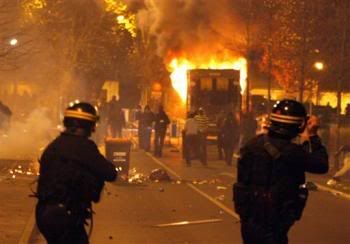
"Rampaging youths threw Molotov cocktails and set fire to cars in a troubled neighborhood outside Paris on Monday, the second night of street violence after two local teens were killed in a crash with a police patrol car," says the AP.

It seems appropriate at the moment that the phrase déjà vu is French. The difference this time is that the euphemistically described jeunes are using live ammunition. On police and even journalists.
"Police officers were targeted with hunting weapons; a certain number of them were wounded by lead shot," said Interior Minister Michele Alliot-Marie. "This is totally unacceptable," she said, adding there were six serious injuries, "people who notably were struck in the face and close to the eyes."
Otherwise, the story might as well have been hauled up from the deep freeze where it was stored after the riots of a couple of years ago. "Youths, many of them Arab and black children of immigrants [how many were of some other description?], again appeared to be lashing out at police and other targets seen to represent a French establishment they feel has left them behind." "Two teens killed." "The depressed projects that ring Paris." "Tensions between France's largely white police force and the ethnic minorities trapped in poor neighborhoods with high unemployment."

Although the AP story predictably milks sympathy for the rioters, and does everything possible to leave religion and ethnicity out of it, let's be honest: these young Muslims are not terrorists, and they are trapped in high-rise slums. The indigenous French people have no use for them. The French, being French, have no use for almost anyone of any other nationality. But if forced to make a choice, they might prefer even Americans in their urban no-go zones than North Africans. You can call it prejudice, or you can call it people who feel they have a right to choose who their neighbors will be and what kind of country they will live in. Either way the situation is the same, and won't change because one-worlders lecture the French about how they need to pour a deal more resources into outreach to the banlieus.

Probably, the government will announce new programs, initiatives, and so on to encourage assimilation. But that's just kicking the can down the road, postponing the day of judgment.

The first time a flic is killed by a weapon wielded by one of the jeunes, the civil war will begin — quietly, under the surface at first, but in earnest. The police and military will believe they know what they need to do, and eventually will do it. Guaranteed.

There is only one way to stop that happening, and I wish that President Sarkozy and his acolytes would have the foresight and political courage to sign onto it. Here is what Sarkozy should say (only he should say it in French):

"My friends, Frenchmen of all races and religions, it is evident that past mistakes are now playing out in a much magnified form. Our predecessors in government heedlessly created policies that seemed right and just at the time, but are now seen to have been disastrous for the social fabric of our society.

"Where French citizenship is concerned, we know now that indigenous French and immigrants from Africa simply do not mix, any more than oil and water. I do not blame either side for this; it's human nature, which I'm afraid our ancestors understood better than today's intellectuals. But, without declaring any group of people wrong, we cannot keep on a suicidal course just to avoid admitting that a mistake has landed us in a situation where areas in hundreds of French cities and towns are reminiscent of no-man's-lands in '14–'18.

"I therefore call on our lawmakers to enact legislation to ensure the peaceful, orderly, and compensated emigration of our African population to homelands that are more agreeable to them, where no French people will look down on them, where they can live under shari'a law if that is their wish. There are of course many difficult details to work out, but the principle is clear: we will become once again the France of traditional ethnicity, while giving a helping hand to others who are currently so alienated, as they are repatriated to lands that are culturally amenable to them.

"Once this process — and I repeat, it is to be a peaceful process with due compensation for any property or business lost in the transition — is completed, we are going to tear down these goddamned suburban hellholes and turn them into green zones and low-density developments.

"Thank you."

Not nice? No, it isn't. But the civil war, when it comes, will be a lot not nicer. The French should spare themselves the worst.

UPDATE 11/28: Since the news media are so coy about reporting the ethnicity of the rioters, false assumptions are possible. Steve Sailer has found a UPI story that suggests the insurgents are mainly black, sub-Saharan Africans rather than North African Muslims. If so, it doesn't affect my point that France should divest itself from its incompatible population elements.

Photo Sharing and Video Hosting at Photobucket

Monday, November 26, 2007

The world is deep

Photo Sharing and Video Hosting at Photobucket

Gustav Mahler's Symphony no. 3 is very likely the most philosophical piece of orchestral music ever composed — certainly nothing like it on such a scale (an hour and a half in length, calling for a gargantuan ensemble including a vocal soloist, chorus, and unusual instruments) has been attempted before or since.

That in itself is would have been no guarantee of immortality, and the symphony might have been a crackpot folly if it were not, like almost all Mahler's music, the product of genius. Even without knowing a scrap of what the composer had in mind, listening to a performance of the Mahler Third is an overwhelming experience. The themes, instrumental colors, rhythms, moods combine to captivate a listener's senses. But there is no doubt that Mahler was probing the meaning of life and the universe, influenced by Schopenhauer and Nietzsche, whose "Midnight Song" from
Also Sprach Zarathustra he used in the symphony's fourth movement.

Explaining and illustrating the philosophical content of the Mahler Third in a video sounds quixotic, boring, or impossible. But the documentary What the Universe Tells Me is none of those things; it accomplishes its purpose brilliantly, a work of controlled imagination that enthralls as it elucidates.

Mahler originally titled the six movements "Pan Awakes: Summer Comes Marching In," "What the Flowers in the Meadow Tell Me," "What the Animals in the Forest Tell Me," "What Humanity Tells Me," "What the Angels Tell Me," and "What Love Tells Me." Before the premiere performance he scrapped the titles, perhaps fearing that the audience would picture the themes too literally and miss the variety and subtlety of the music. The video narration takes its cues from the original titles, though, and tries to understand what Mahler implied.

The narration — by the actress Stockard Channing plus specialists, both musicological and philosophical — is closely bound into excerpts from a well played performance of the symphony by the Manhattan School of Music Orchestra, expertly conducted by Glen Cortese. The sound recording is clear and wide-ranging, the location a beautiful neo-Gothic church.

Photo Sharing and Video Hosting at Photobucket
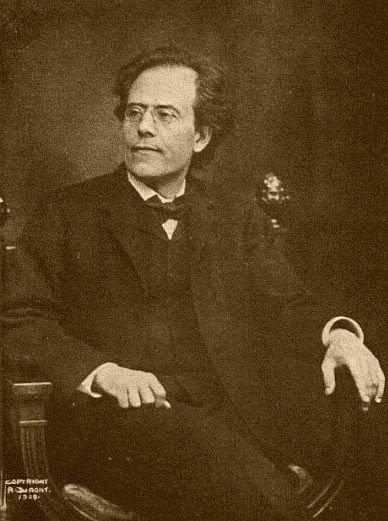
Gustav Mahler

At the cost of being overly schematic, the course of the symphony can be described as a journey from the creation via a blind but imperative "Will" (as Schopenhauer put it), through the stages of a kind of spiritual evolution that includes both sweet and angst-filled intervals, to a final, paradoxical knowledge of ultimate joy won by passing through despair. A mezzo-soprano (here, Mignon Dunn, previously unknown to me but very much up to her part) singing the Nietzsche lyrics and a solo played on a posthorn (literally, a somewhat primitive instrument played by postmen in Mahler's youth) provide some of the work's misterioso effects. The long, slow final movement could well have been called "What Love Tells Me": it streams from another world of ineffable glory.

The performance selections aren't just little snippets, but long enough to convey the flavor of the part of the symphony under consideration. Visuals, mainly from nature, and commentary are very skillfully integrated with the music. The scholars who offer their thoughts (and who expand on them at greater length in the special features bundled with the documentary) provide interpretive insights without any of the agit-prop that would have been in the mix had this been produced by the BBC or PBS. Commenters include Henry-Louis de la Grange, author of the immense biography of Mahler, the star baritone Thomas Hampson, thoughtful musical scholars Morten Solvik and Peter Franklin, and an eloquent (and pretty) theologian, Catherine Keller.

Photo Sharing and Video Hosting at Photobucket

Even if you think you know Mahler's Third Symphony well, I can almost promise you that What the Universe Tells Me will deepen your appreciation. It's available for rental as a single disc from Netflix, although I didn't realize until I read the reviews on Amazon.com that it's actually from a two-disc set that includes the complete performance on the second disc.

One of the incidental pleasures for me was seeing the young instrumentalists — mostly under 30, by their looks — playing their hearts out for Mahler. They will carry his vision to generations yet unborn, provided Western civilization survives its current troubles.

Midnight Song
(Friedrich Nietzche)

Oh, man, give heed!
What does deep midnight say?
I slept!
From a deep dream I have waked.
The world is deep,
And deeper than the day had thought!
Deep is its pain!
Joy deeper still than its heartbreak!
Pain speaks: Vanish!
But all joy seeks eternity,
Seeks deep, deep eternity.

Photo Sharing and Video Hosting at Photobucket

Thursday, November 22, 2007

Intermission

I'm out of town for a family visit. Probably no more postings until next week.

To all my dear friends and readers,

Happy Thanksgiving!

Wednesday, November 21, 2007

Scotland Yard's mascot sacked for being too white

Photo Sharing and Video Hosting at Photobucket

Look, I admit it. I've exceeded my weekly quota of entries about politically correct dementia in Britannistan. You are entitled to more variety. But I just can't let this pass without note.

From the Times:

Mascot is too white, male and blond …
so Met introduces the PC PCs
Scotland Yard is spending £15,000 on ethnically diverse police mascots after complaints that PCSO Steve, its current rubber representative, is too white, too male, and too blond. …

The initiative follows the creation of a working group within the force’s Diversity and Citizen Focus Directorate to tackle “race and gender” issues within the Met’s mascot division.
I love these ideological Holy Office titles the U.K. is lumbered with nowadays — "the force's Diversity and Citizen Focus Directorate."

When I read the headline I thought at first that the mascot must be a dog, like fire departments' proverbial Dalmatians. I was going to title this posting "Cry 'fetch' and let slip the dogs of diversity." Oh well.
Complaints about him first appeared in The Job, the Met’s monthly magazine, in September when a Sergeant Wright wrote about using the mascot at a community event.

“An Asian member of our team agreed to be Steve,” the sergeant said. “He was wearing a short-sleeved shirt and because the character would not have dark-skinned arms it became apparent that the officer would not be able to perform the role. Female team members also felt isolated.” The Met responded by saying that it was addressing the race and gender issues around mascots, prompting Richard Barnes, a Conservative member of the London Assembly, to table a series of questions to Sir Ian.

After receiving the answers, Mr Barnes told The Times yesterday: “Are they serious? There are so many issues that are of greater importance than the gender of a giant foam doll.”
Special relationship, blood is thicker than water and all. But Britannistan needs to be sedated and kept for its own protection in the attic and fed through a slot in the door.

Photo Sharing and Video Hosting at Photobucket

Tuesday, November 20, 2007

A slight victory in the Battle of Trafalgar (Square)

Photo Sharing and Video Hosting at Photobucket
Rule, Britannia!

Photo Sharing and Video Hosting at Photobucket
Rude Britannia.

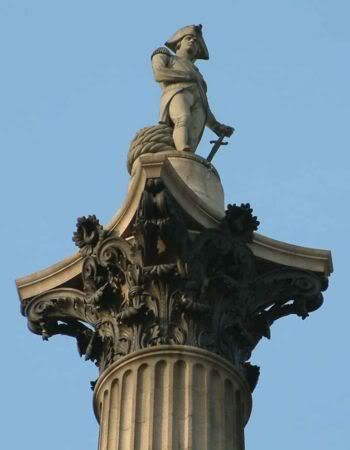
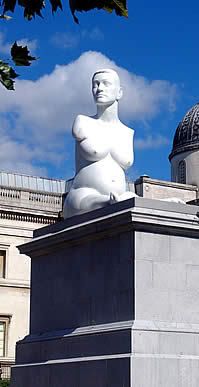
Lord Nelson's column stands in the center of London's Trafalgar Square, the city's symbolic heart. At the corners of the square, statues of celebrated political and military figures on three plinths, or bases, have been supplemented for the past two years with a different kind of monument: to the classless elite's new standards based on cultural Marxism and ugliness inflicted on the helpless population in the name of authenticity.

Along with the relics of a formerly self-confident society with a sense of gravitas, the statue Alison Lapper Pregnant has occupied a strategic place on the fourth plinth in the square. It portrays a naked, real person's misshapen body.

You understand the symbolism. Uncompromising. Nothing to hide. A cool Britannia taking the piss out of those laughable old celebrations of nationhood. Above all, Homage to the Victim. Yes, Alison is a victim of Nature, not Man, but that will do.

"I regard it as a modern tribute to femininity, disability and motherhood. It is so rare to see disability in everyday life – let alone naked, pregnant and proud," said Alison Lapper. The Telegraph magazine said, "If you like art to be brave, original and challenging you'll love the Fourth Plinth in Trafalgar Square." And chortled, "Since its award-winning refurbishment, Trafalgar Square has regained its place as London’s central piazza where people can meet and relax." As though the space had previously been as empty as the Arabian desert, and Alison added a touch of casual chic that left people feeling relaxed, good all over.

"Its re-opening has seen visitors increase by more than 200 per cent. These stunning pieces of modern art exhibited on the fourth plinth will further enhance the Square’s appeal. And provide a bit of company for Nelson." A bit of company, ha ha, yuk yuk.

Well, Alison's had her brush with fame, and much good may it do her. Time's up. The statue's been removed — not because the light of graciousness has broken through, but because it had been scheduled for a two-year run and is now replaced with another modern sculpture.

Brendan O'Neill, writing in Spiked, has a few appropriate thoughts on this chapter in the barking-Chihuahua cultural politburo's determination to undo the United Kingdom's cultural heritage:
The statue captured much of what is rotten in the heart of new Britain. When it was first unveiled, some art critics gushed about how it would challenge people’s perceptions. ‘Against a sky the colour of old underwear, and a circle of buildings that might as well be built of concrete for all the life and warmth their stony facades exude, Quinn’s womanly but warrior-like Lapper [glows] like a beacon’, said one overexcited observer.
In truth, Alison Lapper Pregnant was about as challenging as old underwear. It was a drab monument to the backward pieties of our age. It showed that we value people for what they are rather than what they achieve. In our era of the politics of identity we seem more interested in celebrating individuals’ fixed and quite accidental attributes - their ethnicity, cultural heritage or in Lapper’s case, her disability - rather than what they have discovered or done in the world outside of their bodies. We prefer victims to heroes.
He went on to deliver the coup de grâce:
Alison Lapper Pregnant celebrated what nature, in all its arbitrariness, does to humans rather than what we do to shape, lead and transform the world around us. In this sense, it captured the deeply conservative nature of the identity agenda. The politics of identity privileges fate over self-made destiny. In all the talk of black, Muslim, gay or disabled ‘identity’ - categories created and sustained by the authorities to describe sections of the population who apparently have special needs and desires - we can glimpse the reintroduction of fate into public life, where individuals’ fortunes are seen as being determined by their skin colour or physical afflictions or cultural background rather than by the choices they make and actions they take.
Lord Nelson, on his lofty pinnacle in the square, was not portrayed as a giant eye patch, and his empty sleeve is no more than a detail. For our ancestors, it was enough that the man was responsible for destroying Napoleon's fleet in the Egyptian harbor at Aboukir and quite possibly prevented the Little Corporal from invading England by handing him another thrashing at Trafalgar. Nelson was killed in the battle. He was only a hero, not a victim.

Photo Sharing and Video Hosting at Photobucket