
"People tell me I look taller on radio."
That's the first remark by Tom Tancredo in a radio show interview by host Jim Bohannon, which was also taped and broadcast yesterday on Book TV (the weekend avatar of CSPAN 2).
By which I take it he is shorter than average. I wouldn't know, because, while I have of course read quite a few print media and internet reports about Tancredo, I'd never seen him on the tube.
I'm not given to idolizing politicians. You can take it to the bank that they all have clay feet. Moreover, even the president of the United States is not an absolute dictator (a source of much regret to Jorge W. Bush-Gonzales). Even if your ideal politico wins, that doesn't mean the campaign promises win. A good deal of the perpetual silliness surrounding elections in this country has to do with the naive idea that if you just elect "the right man" (or woman) a new, Arcadian era of peace, prosperity, and cheap gas prices will ensue. So you get these ridiculous worshipful crusades for the likes of Eugene McCarthy, Ralph Nader, Ross Perot, and Howard Dean.
Nevertheless, Tom Tancredo seems to me spot-on in his unwavering stand for enforcing existing immigration laws, one of the two issues that will determine whether the United States will survive in anything like its historic form. On the other -- the response to Muslim aggression -- I am not aware of much that he's said, but what little he has suggests that he is realistic.
Not only is he right on illegal immigration, he isn't wishy-washy about it. And, given that his view has made him a public enemy in so-called progressive quarters, and widely denounced in the most vile terms, you can't help but acknowledge that he has guts in sticking to his principles.
Does he have what it takes to be a presidential candidate in '08, and if so, to win the general election? Not being by nature a political person, I don't claim to be any good at the kind of handicapping on which newspaper pundits rest their dubious reputations. That said, if Bizarro Bush-Gonzales continues for the next two years ignoring the overwhelming will of the people on immigration and promoting the combination of the U.S., Mexico, and Canada in a North American Union (as he is reported to be working toward), the Republican party wheelhorses just might go for Tancredo to save their skins.
I watched for clues about what kind of presidential candidate Tancredo would make. So many factors, aside from political positions, matter.
He remained seated in the guest's chair in the radio control room, so I still don't know his vertical dimension. He is neither handsome nor ugly, an asset in politics, since so many people can identify with it. The voice is pleasing; he stayed calm during the show and didn't rise to the bait under hostile questioning from several listeners. Good again.
Still, Bohannon was an acknowledged sympathizer, so there was no way to tell whether Tancredo would puddle if faced by an hour or more of loaded questions from the mainstream media. Needless to say, the MSM would respond to a Tancredo candidacy with a viciousness it used to reserve for Hitler or Mussolini. It would investigate him with a thoroughness that would do a forensic lab proud, and if he has ever gotten a speeding ticket, it would be on the front page of The New York Times.
I have a feeling Tancredo would come out of a media beating looking good. For one thing, he's heard all the attacks already a hundred times. (Not only in the American media; he remarked that he has visited Mexico often, and been used for target practice by the local press.) His answers have been polished by abrasion over the years. As his opening comment indicates, he is capable of a humorous quip, and unlike, say, -- who was that guy the Dems nominated in '04? Yes, him -- he can deliver it in a way that at least sounds spontaneous.
He hasn't asked for it yet, but so far, Tancredo has my vote.
Sunday, July 09, 2006


Thursday, July 06, 2006
Smoke gets in your lies
I'd always suspected that the issue of smoking in public places had escaped whatever gravitational pull rationality still exerts. But reading a newspaper piece recently about some town in California which has made smoking on the beach illegal has eliminated all doubt. (Sorry, no link because at the time I hadn't thought to blog about it and so didn't bookmark the article.)
I haven't smoked in 20 years. No, wait: a couple of years ago, during a visit to Miami's Little Havana district, perhaps the only place in the United States where you can do so without fear of incurring the Evil Eye, I smoked a cigar in one of those little store-front factories where they're rolled. Two other blokes were there doing the same, and it was as if we were members of a secret lodge indulging a Forbidden Pleasure. Hugely enjoyable.
As I say, that was a one-off experience. I have no desire to be a habitual smoker. But the holy fanaticism of the anti-smoking crusaders makes me sick. They have taken the issue so far beyond whatever legitimate health concerns there may be that they obviously operate from other, unstated motivations. Latching onto and sponsoring junk science at every turn, the smoke eradicator Warriors of God are themselves addicts: they're hooked on control.
True, the issues involved — not only in smoking itself but the Dictatorship of Virtue behind its prohibition — are complicated. Which is why I didn't intend to do a post; frankly, I just don't have the time or energy to go into it all. What changed my mind was running across an extraordinarily well argued essay on the subject by, of all people, the musician Joe Jackson. (Tip of the hat: Luxurious Misery.)
Regardless of how you personally feel about smoke, give Joe a few minutes of your time. He dishes the whole subject in all its ramifications, including those of health tyranny, elitist scorn for individual choice, and lying statistics.
I haven't smoked in 20 years. No, wait: a couple of years ago, during a visit to Miami's Little Havana district, perhaps the only place in the United States where you can do so without fear of incurring the Evil Eye, I smoked a cigar in one of those little store-front factories where they're rolled. Two other blokes were there doing the same, and it was as if we were members of a secret lodge indulging a Forbidden Pleasure. Hugely enjoyable.
As I say, that was a one-off experience. I have no desire to be a habitual smoker. But the holy fanaticism of the anti-smoking crusaders makes me sick. They have taken the issue so far beyond whatever legitimate health concerns there may be that they obviously operate from other, unstated motivations. Latching onto and sponsoring junk science at every turn, the smoke eradicator Warriors of God are themselves addicts: they're hooked on control.
True, the issues involved — not only in smoking itself but the Dictatorship of Virtue behind its prohibition — are complicated. Which is why I didn't intend to do a post; frankly, I just don't have the time or energy to go into it all. What changed my mind was running across an extraordinarily well argued essay on the subject by, of all people, the musician Joe Jackson. (Tip of the hat: Luxurious Misery.)
Regardless of how you personally feel about smoke, give Joe a few minutes of your time. He dishes the whole subject in all its ramifications, including those of health tyranny, elitist scorn for individual choice, and lying statistics.
Tuesday, July 04, 2006
New York's Morganatic marriage
The J.P. Morgan Library and Museum used to be one of those little-visited gems that can remain off the track in a huge city full of famous attractions like New York. Originally part of the Manhattan mansion of the Wall Street millionaire -- I suppose billionaire in today's terms -- J.P. Morgan, it was opened to a largely indifferent public by J.P.'s son, known as Jack.
With real estate taxes what they are today, though, no institution can afford to pass up maxing out on the arty visitor's coin. Like the Frick Art Museum in Manhattan, which was also once a civilized and quiet refuge that has lately courted the mass market with blockbuster exhibits, the Morgan has gone big time. Its principal drawing card at the moment for many is the new architectural addition by designer du jour Renzo Piano.
Piano's expansion space could hardly be more different than the original two rooms, Morgan's Library and study, as well as the hallway between them. The new Morgan is a marriage of incompatible extremes.
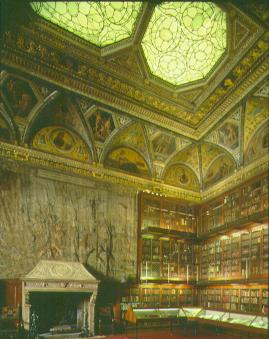
Both the library and study are comfortable rooms, not cold and intimidating: you can imagine sitting in either and actually reading or studying the old books and artistic treasures they hold. I don't know anything about J.P. Morgan, but no doubt his wealth was earned for him in part by exploitation. And surely the one-upmanship of collecting played a part in his acquisitions -- not even a dedicated scholar could possibly read all those books and manuscripts in a lifetime. For all that, when visiting his quarters, you get the impression that the man was a genuine connoisseur.
The new addition, opened just this past April, had the task of integrating the study, library, and hall; a 1920s annex; and Jack's townhouse. It added exhibition rooms and provided space for the facilities no modern arts complex can do without: a restaurant, performance hall, and of course a gift shop.
Piano's architectural contribution is ... is ... well, let's start with a picture of the outside entrance and the new central court:
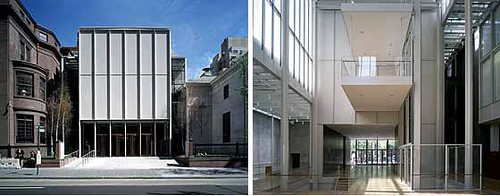
Now, it's true that photographs don't do justice to architecture, but these two photos save me some explaining.
Piano's extension of the Morgan obviously couldn't have been in the Renaissance Revival style as the original -- neither the money nor, probably, the workmanship would have been available to replicate it. That isn't the issue. What bugs me is that Piano and the directors who hired him seem to have made no effort at compatibility. The spirit of the new section rejects the old.
A couple of gushing newspaper articles I read make a big deal out of the way light is used as an architectural element in Piano's design. In other words, he uses a lot of glass. (I wonder how impressive the light will be next winter when it's gray outside.) But the original wing deliberately doesn't admit external light. It chooses not to bring the outdoors indoors. The library and study were created in the spirit of introversion. They are places to read, contemplate, and think. Piano's contribution rejects that sensibility -- it's made for high-class, adult mall rats, not scholars or philosophers.
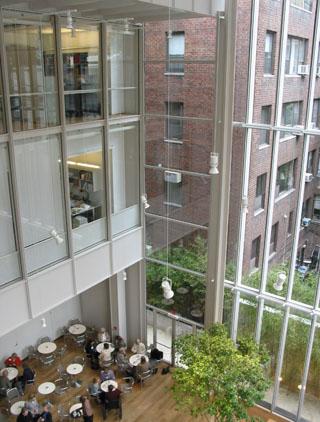
The entrance is now from Madison Avenue into the late-neo-Sauna court, which takes center stage. J.P. Morgan's glorious rooms are out of the view, their entrance tucked away in a far corner. Maybe some visitors never even discover them.
The best I can say for the Piano contribution is that it's tasteful, in a bland, unsurprising way. New Yorkers have an expression to indicate casual disdain: "Eh." I couldn't say it better.
On a purely functional level, the renovation is successful. It's opened up plenty of new fiendishly sterile, well-lighted space for the exhibits; the library no longer is forced to house display cases. And you can now walk inside the study, which was formerly roped off, a definite improvement.
None of my complaints should discourage you from visiting the Morgan if you are interested in its illuminated manuscripts and early books, including transitionary books that were typeset but still had hand-painted illustrations and initials. The collection is breathtaking. There is nothing like an illuminated manuscript to give you an exact idea of the decorative ideal of the Middle Ages (and in a few exhibits on display, even earlier). Paintings that old have inevitably faded with time or been restored, but the inks of almost a millennium ago appear to be perfectly preserved, as though the illuminations were painted last week. You cannot doubt that the artists and craftsmen of the monasteries and workshops, as well as their ecclesiastical and noble patrons, were in love with glowing color. The angels with multiply tinted, iridescent wings were part of their lives.
With real estate taxes what they are today, though, no institution can afford to pass up maxing out on the arty visitor's coin. Like the Frick Art Museum in Manhattan, which was also once a civilized and quiet refuge that has lately courted the mass market with blockbuster exhibits, the Morgan has gone big time. Its principal drawing card at the moment for many is the new architectural addition by designer du jour Renzo Piano.
Piano's expansion space could hardly be more different than the original two rooms, Morgan's Library and study, as well as the hallway between them. The new Morgan is a marriage of incompatible extremes.
Original J.P. Morgan Library
The original library with its nearly floor-to-ceiling rare books and early editions, as well as the hallway, are brilliant evocations of the Italian Renaissance, designed in the early 20th century by the famous firm of McKim, Mead and White. Like so much of the 16th century architecture they are modeled after, they balance splendor with historical and mythological detail that helps make them human and accessible. Morgan's study is a surprisingly intimate space, containing little but a desk, old paintings on the walls and objets d'art on a shelf that runs around the room. Such furnishing as there is, is dark and restrained. The effect of the whole room is old wordly and restrained, far from the neo-Baroque frou-frou decor favored by most of the 19th century rich.Both the library and study are comfortable rooms, not cold and intimidating: you can imagine sitting in either and actually reading or studying the old books and artistic treasures they hold. I don't know anything about J.P. Morgan, but no doubt his wealth was earned for him in part by exploitation. And surely the one-upmanship of collecting played a part in his acquisitions -- not even a dedicated scholar could possibly read all those books and manuscripts in a lifetime. For all that, when visiting his quarters, you get the impression that the man was a genuine connoisseur.
The new addition, opened just this past April, had the task of integrating the study, library, and hall; a 1920s annex; and Jack's townhouse. It added exhibition rooms and provided space for the facilities no modern arts complex can do without: a restaurant, performance hall, and of course a gift shop.
Piano's architectural contribution is ... is ... well, let's start with a picture of the outside entrance and the new central court:
Now, it's true that photographs don't do justice to architecture, but these two photos save me some explaining.
Piano's extension of the Morgan obviously couldn't have been in the Renaissance Revival style as the original -- neither the money nor, probably, the workmanship would have been available to replicate it. That isn't the issue. What bugs me is that Piano and the directors who hired him seem to have made no effort at compatibility. The spirit of the new section rejects the old.
A couple of gushing newspaper articles I read make a big deal out of the way light is used as an architectural element in Piano's design. In other words, he uses a lot of glass. (I wonder how impressive the light will be next winter when it's gray outside.) But the original wing deliberately doesn't admit external light. It chooses not to bring the outdoors indoors. The library and study were created in the spirit of introversion. They are places to read, contemplate, and think. Piano's contribution rejects that sensibility -- it's made for high-class, adult mall rats, not scholars or philosophers.
Piano's glass is empty.
It would have been possible to design a fully contemporary expansion that would complement the original rooms, using darker, richly colored materials, updating Renaissance design elements. Piano's architecture isn't even contemporary. The closest thing you can compare it to is Swedish modern, circa 1950, a refinement of the Bauhaus. Piano has given us severe straight lines, blond wood, and -- are you ready for this? -- glass enclosed elevators! I'll bet one of these days, Radisson and Westin hotels will be copying that idea!The entrance is now from Madison Avenue into the late-neo-Sauna court, which takes center stage. J.P. Morgan's glorious rooms are out of the view, their entrance tucked away in a far corner. Maybe some visitors never even discover them.
The best I can say for the Piano contribution is that it's tasteful, in a bland, unsurprising way. New Yorkers have an expression to indicate casual disdain: "Eh." I couldn't say it better.
On a purely functional level, the renovation is successful. It's opened up plenty of new fiendishly sterile, well-lighted space for the exhibits; the library no longer is forced to house display cases. And you can now walk inside the study, which was formerly roped off, a definite improvement.
None of my complaints should discourage you from visiting the Morgan if you are interested in its illuminated manuscripts and early books, including transitionary books that were typeset but still had hand-painted illustrations and initials. The collection is breathtaking. There is nothing like an illuminated manuscript to give you an exact idea of the decorative ideal of the Middle Ages (and in a few exhibits on display, even earlier). Paintings that old have inevitably faded with time or been restored, but the inks of almost a millennium ago appear to be perfectly preserved, as though the illuminations were painted last week. You cannot doubt that the artists and craftsmen of the monasteries and workshops, as well as their ecclesiastical and noble patrons, were in love with glowing color. The angels with multiply tinted, iridescent wings were part of their lives.
Thursday, June 29, 2006
Out of town tryout
Don't know what exactly, but I'll try something. Anyway, I'll be away until after Monday July 3, so probably no posting during that time.
Meanwhile, as always, I redirect you to the sites listed on the blogroll to the right.
Meanwhile, as always, I redirect you to the sites listed on the blogroll to the right.
Monday, June 26, 2006
Must Britain "suffer atrocities from time to time"?
The New York Times has carried a surprisingly balanced article on Britain's unbalanced (as in mentally) attempt at a balanced policy aimed at curbing Muslim terrorism.
The Times piece shows the contradictions that the British ruling class (which is now mainly the media and politicians, not the old aristocrats) have forced on themselves in trying to put the damper on Muslim terrorism: they want to believe that the country's Muslims are their allies, so while they have put through some tougher laws and seem less reluctant to allow police raids, they go the last mile to convince Muslim communities that the police and the government are their friends. Thus, they expect, the proverbial 99.99percentofordinaryhardworkingdecentMuslims will "grass" on the tiny number of violent extremists.
On paper it sounds fair and sensible — the only trouble is it's not congruent with reality. The strategy is a product of today's non-Muslim Brits, who've been raised on a bizarre mixture of social engineering and American-style capitalism, and have trouble getting their heads around anything but scientific, technical, and economic issues, sports, and celebrities. They take pride in being utterly reasonable, which puts them at a terrible disadvantage in dealing with their countrymen who take cultural cues from parts of the world where tribalism is the template, and where life is traditionally short and brutal. And, of course, they're a universe away from Britons who not only believe in their religion (which not many British do anymore) but for whom it trumps everything else.
The London Metropolitan Police have long had an official, national counterterrorist role and were prominent in the fight against the I.R.A. But there is not yet a consensus on what the police role ought to be in the fight against Islamist terrorism. Are they there to take the fight to the malefactors, assuming they can find them, through hard-edged tactics ranging from surveillance to raids? Or are they there to keep the peace and listen, particularly in minority neighborhoods, minimizing the discontent, insecurity and alienation on which terrorism feeds? "Communities defeat terrorism" has become the mantra of the police under Sir Ian Blair (no relation to the prime minister), who has been commissioner since early last year. …The writer, Christopher Caldwell, describes the traditional — and maybe still current — attitude that has created "Londonistan."
By the end of this year, he hopes to have set up hundreds of Safer Neighborhoods teams, … which mix traditional bobby work with a bit of cultural translation. Commissioner Blair aspires to kill two birds with one stone — enhancing police familiarity with the most intimate corners of dangerous neighborhoods while winning the trust of communities that often feel left out of the main current of British life. But, as in the London of Hogarth and Mayhew, the borderline between cultural variety and dangerous criminality can be a fuzzy one.
Britons have a strong rhetorical attachment to liberty, as something for which a certain price in danger and disorder is worth paying. When I asked [David] Blunkett [the former home secretary] if he accepted the idea that terrorists had enjoyed too many freedoms in London in the 1990's, he said, "Well, in the sense that Karl Marx moved to London, Britain has always had a tradition of taking in people oppressed in their own countries." This is a common view. Immigrant troublemakers are likened to Marx and Engels, and any difficulties welcoming whole groups are likened to those occasioned by the arrival of Russian Jews in the 19th century or of Huguenots in the 17th.But Marx and Engels didn't have financial, religious, cultural, and logistical connections or jet travel and instant communications linking them with a worldwide network of violent fanatics.
The Times piece shows the contradictions that the British ruling class (which is now mainly the media and politicians, not the old aristocrats) have forced on themselves in trying to put the damper on Muslim terrorism: they want to believe that the country's Muslims are their allies, so while they have put through some tougher laws and seem less reluctant to allow police raids, they go the last mile to convince Muslim communities that the police and the government are their friends. Thus, they expect, the proverbial 99.99percentofordinaryhardworkingdecentMuslims will "grass" on the tiny number of violent extremists.
On paper it sounds fair and sensible — the only trouble is it's not congruent with reality. The strategy is a product of today's non-Muslim Brits, who've been raised on a bizarre mixture of social engineering and American-style capitalism, and have trouble getting their heads around anything but scientific, technical, and economic issues, sports, and celebrities. They take pride in being utterly reasonable, which puts them at a terrible disadvantage in dealing with their countrymen who take cultural cues from parts of the world where tribalism is the template, and where life is traditionally short and brutal. And, of course, they're a universe away from Britons who not only believe in their religion (which not many British do anymore) but for whom it trumps everything else.
Today, British authorities are not much more confident of thwarting all plots, so they have erected a line of defense that is absorptive, not pre-emptive. It rests on harmony between social groups and on the country's ability to suffer atrocities from time to time, as it did during the heyday of the I.R.A., without escalating unrest or oppression, or the rise of extremist parties.But the IRA, which at its worst never tried to sink Britain in a worldwide Ireland, was basically an external threat even when it was expressing its thoughts by blowing up shopgirls and pub customers in England. Britain's most dangerous enemies are among its own citizens, the ones the government is trying to woo. Even now, it's officially taboo to acknowledge that the U.K. made a terrible mistake in promoting large-scale immigration from Muslim countries. Having made the mistake, it should now at least be single minded in drawing the line against any form of incitement to violence, and no quid pro quo is needed. Protecting the innocent doesn't need to be balanced with appeasement.
Saturday, June 24, 2006
Guilt tourism
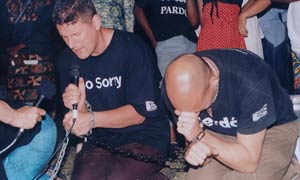
His ancestor had his way. Now he must pay.
25,000 Africans are glad that he's sorry now.
Who's sorry now?
Andrew Hawkins, for one. He and his friends enclosed themselves in chains -- bound for glory -- and asked forgiveness from 25,000 Africans in The Gambia, west Africa.
What had Hawkins done to the Africans that set off such conscience tremors? Well, nothing, but everything. He had allowed himself to be descended from Sir John Hawkins. Once an English hero for helping to defeat the Spanish Armada in the time of Queen Elizabeth I, Hawkins is now stripped of his rank and demoted to villain for launching the European slave trade, thereby bringing Europe up to speed with the Muslim middle east and Africa itself.
“There was a huge procession of people representing cultural groups from around Africa,” Mr Hawkins said on his return to England yesterday. “We came in last and the atmosphere changed as we walked up. We knelt down and everything went very quiet.
“We made our apology in French, English and German. I apologised on behalf of my family. I apologised for the adults and children taken. There was a long pause and we didn’t really know what to expect. They could have said: ‘We don’t accept your apology. Go away.’ ”
Fortunately for Hawkins the Younger and his co-inculpationists, the country's vice president "was in a forgiving mood," the news story says. (Or, one suspects, she had the good manners to wait until retiring into the company of her advisors before she and they, quite rightly, fell about laughing and slapping their knees.) Things didn't go so well later in their Calvary charge.
During their visit to The Gambia, Mr Hawkins and his party again wore chains and staged a “reconciliation walk” through the rural village of Juffureh. The local elders were not impressed by the gesture, Mr Hawkins admitted, although their attitude softened after talks with the vistors.
“I think they wanted to see an emotional connection from us, and to see that we had gone there in humility,” Mr Hawkins said. “All I could say was that we have got to do more listening and learning.”
A little more learning might be a dangerous thing for Hawkins. He might learn that most slaves had been captured by African tribes who then sold them to Western traders. (The Gambian vice president might herself be descended from tribal slave merchants.) He might also learn that Britain was the first country in the world to abolish the slave trade, or how Africans behaved toward one another before the white man's intervention, as revoltingly described, for example, in Edward Rice's Captain Sir Richard Francis Burton.
No, Hawkins would probably be best advised to stick to his story. It's a briliant piece of moral gamesmanship. First, he makes a big score by debasing himself, unrolling his guilt like a Persian merchant displaying a carpet. But, you understand, he's not really apologizing for himself; it's a symbolic apology. His heart has metastasized to the point where he's ready to apologize for an ancestor 20 generations back! He begs forgiveness for carrying wicked DNA.
In the Olympics of white race self-hatred, it'll be hard to top that. Although I'm sure someone will, and I can't wait to see who the crown passes to next.
Meanwhile, the wise businessperson will catch a wave by starting the first agency to organize guilt tours. There is hardly a country or ethnic group on this thick planet that hasn't been done the nasty to by somebody else. Entrepreneurs! Listen up!
Advertisement
Why Send Your Apology
When You Can Deliver It Yourself?
When You Can Deliver It Yourself?
We know how bad you feel and we're here to help, you Hellhound from a long line of exploiters of the Wretched of the Earth. We'll ease your guilt by doing everything in our power to get you the worst connections, the middle seat, and a no-star hotel.
Guilt Trips Travel™
Others can offer luxury — we promise expiatory punishment.
Among the most popular offerings are expected to be Indian reservation bus tours for Anglos wearing arrows stuck to their chests; for Germans to Jerusalem, where they will be given symbolic nonfatal doses of Zyklon B gas; and for Englishmen wearing kilts, to Scotland. Similar products are being developed.Guilt Trips Travel™
Others can offer luxury — we promise expiatory punishment.
The money should come rolling in, at least until the Department of Justice's Diversity Enforcement Branch steps in after someone notices that all the guilty customers are white.
* * *
Certain sections of this posting are in extremely poor taste. I didn't actually write it myself. It was dictated through a psychic medium and written by my ancestor, Punctilius Quintus Darbius (29-79 A.D.). That gentleman was killed at Pompeii just as he was putting the finishing touches on his Ode to Cilician Soybeans, widely expected at the time to prong Virgil. Anyway, I am very sorry. Very. Please, please, accept my apology.
Subscribe to:
Posts (Atom)