Wednesday, January 24, 2007

Is El Presidente backing down on amnesty?

"We need to uphold the great tradition of the melting pot that welcomes and assimilates new arrivals. We need to resolve the status of the illegal immigrants who are already in our country — without animosity and without amnesty." George W. Bush, State of the Union speech, January 23

Roy Beck, president of NumbersUSA, thinks he perceives signs in the speech that Bush is dialing down the saccharine rhetoric about all those your-land-is-my-land "migrants" and is notably less confident about what he can get in an immigration bill. Beck comments, in an action alert to the e-mail list, on the quote above:
To our President, the tradition of the melting pot apparently means we have to take away the stigma of illegality from those foreigners who have violated our laws to be here!

But here is the place in the speech where the President and his speechwriters obviously got cold feet. What is the term "resolve." Notice that he didn't dare use the terms "earned legalization" or "regularize" or "legalize." But "resolve?" He is not talking about "resolving" the illegal alien problem. No, he wants to "resolve" their "status."

Now, you and I might want to resolve whether the person is an illegal alien, and once doing that, begin deportation proceedings. But I don't think that is what the President wants to resolve. Again, the fundamental problem with Pres. Bush and his advisors is that they believe the problem with illegal aliens is their "status." If they just weren't illegal, they would be wonderful to have, according to them.

To NumbersUSA, the primary problem with illegal aliens is not that they are illegal but that they are here -- all 12 million of them crowding our infrastructures, congesting our quality of life, helping drive the destruction of natural habitat, farmland and open spaces, and driving down wages and benefits in the occupations where they settle. They aren't primarily bad people. But they are 12 million people who aren't supposed to be here. We don't need them. Their presence harms Americans.

But the President wants to "resolve" their status -- which I am sure means that he wants them to remain in our communities forever.
Beck analyzes the other references to immigration in the speech, and the style in which they were delivered. He askes, "Did he look like he really wanted to be talking about immigration on national TV tonight? He got in and out fast. It was almost like he couldn't wait to start talking about energy."

I like Roy Beck and I have contributed to his organization. He understands that "illegal immigration" is a phony issue — if the "illegal" part were all there was, we could solve it in an instant, by making the illegals legal. That, basically, is the argument the president and his masters in the corporate world want us to swallow. But NumbersUSA, as its name implies, puts the focus where it needs to be: on the numbers. Why does our country, whose population has increased by 100 million in 35 years, need another couple of hundred million — a widely quoted estimate of what will happen if the open borders lobbyists get their hearts' desire. Don't we have enough environmental problems already? There's not a one of them that isn't caused, or worsened, by overpopulation.

The only reasons for millions of "guest workers" are to keep labor costs as low as possible for big businesses (while they pass the social costs of a Third World proletariat onto the public treasury) and the belief on the part of both parties that they can buy the votes of a huge hispanic bloc.

It's not a done deal yet, though. And there's hope the American public, which was supposed to be a clutch of suckers and pushovers, is beginning to make even Sombrero George feel the heat.

Tuesday, January 23, 2007

The last days of free Britain

The recent U.K. Channel 4 "Dispatches" program has received a lot of attention -- except in the country most directly concerned -- but I'm not sure how many people elsewhere have actually seen it; I don't think it has been broadcast anywhere else. But the blog "State of the Oldest Nation," based in India, has made it available on YouTube, at least until YouTube's owner, left-leaning Google, removes it. Click here to view it.

Shocking stuff? To you and me, maybe, but not in the U.K. The media there, other than Channel 4, have scarcely mentioned it and the dhimmi politicians, in a self-debasing contest for the Muslim vote, dare not take any notice. Today's jellyfish Brits can't be bothered to worry about domestic imams who'd like to cut their throats for them. They have more important things on what passes for their minds: binge drinking, gambling, and football, all at the same time if possible.

It's hard to doubt that life has become so awful in the U.K. that most people there would just as soon opt out. Freedom? What a drag. A Muslim dictatorship and sharia law? Bring it on.

Can this be the country that produced Shakespeare and Johnson and Chesterton and countless other credits to mankind, that gave the lifeblood of many of its citizens to stop Hitler? No. It is not that country.

Monday, January 22, 2007

Warning: Unfiltered information

We bloggers are really getting under the skin of the journalistic priesthood. I was on about this just the other day, and here's another viewing-with-alarm newspaper column about how the little minds out in the Republic are in danger from "unfiltered" information — unfiltered, of course, meaning "stuff that journalists can't control." Ben Bova writes:
Anybody can write anything he or she wants to and post it on a blog or a Web site, or send it out as an e-mail message to anyone and everyone the writer knows. Anyone can read as much material as he or she wants to. There are no filters, no fact-checkers, no arbiters of taste or manners, no one to object to abusive language or foul words or just plain lies. …

In earlier eras, communications generally went through filters. There were almost always editors in the loop whose job it was to make certain that the writing — or broadcast, in the case of radio and television — was understandable, factually accurate, and in good taste.

If all editors did was what he says, he might have a point. Actually, few media even bother with such reasonable steps today. How many newspapers or broadcasters actually have "fact checkers"? The game is about getting the story out before the opposition; at most, a newspaper or TV producer might run a story through the legal department if there is any question of libel. Did the "respectable" New York Times check Jayson Blair's stories datelined from places far from where he actually was? Did CBS fact check Dan Rather's phony National Guard document?

But Bova's weaseling goes further. He confuses two completely different functions, copy editing (checking spelling, grammar, following the house style guide, etc.) versus the real "filtering" that goes on in the legacy media: the editors and publishers in corner offices who decide what is legitimate news or opinion that the public is entitled to see, and what is to be withheld. For instance, a couple of years ago an editor on some Pennsylvania rag announced that, supposedly after much soul searching, he was no longer going to publish Ann Coulter's column. The reason: she was an "extremist."

Editors and publishers believe that views — and often, plain facts — that don't fit into a standard ideological template are dangerous, per se. One and all, they imagine themselves to be "centrists" when they actually have their own biases in favor of political correctness, reverse discrimination, the Democratic Party, open borders and various other positions. They are centrists only in that their particular biases are widespread, not necessarily in the country at large, but among other people in their profession.

So they see it as a large part of their mission to make sure that the public isn't exposed to "wrong" ideas that might corrupt them.

There is no reason to have an exalted opinion of the public's ability to assess the truth or make good decisions. But editors who believe they ought to determine what reaches the public are no more wise or objective than anyone else. The editor-in-chief or publisher of a newspaper hasn't spent his life studying history, philosophy, spirituality, politics, the scientific method, the arts, or any other useful discipline. His career history consists of interviewing people who may be pig ignorant, writing stories to meet deadlines, and playing office politics to be promoted to that corner office. But Bova thinks that he and others like him ought to determine what is "fit to print."

Bova was upset because "
my grandson (age 12 at the time) read on an Internet site that the government is lying about the 9/11 terrorist attack on the Pentagon. With graphics and supposedly expert testimony, the site purported to show that the Pentagon was not hit by a hijacked airliner, but by a missile fired by the Department of Defense itself. I looked at the presentation and it was pretty convincing, as far as it went. It’s easy to prove a point when you don’t allow any contradictory evidence to be presented."

Yes. Just like The New York Times, The Washington Post, and the rest of the mainstream media. The Times allows no uncouth dissent in its pages to confuse tender liberal minds; The Post has one tame "conservative" in George Will.

Bova should have said to his grandson something like this:

"As you go through life, you'll find that the world is full of people with different opinions and different shadings of opinion. There aren't two sides to every question; there are as many sides to every question as there are people with ideas about it. Some opinions will strike you as crazy, others will seem crazy but those who hold them may offer what looks like convincing evidence. You'll discover that for every subject, there is a 'conventional wisdom' — that is, a standard view held by most 'experts' and people who imagine themselves to be experts, like journalists. In controlled media, like newspapers, magazines, and TV networks, this 'conventional wisdom' with slight variations or disagreement on minor points is all you'll hear. When you go on the Internet and whatever other uncontrolled media may pop up in the future, there will be a far wider variety of facts and ideas. There isn't much hierarchy, and anybody can publish what they damn please.

"What you see and read on the uncontrolled media will range from brilliant unconventional insight to dull platitudes to crackpot theories, only there will be no 'higher authority' like in the mainstream media to tell you which is which or keep you from knowing about anything they disapprove of. To reach any tentative conclusions, you're going to have to start from the position that nobody, yourself included, knows all the answers going in. Crackpots are mostly what they seem, but occasionally not. The conventional wisdom is sometimes right, maybe usually, but remember that it's basically just a machine that adds up the votes.

"In short, young man, you're going to have to do what successful cultures have always relied on their citizens to do. You're going to have to think."

Thursday, January 18, 2007

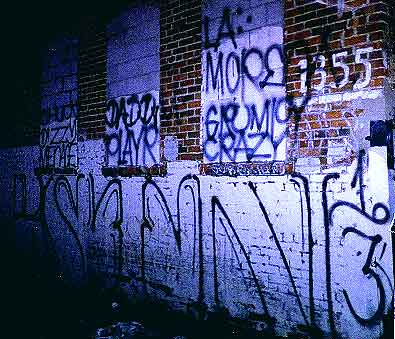
The gang's all here (thanks to open borders)

p2


Los Angeles County is fighting gang warfare, it says.
Mayor Antonio Villaraigosa and Los Angeles County Supervisor Zev Yaroslavsky joined together at the LAPD's North Hollywood station to unveil a $500,000 program that will assign one probation officer to each of the department's six Valley divisions. The program will begin Feb. 5, they said, and will allow authorities to quickly identify and arrest suspects who violate terms of their probation. … While the mayor and Yaroslavsky focused on violence in the Valley, City Councilwoman Janice Hahn said she may ask voters to approve a parcel tax or sales tax increase to provide $50 million to fight the estimated 40,000 gang members in Los Angeles.
According to the L.A. Daily News, "There are about 100,000 gangsters in more than 1,300 gangs in Los Angeles, Ventura and San Bernardino counties. They make up less than 1 percent of the population but commit at least half the region's homicides — taking the lives of nearly 3,100 people in Southern California since 1999, more than three times the number of U.S. casualties in the war in Iraq." If you want to see what this looks like in LA's suburban San Fernando Valley, click the interactive map headed "Valley homicides" in the link above and select "For 2006 homicides … " right under the map. Each of those 86 numbered pins shows the site of a gang killing. That's just the San Fernando Valley, which only a generation ago was a peaceful, if uninspiring, middle-class area; to find the real hot spots, you'd need to look at East LA and South Central.

The Daily News quotes
Dr. Gary Slutkin, director and professor of epidemiology and international health at the University of Illinois at Chicago: "It's what we'd call a situation out of control; it's like war ... It's like 'Apocalypse Now."'

Yes, it is; but to the Liberal Establishment, it's business as usual. The response is scripted. Raise taxes to "fight" the gangs; hire more social workers — six, count 'em, six new probation officers.

"A report released last Friday by respected civil rights lawyer Connie Rice criticized the area's piecemeal approach to gang crime and called for a comprehensive solution with a single agency headed by a gang czar with enough 'political clout' to cut through red tape and coordinate prevention and intervention services," the paper reports.

"They are living in a pressure cooker and the way society has managed this group is by adding more pressure," says Dr. Slutkin. "The only way to relieve this is to put something around them that allows them to release it that doesn't push back. Our outreach workers are trained to do that. Somebody has to make sense to them about what's going on."

Sorry, but a half dozen more probation officers and more "prevention and intervention services" and "outreach" aren't going to to make a scratch in the widespread blood sacrifice. I can't imagine what Dr. Slutkin wants to "put around" these young thugs "to release it that doesn't push back" — the sentence is grammatically and logically opaque; but whatever his outreach workers are trained to do, it will be at best a band aid. This is war, and social services don't win wars. Even better policing doesn't win wars. You win wars by eliminating the enemy, one way or another.

No, I don't propose a campaign of killing gang bangers, even though they are all potential or actual murderers. Let's get to the … wait for it … root cause of the problem. That's illegal and legal immigration from Mexico. Sure, there are black gangs (probably having a hard time holding their turf these days) and maybe a few white gangs, but the great majority of these vicious criminals are Mexicans who either got to LA by subterfuge or attained automatic U.S. citizenship by going to the trouble of being born (in a U.S. hospital, at U.S. taxpayers' expense).

Of course, in our p.c. society, you can't acknowledge such truths. So instead of a campaign to deport illegals for any crime, from illegal drug possession to overparking, and damming up the river of "migrants" from Mexico who will not and probably cannot become honest American citizens, we play the same old scratchy record: hire more sociological bureaucrats, concoct more "intervention" programs administered by otherwise unemployable academics, tell the police to police harder and blame them when it doesn't work. Meanwhile, gang homicide continues to vacuum up lives — in many cases, of immigrants themselves. They are victims, all right, but not primarily of the gangs. Our politicians are willing to see them fall to bullets, shotgun pellets, and knives rather than break the code of silence about the real results of "diversity" at all costs.

UPDATE 1/20
I am conscious that, under time pressure, these postings are not always as logically watertight as they might be. There are gaps that ideally should be filled in.

When I wrote, "This is war, and social services don't win wars," that might have sounded like hyperbole. While no one can doubt that these gangs are at war with one another, the level of violence, which sometimes spills over into random killings of "civilians" for racial and ethnic reasons, is a war against society. No nation worthy of the name can have "no go" areas in its major cities, gangs that are so large, so well armed, and so organized that they are effectively rebel armies. It may not be their intention, but these gangs with their ceaseless clashing and killing are declaring that they are outside the law, that they make the law of the streets.

We need to acknowledge this reality if any progress is to be made. These aren't juvenile delinquents or mixed-up kids, who can be saved by counseling. They are a criminal subculture without any moral sense, unless you can call loyalty to their own gang morality. Their daily employment is hard drug smuggling and sales, spiced up with homicide now and then.

I would bet money that if the authorities checked every time they busted a gangster, they'd find that more than half of the hispanic ones are illegals. They should be deported forthwith, along with their illegal family members. And while the LA police can't do anything about our insane "birthright citizenship," which ensures that any woman who can make it across the border to bear her children guarantees them U.S. citizenship, California's representatives in Congress should lead the movement to abolish automatic citizenship for the scions of lawbreakers.

But they won't, of course. For various reasons, they want to keep the Mexican influx going. They are accessories before and after the fact. For political and financial advantage, they wake up every morning with blood -- including that of innocents caught in the crossfire -- on their hands.

Tuesday, January 16, 2007

Trust but verify

To be a critic in the old days, you had to have a list of intellectual credentials as long as your arm and be employed by a newspaper or a magazine. Now, everyone's a critic, and media outlets themselves are in the crosshairs. The burgeoning world of the Internet is filled with people - some qualified, many not - who call themselves media critics. Their stock in trade is, in many cases, abuse, and their targets are the traditional media they'd like to replace.
Nick Madigan, The Baltimore Sun, January 14, 2007

A word in your ear, Nick?

Let me admit, straight off, that although I have two degrees, neither is in journalism or media studies or whatever intellectual credentials it takes to write a column for The Baltimore Sun. I am clearly not qualified to call myself a media critic. And I am not here to abuse you. How difficult your world must be these days, after you have no doubt spent years deciding what is and isn't news, and what criticism may be expressed and what may not. I can understand that it doesn't steady your nerves when those who are not ordained get it into their heads that media people can have unexamined assumptions — "biases" is the term sometimes used — that affect their news coverage.

You lay bare your hurt feelings when you write, "
Some media criticism sites are widely respected within the profession for their care in checking facts and balancing the comments of critics with responses." Please accept my sympathy. No one should have to accept scrutiny or, God help them, criticism from anyone outside their profession! Least of all a journalist. After all, only another journalist knows how tough it is — as one you quote says, "Traditional journalism has dug a bit of this hole itself, with that imperious 'We're delivering the truth to you every day' attitude,' he said. 'We all knew they were putting out what the reporter could cobble together on deadline.'"

That's bad enough for one media person to endure in a lifetime, but I can scarcely imagine your pain when what one of your interviewees calls a "self-appointed critic" isn't just going on about loose ends not tied up under deadline pressure, or even frauds like Jayson Blair and Janet Cooke, but about slanted news. Everyone knows reporters are middle-of-the-road, split-the-difference, anti-extremist types, careful to give each side its due. How could anyone possibly imagine any contrast in tone between "older organizations like Fairness and Accuracy in Reporting, a 'national media watch group' that refers to itself as progressive" and "the Media Research Center, whose self-proclaimed conservatism dictates its denunciations … ."

Fortunately, as you note, there are real media watchdogs, a far cry from those unlicensed bloggers, to point out when newspapers go too far in, for example, shading stories to make illegal immigrants or minority-group killers look bad.
Florin's NewsTrust site aims to spotlight excellence. Funded by The Global Center, a nonprofit educational foundation established by Rory O'Connor, a documentary filmmaker and journalist, News Trust hopes to help support itself by offering media outlets its rating service, which would enable readers and viewers to rate stories based on criteria such as fairness, objectivity, factual evidence, clarity and relative importance.
Thank goodness for "professionally edited" sites! NewsTrust wants to make sure we don't overlook any of the media they've anointed for excellence: magazines like Mother Jones and The New York Review of Books; newspapers like The Los Angeles Times, The New York Times, and The Observer; "TV sources" like Democracy Now, PBS, and BBC News; and wire services like Reuters, the Associated Press, and Agence France Presse. Only there's something about all those "top rated" sources — I can't quite put my finger on it. Not to worry at all, though, Nick. I'm one of those unqualified commentators on other Internet sites who are, in your words, "far less careful" than NewsTrust.

Oh, by the way, Nick … that word in your ear. The NewsTrust site spells its name with the words "bumped" — no space in between. Journalists are supposed to notice little things like that, and I can't imagine a copy editor on an excellent paper like The Baltimore Sun messing up your careful work. Please don't take this as criticism. I know you just had to cobble your piece together to meet a deadline.

Monday, January 15, 2007

The Flying Fox

flying fox edit

This is a small, "back-of-the-book" ad from an aeronautical magazine of 1949. (The faint secondary image in print-through from the other side of the page.)

So?

It's interesting as a tiny window into another time and place. What can we deduce from this?

1. At least for minor "name recognition" ads in postwar England, the basics of typesetting (as we think of them now) weren't considered very important. None of the lines are centered, even in relation to one another. Kerning, to make letters of different sizes appear to be evenly spaced, never crossed the typographer's mind.

2. On the other hand, the Flying Fox logo is delightful: a quasi-geometric, post-Art Deco fantasy. This was a decade before corporations started going in for meaninglessly abstract logos that were the equivalent of Bauhaus architecture, untouched by human hands. The Flying Fox, as befits a steel manufacturer's symbol, is dignified but symbolizes motion (because the company's products were used mainly in aircraft?) and induces that mythological tingle we feel when kinds of animal are combined, as in a centaur or sphinx.

3. These "electric steels" (I'm not up enough on steel technology to tell you what that means) were made in Sheffield, where "The Full Monty" was set in a post-industrial wasteland. But, obviously, in 1949 the city still had a reason for being: they made things there.

4. The company had very likely been founded, probably in the 19th century, by one S. Fox. His descendants had been bought out by a bigger firm, United Steel Companies.

Googling "Flying Fox Electric Steels" or "S. Fox & Co." yields no useful results. I wonder if anyone in Sheffield today remembers them. United Steel Companies is listed on the site of the Durham Mining Museum; apparently it mined its own coal for its steelworks. It was nationalized in 1947 under Britain's Socialist government, although the board doesn't seem to have changed much from that of 1940, and as we have seen, it was still running adverts in shameless capitalist fashion.

As a note on the bizarre socio-political status of Britain at the time, it can be seen that this government-owned corporation was still headed by a baronet -- the bottom rung of the English artistocracy, but still, an aristo. Nor had the proletariat seen off the Right Honourable
W.S. Morrison, M.C., K.C., M.P. from his director's chair.

The director lists for 1940 and 1947 show where captains of industry lived. J. Henderson was at home at
44 Campden Hill Gate, London, W.8. I can place that: it's in Kensington, still a tony district, and I've been to a meeting of the Society for Psychical Research in the Campden Hill Library. Residences of other board members offer the flavour of Old England: The Manor House, Tittensor, Stoke-on-Trent; High Rogerscale, Lorton, Cockermouth, Cumberland; 4b Fredericks Place, Old Jewry, London, E.C.2 (I bet "Old Jewry" has since passed out of use); Chetwode Priory, Buckinghamshire.

So it was, in the day of the Flying Fox.