Tuesday, July 15, 2008

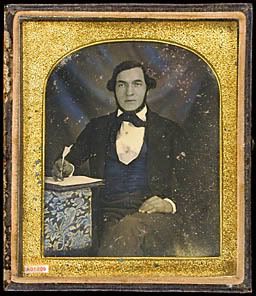
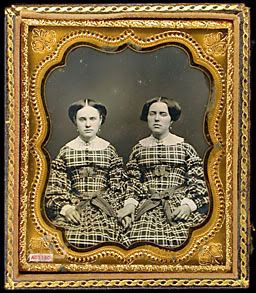
Daguerreotype portraits

Photobucket
1138

Photographs are the closest thing we have to a time machine. Even "realistic" paintings and drawings of earlier times are inevitably influenced by the artist's style, imagination, and technique (which of course is as it should be). Photographs, though, show how people and things actually looked at a given time. (I exempt "art" photography and, naturally, shots that have been digitally manipulated.)

Daguerreotypes were one of the very earliest media, invented in 1839, according to the Lazy Person's Quick Reference Handbook, aka Wikipedia, and most date from then to about 1850, when other photographic techniques began to replace them. Daguerreotypes were made by exposing an image on light-sensitive chemicals on a metal plate.

Only one "print" could result, a negative, which however looks positive when viewed at the right angle to the light. Seeing original daguerreotypes (not conventional photographic reproductions of them) is a strange, almost unsettling experience: something about the metal on which the image resides, or maybe the chemicals, gives them an uncanny lifelike appearance, as though you are looking through a hole in space-time to another reality — which is not far from the truth.

Photobucket

Photos from the later 19th century are not that uncommon; we've all seen Matthew Brady's Civil War-era pictures. Part of what I find fascinating about daguerreotypes is that they date from a generation earlier, a time not often seen in photographs.

The Daguerreian Society has an online collection, arranged by category. The pictures of buildings &c are interesting enough, but some of the houses and offices, or similar ones, are still standing. What I am most drawn to are the portraits: people like us, yet living in a physical and social environment so different that most of us have trouble imagining it.

I'm posting a few samples here. They are in Flash format, and I cannot enlarge them when I transfer them here (or if there's a way to, I don't know it). But If you go to the Daguerreian Society site and look them up — I've included their identification numbers — you can zoom in on any part you want to see up close, such as faces. (You click the image and then navigate by clicking the plus and minus signs and arrows.)

Photobucket

Most of the men and women are well dressed — they would be, wouldn't they? When photography was a rarity, it was the well-to-do who had their pictures taken, although they were probably comfortable middle class. The very rich still had their portraits painted, and probably thought getting your features captured by a bizarre new device was déclassé.

Surprisingly, quite a few portraits are of blacks, looking reasonably prosperous. These portraits were almost certainly made in the northern states.

Not many of the women are dressed in formal wear (some of the men are), but their gowns look well tailored and accessorized (nice shawls). Women's jewelry doesn't change much over time. Plenty of jewelry in museums from ancient days could be worn today without attracting particular notice.

Photobucket
206

The women's dress fabrics and patterns are often pleasing, especially if you visualize them in color, but bonnets strike us as goofy. Even the attractive woman above can't pull it off (according to our standards).
Photobucket
1208

The way people wore their hair is another thing that leaps to the modern eye. While the women's hair is styled, ringlets and buns don't do much for their sex appeal. As for the men, well, the very concept of hairstyling didn't exist. I guess the best a bloke could hope for was a competent barber.
Photobucket
1180

There aren't many smiles in these portraits. Partly, that may be because taking a photo wasn't the instantaneous process it is now. The subject had to sit still for a minute or more to let the image register on the plate.

Nevertheless, it's hard to doubt that this was a generation for whom life was a very serious business. They knew they or their loved ones could be taken out of it by illness with little prior notice, and most of them expected they would be judged severely in the afterlife. Yet it was more than that, I think: they believed in reflecting dignity and earnestness to the world. Did that take some of the fun out of their existences? Perhaps. But fun isn't happiness. And happiness isn't everything life is about, which the people in these daguerreotypes may have known better than most of our contemporaries do.

Photobucket

Monday, July 14, 2008

Take! Me! Out! of! the! Ball! Game!

Lawrence Auster's correspondent Shrewsbury had a shock when he went to a baseball game recently:
Shrewsbury briefly made it back to New York last summer, and took Shrewsbury fils to a game at Yankee Stadium, the third deck of which the elder Shrewsbury were wont to haunt as a yute in the 1960s; Shrewsbury fils is a rabid Yankees fan, apparently by some process of Lamarckian inheritance, since the elder Shrewsbury had ceased to follow baseball soon after he had procreated, and made no attempt to encourage yankeephilia in his progeny.

For the elder Shrewsbury on this foray there was one madeleine-biting moment when he inhaled an air of "dawgs wit kraut" in the heavy Bronx atmosphere--not the hideously dry, odorless California vacuum which is such a depressing contrast to the rich, muggy, nourishing humidity of Gotham. Generally however the experience was rather ghastly for him. The atomic PA system, the hideous Jumbotron where erewhile the sedate centerfield scoreboard had stood, dominated the environment, filling every moment with strobe effects, colossal images of the players' talking heads, blaring, eardrum-abusing samples of each player's favorite pop song whenever he came to bat, with enough bass to liquify one's internal organs--a scene from Idiocracy. The actual baseball game seemed to be reduced to an insignificant sideshow.

Baseball is a contemplative game, but not one moment for contemplation was permitted. Gone were the sublime summer sounds of wood smacking and leather slapping horsehide, the lazy crowd murmurs, an awareness of breezes...no, it was more like being trapped in a video game than attending a baseball match.
I have not been to a baseball game in decades. My wife suggested the other day that it might be fun to go to one, and I was inclined to take her up on it … partly out of nostalgia, but partly out of some agreeable memories. I can still recall my astonishment when, as a 12-year-old, my dad took me to my first game and I saw what a long ball to center field actually looked like, as opposed to only the alpha and omega I saw on TV (the batter hitting it, the outfielder catching it, or not, with the ball vanishing into an etheric untelevised realm in between). Or how a "pop-up," which the TV announcer reported with narcoleptic boredom, was in reality a magnificent sight, the white sphere shooting up with the speed of a cannonball to what seemed to my young eyes almost a vanishing point.

Photobucket

But there was also that contemplative side: despite the pitching and running, so much of the game occurred at a lazy, ambling pace, most of the players just standing there most of the time, so unlike our other national big-time sport. They were Men in White, it was summer, probably afternoon. (Later, I read that Henry James said the most beautiful words in the English language were "summer afternoon.") Between moments of acute excitement, you relaxed, your retinas soothed by the green grass, the milky blue sky, the pennants on the bleachers roofline shimmying in the breeze. Have another beer.

Per Shrewsbury, I guess it's not like that anymore. Some years ago I read a newspaper story that said Americans were going off baseball. Not enough action. It must be true: when I drive past school athletic fields, the kids are out there playing football or soccer. The new schools they build probably don't even have baseball diamonds.

Photobucket

So the baseball corporations wised up, I suppose, and decided to give the fans what they liked: noise and Vegas-style razzle dazzle. Why do the teams still wear white uniforms? Wouldn't they be cooler if they dressed like hip-hop musicians?

I find the idea of playing loudly amplified pop music during the game — between innings would be bad enough — particularly appalling, contrary to what was the spirit of the sport. But the people who manage our public spaces seem to agree that we've got to have our eardrums whacked all the time or we'll up sticks and leave. Even if we can't leave, like when we're in an airport boarding lounge. And they're making stores nearly unbearable for some of us.

Photobucket

Normally I ask for a recount and appeal to the Supreme Court before I agree to go shopping, but this weekend I went twice. My old reading lamp had packed up and I needed a replacement, because for a bookworm like me, reading comes with the basics in Maslow's hierarchy of needs. Anyway, I steered myself to a Target and an IKEA.

They've changed too. Target had bilingual signs throughout, and the designer stuff they featured a few years ago has mostly gone, replaced by
lowest-common-denominator style merchandise. The clientele was mostly Third World immigrant. Target has decided where its — and America's — future lies.

IKEA, which I once thought was a model store of its kind, offering furnishings with some aesthetic appeal at sensible prices, shook me up. Now it, too, plays uptempo music-while-U-shop, punctuated with KMart-type announcements. O tempera! O mores!

Photobucket

Thursday, July 10, 2008

Twit disguises himself as priest to fool congregation

Say what you like about the Daily Mail — or what you don't like — but it never fails to provide material for an amateur satirist such as your blogger.

Here's today's installment:

Priest disguises himself as a tramp to teach his own churchgoers a lesson

When Reverend Rigby wanted to teach his congregation a lesson about being kind to others he came up with a rather colourful way of demonstrating his point. As the 70 churchgoers turned up for their regular Sunday morning service at the Methodist church in Prestatyn, north Wales they found a scruffy tramp sitting in the church porch. Stinking of beer and dressed in filthy clothes, the disgusted churchgoers did their best to ignore him as they filed past. This task was made even harder when the unwanted guest joined them on the pews, surrounded with syringes and drinking from a can of lager.

‘It was interesting to see the reaction from people - I was totally ignored. It showed that we don’t recognise God at work and in each other.’

He said: "In other places I was given as much as £4.50, a packet of biscuits and a blanket - but in Prestatyn I got nothing. ‘I told the congregation they are a stingy lot. Everyone was amazed and later complimented me on my acting skill, though some said I had made them feel terrible.’

Let's examine the moral implications of this stunt.

Reverend Rigby believes that the churchgoers should not have reacted with distaste to a "scruffy tramp" sitting on the porch of their house of worship. They should have looked through his earthly form and seen the God within. But, being a "stingy lot," they failed to immediately shower him with love and money.

Photobucket

The priest is right to this extent: all have sinned and fallen short of the glory of God. However far we stray — and certainly there are people who stray a lot farther than the "tramp" — we are all connected with God and perfection, no matter how much we fall into the delusion of believing we are no more than human, or perhaps no more than animals, or machines.

Many good people come to misfortune, are down and out through no fault of their own or even through faults that should not earn them rejection by human society. If the congregation of Prestatyn consists of ordinarily decent people, I'm sure they recognize this.

But that isn't the lesson Reverend Rigby wants to convey. If the article is an accurate account, there seems no other conclusion to draw than that he wants his flock to accept the "tramp's" behavior. Namely, sitting on the porch steps, probably blocking the way in. Smelling like a brewery. And then, sitting in a pew, tossing back the booze, "surrounded with syringes."

Photobucket

Such a person is expressing contempt for the congregation as well as whatever spiritual presence the church represents. He is quite brazenly spitting in the eye of society, declaring by his actions that he is not bound by even the ordinary conventions of good manners. He is completely indifferent to propriety.

Photobucket
Reverend Rigby expressing his real identity (above)
and posing as a spiritual leader (below)
Photobucket

I doubt that all, or even most, of the churchgoers Reverend Rigby ministers to are rich. Some of them probably make sacrifices to be able to put a few bob on the collection plate. They may be no better or worse than the run of us people, but they have enough respect for themselves and each other to know how to behave in church.

So tell me why they should accept a lout in their midst and, in effect, reward him. In fact, the priest tells us they ignored him, which shows considerable forbearance. In another day and time, a couple of beefy men in the congregation would have persuaded the man who was defiling the service to take himself away, with whatever degree of persuasion was necessary.

Photobucket

Yes, people who have lost their minds, who have destroyed themselves or cannot help themselves do not lose all claim to empathy. In a different setting, in another way, most of the congregation would probably help someone taking the initiative (or at least cooperating) in trying to turn his life around. That, I think, is compatible with what God wants of us.

But to imply that we must tolerate and enable anti-social behavior in the name of compassion is not Christian, is not spiritual, is not virtuous if a society wants its self-destructive citizens and its unfortunates to be something greater than dole collectors. But today's Britain has no higher aspirations for them.

Photobucket

Tuesday, July 08, 2008

French government site warns against U.S. no-go areas

A French government Web site is bluntly honest about parts of U.S. cities that its country's tourists ought to stay away from.

In its "Advice to Travelers," the Ministère des Affaires Étrangères offers guidelines for Places to Miss, complete with maps. (Click the tab labeled "Sécurité"— French for "safety" as well as "security.")

The heading says, "The increased risk of terrorism should not make you forget that the principal risk remains criminality." Scroll down to see the city maps. I've translated some of the descriptions:

Boston: "Avoid foot traffic at night in the districts of Dorchester, Mattapan and Roxbury." It also warns of the "revival of juvenile delinquency."

New York: Be vigilant in tourist areas like Times Square and the Statue of Liberty, "as well as in airports, railroad stations, the subway, restaurants, museums, and certain hotels on the West Side. Do not go alone in Harlem, the Bronx, and Central Park at night."

Washington: "Avoid the northeast and southwest quadrants, as well as the bus stops and Union Station at night. In the tourist areas of Georgetown and Dupont Circle it is a good idea to be vigilant at night. The Anacostia area is not recommended either by day or night."
Photobucket
Pittsburgh: Les lieux dangereux
(circled in red), according to the French government.

"Baltimore is considered a dangerous city except for downtown."

"Detroit: The center is not recommended after offices close."

New Orleans: The warning is long and boils down to, avoid most of the city and be on your guard everywhere. "Do not hesitate to take a taxi, even for a short distance."

Los Angeles: "Large areas are to be avoided, notably the east, south and southeast districts, such as Watts, Inglewood, and Florence" and caution should be exercised in tourist areas. In the West Side (much of which is considered posh) watch out for aggression, carjacking, burglary in hotels and on private property.

The site also counsels French visitors on the dangers of "natural catastrophes and meteorological dangers," hurricanes (ouragans), tornadoes, seismic risks, floods, seaside hazards, and shark attacks.

Mais oui, but still, the Euro fort, the dollar faible … there's never been a better time to visit the USA!

Good on the French authorities for warning tourists about some of the less savory realities that the tourist industry glosses over. And it's not anti-American prejudice. The French government is equally forthcoming about the "sensitive urban areas" at home.

Photobucket

Sunday, July 06, 2008

Police sniffer dogs shake their bootees

Photobucket

Canine Detective Inspector Milo Plimsoll

Police sniffer dogs will have to wear bootees when searching the homes of Muslims so as not to cause offence.

Guidelines being drawn up by the Association of Chief Police Officers (Acpo) urge awareness of religious sensitivities when using dogs to search for drugs and explosives. The guidelines, to be published this year, were designed to cover mosques but have been extended to include other buildings.

The Sunday Times (London), July 6, 2008


Special Branch Office
Sensitivity Station no. 2844
Wretchley-on-Whelm
London ES5 GL9

7th July 2008

To our esteemed neighbours:

In an announcement which I am sure that you will applaud, I am happy to inform you that on those occasions (which I am confident will be extremely rare) when it is necessary to perform a search for explosives or drugs in the Old Smithy area of Wretchley -- be assured we on the Force will prosecute anyone using the term "no-go area" -- a new team has been formed to fully respect the sensitivity of inhabitants who are followers of The Prophet (pbuh).

Our search team will be led by Canine Detective Inspector Milo Plimsoll, pictured above. CDI Plimsoll has been thoroughly briefed on correct attire for explosives or drugs detection and seizure, in the unlikely event that such detection and seizure should occur.

In the spirit of reaching out to the community, I invite you to stop by Sensitivity Station no. 2844, only a camel trot from the mosque on Gorse Road, and meet all the members of the new team. Please provide 24 hours advance notice so that we can ensure that all squad members are wearing their proper kit.

Photobucket

Canine Detective Sergeant Camilla Sleed-Bramway

Kind regards
DCI Markham Down


Special Branch Office
Sensitivity Station no. 2844
Wretchley-on-Whelm
London ES5 GL9

12th July 2008

Dear Sheikh Al-D'Alusia,

Yours of the 10th has been received and noted with the greatest sensitivity. In response to your protest that "boots do not make an unclean animal clean in the eyes of a Believer," a special meeting of the Community Relations Council, chaired by the Anti-Terrorism Assistant Minister for Diversity (Acting) herself, was called yesterday. I am pleased to inform you that in the interest of harmony among our rich tapestry of citizens, a new policy is now in effect. Taking note that the equine species is in much favour among your community -- is there not a breed called Arabian? And did not The Prophet himself (pbuh) ride off to heaven on a steed called (I believe) Burqa? -- the search team has been thoroughly reconstituted. I invite you and all your community to stop by Sensitivity Station no. 2844 at any hour of day or night (no advance notice required) to acquaint yourselves with our new explosives inspectors.

Photobucket

Equine Detective Inspector Racing Stripe

Hoping that you will greet this gesture of respect with equine-imity, uh, scupper that, I meant to say with full acceptance,

Kind regards
DCI Markham Down

Photobucket

Thursday, July 03, 2008

We don't need this cringing defense of a free society

Weasels who want to play the courageous defender of freedom while keeping their dhimmi qualifications intact often use a standard ploy. It works like this: claim that a flap over something said to be offensive to the Muslim population is just down to over-sensitive non-Muslims. Like this:
What I would not do was make a police spokesman go down on his knees and grovel for supposedly causing offence by putting a picture of a dog sitting in a policeman's hat on a poster for a new non-emergency number. …
The idea that Muslims are offended by the very sight of a dog seems to derive entirely from one Dundee councillor, and even he didn't try to make out that he was upset, only that others “could” be. By rolling over and apologising, the police have made themselves look weak and inadvertently given the impression that Dundee's Muslims are an intolerant bunch intent on Islamifying the British way of life.
Do writers for what was once, in its pre-Murdoch days, England's most respected and literate newspaper no longer have to know syntax? You do not mix a conditional tense ("would not do") with a past tense ("was"). But that's a side issue.

Clark, the columnist, obviously feels he dares not step out into the clear without first strapping on his flak vest and singing the multicultural company song: "If I were diversity officer at Tayside Police I would go to great lengths to avoid offending Muslims. I would make sure that they were not stopped and searched just for looking a bit shifty, and, nothwithstanding the Government's victory in the Commons, I would want to make sure that young Muslims were not driven into the hands of radicals by being incarcerated for 42 days without charge."

Photobucket

Take that, you racist Islamophobes! As though someone had suggested that a police "diversity officer" — Lord, how I hate that expression — should offend Muslims by not going to great lengths. As though he were bravely standing in the way of a howling mob demanding Muslims be stopped and searched "just for looking a bit shifty." This is what is known in slightly more rational circles than those our pundit inhabits as a straw man argument.

Next, he presents a one-off incident and generalizes as if it applies to every situation in which Britain's multi-culti commissars bow to the ground to avoid offending Muslim sensibilities. Maybe no one did complain about the advertisement. But there certainly are cases on record (see here and here) in which Muslims have been so offended by "the very sight of a dog" that they refused to perform the public service jobs they were licensed to do. The police diversity officer was hardly excessive in imagining that Muslims would wax indignant yet again.

Photobucket

And why would the police hire a diversity cop and all of Britain's officialdom go tippy-toe around anything to do with Muslim beliefs if they weren't afraid of trouble — complaints, political pressure, maybe even calls for the heads of infidels? Yet the clear implication of the article is that the problem is in the minds of non-Muslims. They're making the mountain Mohammed went to out of a molehill.

But the main reason why arguments like Clark's are despicable is that, under the cloak of sweet reason and criticism of the deepest fathoms of political correctness, they actually reinforce dhimmitude. He implies that his society should trim its discourse to please its most fanatical colonists. To him and people like him, it's axiomatic that Muslims must never be offended. The only thing that can legitimately be discussed is whether any speech or act really offends them.

Photobucket

Every day Muslims in a Western country are wound up about something the "Crusaders" do. A great many Muslims are "an intolerant bunch intent on Islamifying the British way of life," as Clark says with lofty irony.

So he reassures his Muslim readers that here's one good dhimmi who'll be their sword and shield, while assuring everybody else that all this carry-on would stop if only they'd quit expecting Muslims to run true to form. What a guy.

Photobucket