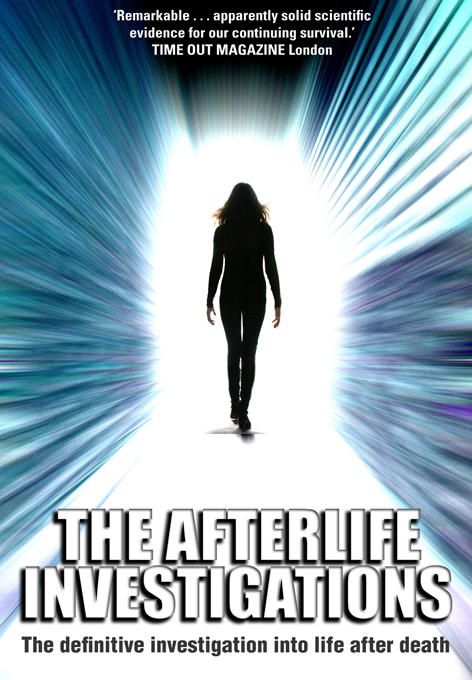
Anyone who would make a serious documentary about survival of the human spirit after the death of the physical body faces daunting obstacles. The evidence is largely based on spontaneous phenomena that can't be summoned at will for the camera. It depends on the cumulative weight of many individual data points rather than a few spectacular events. Logically, even the strongest cases defy "proof": it is hard to conceive anything that would see off every alternative explanation to survival.

As if that weren't enough, any producer, director, or writer for such a film is at the mercy of network executives if the program is intended for TV viewing. TV is designed for entertainment, not truth. So we get junk shows about ghosts and haunted houses featuring credulous witnesses and spooky music on the sound track. Intelligent viewers are more likely to have their skepticism stoked than to be convinced or even have their minds opened.
Occasionally, though, someone overcomes the odds. Tim Coleman has made what is, as far as I know, the first feature production with extensive footage of the sessions that resulted in the Scole Report, originally published in the Society for Psychical Research Proceedings, now reissued as a book. The video, The Afterlife Investigations, is available on DVD.

For those who would like a relatively brief summary of the Scole investigations, here is an article by Montague Keen, one of the three SPR investigators who were present at and witnessed many of the remarkable paranormal events.
Back to Tim Coleman's video. In addition to making good use of video recordings from Scole, The Afterlife Investigations introduces us to Marcelo Bacci, who is somehow able to use an old table radio (it looks like '30s vintage) for communication with the deceased; other examples of the electronic voice phenomenon, in which spirits in the afterlife speak to the living on tape recordings; and Allison DuBois, of whom I know nothing except that she is said to be a famous medium on which the NBC series Medium is based.

DuBois is shown (allegedly) communicating with the spirit of Montague Keen, who died several years after his role as lead writer for the SPR's Scole Report.
The main interest of The Afterlife Investigations, for me, is the shots taken at Scole, showing amazing spirit-generated "physical phenomena." The mediums involved are interviewed and give their own first-hand accounts.
Despite having appeared on television (something unfortunately called UFO TV -- I don't know if that's a U.K., U.S. or both network), the video's tone is determinedly non-sensationalistic, even if some of the phenomena shown are pretty sensational. What is seen here deserves the careful treatment it gets.
Not that the video is flawless. It stops from time to time to insert man-on-the-street interviews of pedestrians giving their views of life after death, which struck me as pointless. I also could have done with fewer repetitive establishing shots of the town of Scole seen from a traveling car; one would have been enough, and each return to Scole could have been labeled with computer graphics.

Nevertheless, I consider The Afterlife Investigations to be an immensely valuable contribution to a much-abused cinematic genre -- the paranormal show -- and frequently fascinating. I can strongly recommend it to anyone willing to consider the evidence for post-mortem survival on its merits.
For the record, I am not a disinterested observer, since I met Monty Keen soon after the Scole Report appeared and talked with him at some length both at SPR conferences and when he and his wife Veronica came to the U.S. on visits. The account and conclusions of Scole Report were not accepted by many SPR members, but he had no doubts. "I have seen miracles," he told me.

Of course the whole subject of survival, spirits speaking through mediums and electronics, producing physical evidence and so on seems absurd to many people -- most people, in our age of materialistic science. Neither The Afterlife Investigations nor the Scole Report, not to mention the huge body of literature on spirit communication, renders doubt impossible. But I think it makes belief possible.
There was Monty Keen -- dead for seven or eight years now -- interviewed in the video, looking and speaking just as I remembered him, seeming almost present thanks to the high resolution of digital video. Imagine telling someone in, say, the 18th century about such a phenomenon. Imagine the response: "Sir, I fear either your mind is disordered or you have been nipping at the claret to an unseemly degree."
Yes, it would have been self-evidently ridiculous. Like spirits of the "dead" speaking to the living through mediums or electronic instruments, preserved on videotape.