Monday, July 31, 2006

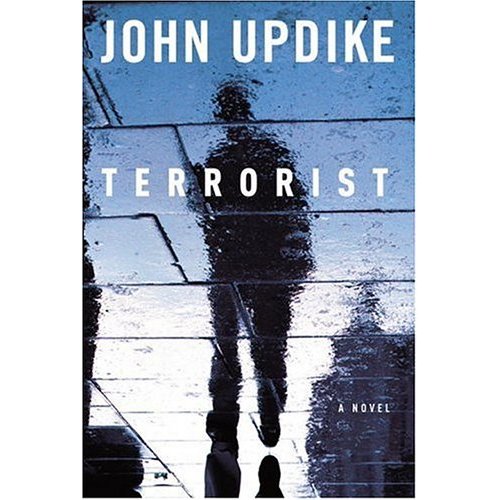
John Updike's Terrorist

Terrorist has been getting a lot of negative reviews, for a novel with obvious literary merits. What's up with that?

Mark Steyn perhaps speaks for the majority, who find Updike's portrait of a young, introverted, Qur'an-drenched teenager unconvincing:
It's doubtful anyone could write "the" novel about Islam today — it is a faith, after all, that can seduce everyone from Ontario welfare deadbeats like Steven Chand to the Prince of Wales. Yet it seems to me Updike has gone awry from the very first word. If Muslims were simply über-devout loners, this whole clash-of-civilizations rigmarole would be a lot easier. But the London Tube bombers were perfectly assimilated: they ate fish 'n' chips, loved cricket, sported hideous Brit leisure wear. Updike's absurdly alienated misfit is a lot less shocking than the video that aired recently on British television of July 7 jihadist Shehzad Tanweer: he's spouting all the usual suicide-bomber claptrap, but in a Yorkshire accent.
And everyone seems to quote from Terrorist's opening paragraph: "All day long, at Central High School, girls sway and sneer and expose their soft bodies and alluring hair. Their bare bellies, adorned with shining navel studs and low-down purple tattoos … " etc. The reviewers' implication, presumably, is that Updike has written a Freudian Lite riff about the randy urgency of teenage hormones being sublimated into an ache for a Mohammedan Paradise.
John Updike Terrorist

True enough, Ahmad, the "terrorist" of the title, doesn't undergo much character development in the book. He's the product of what is called in San Francisco a "mixed marriage" — a man and a woman. His mother is also Irish-American, his father an Egyptian no-account who showed his heels when Ahmad was a child. After electing to pursue the Islamic course with all his heart at the age of 11, Ahmad gives himself for instruction by a shaikh at the mosque above a store in his rundown northern New Jersey town. The shaikh is a hard liner; once Ahmad takes a job driving a truck for a Muslim-owned furniture company, the story line is predictable (although I found the last 20 pages or so admirably suspenseful, more so than any "thriller" I've read in years). But who reads a John Updike novel for its plot?

Ahmad may not be a typical terrorist, if there is such a thing, but this is a work of fiction, not a socio-political treatise. Updike has done wonders, if you ask me, in distilling the psychology of a thoughtful jihadist. And it's disturbing, not only because of what is intolerant and fanatical in it, but because of what is spiritual — a perverted spirituality, misappropriating noble impulses.

Ahmad senses an emptiness around him: "Infidels, they think safety lies in accumulation of the things of this world, and in the corrupting diversions of the television set. They are slaves to images, false ones of happiness and affluence. But even true images are sinful imitations of God, who alone can create." And an emptiness in himself, "the burning misery of separation from God and the scorching of our remorse for our sins against His commands."

Updike captures vividly the yearning for an Absolute, a pure and perfect End to repair the damage inflicted on our souls in daily life. "[The Prophet's words] were not meant to blend: they invade our human softness like a sword. Allah is sublime beyond all particulars. There is no God but He, the Living, the Self-Subsistent; He is the light by which the sun looks black. He does not blend with our reason but makes our reason bow low, its forehead scraping the dust and bearing like Cain the mark of that dust. Mohammed was a mortal man but visited Paradise and consorted with the realities there. Our deeds and thoughts were written in the Prophet's consciousness in letters of gold, like the burning words of electrons that a computer creates of pixels as we tap the keyboard."

Ahmad has contempt for the fragmentary and evaporating pleasures and goods that Americans set such store by.
The sheikh hesitates, and then speaks as if quoting a sacred text: "The unclean can appear to shine, and devils do good imitations of angels. Beware of anyone, however, pleasing, who distracts you from Allah's pure being."

"But the entire world," Ahmad confesses, "is such a distraction."
Too idealistic, too detached for any American teenager, even one whose head is full of the Qur'an? Maybe, but whatever Ahmad finds that is "shining" or "pleasing" in his surroundings is offset by the post-industrial wasteland that Updike describes with his usual flair:
As Ahmad walks along, swift and scissoring in black and white, yet with a native trace of the American lope, he sees shabbiness in the streets, the fast-food trash and broken plastic toys, the unpainted steps and porches still dark from the morning's dampness, the windows cracked and not repaired. The curbs are lined with American cars from the last century, bigger than they ever needed to be and now falling apart, cracked taillights and no hubcaps and tires flat in the gutters. Women's voices rise from back rooms in merciless complaint against children who were born uninvited and now collect, neglected, around the only friendly voices in their hearing, those from the television set.
* * * * * * *
From the bleached boardwalks that do for sidewalks, clusters of people stare at his high square orange truck as if its appearance is an event; they look, in their medley of bathing suits and beach towels and tattered shorts and T-shirts imprinted with hedonistic slogans and jibes, like refugees who were given no time to gather their effects before fleeing. Children among them wear towering hats of plastic foam, and those who might be their grandparents, having forsaken all thought of dignity, make themselves ridiculous in clinging outfits of many colors and patterns. Sunburned and overfed, some sport in complacent self-mockery the same foam carnival hats as their grandchildren wear, tall and striped ones as in the books by Dr. Seuss or headgear shaped like open-mouthed sharks or lobsters extending a giant red mitt of a claw. Devils. The guts of the men sag hugely and the monstrous buttocks of the women seesaw painfully as they tread the boardwalk in swollen running shoes. A few steps from death, these American elders defy decorum and dress as toddlers.
Ahmad's categorical rejection of the phenomenal world in favor of a blissful, heavenly one would seem crazy to most modern Europeans and Americans, but would have been natural to the Christians of the late Roman Empire, and held to be basically sound by a majority of people through the Middle Ages. The Church eventually condemned as a heresy Manichaeism — a religious movement that said that matter was evil, part of a fallen state that must be rejected utterly if the individual was to attain divine knowledge. I don't agree with the idea of heresy, but the Church was wise to reject the Manichaean system: if the everyday world is inherently evil, only a barrier between us and Spirit, then there is no moral blame in perpetrating any kind of harm or destruction on those who inhabit the material plane if they are thought to stand in the way of a higher good.

Ahmad is over the top, even by modern Muslim standards, but I don't think he is a crude caricature of Updike's. Muslims do, in spite of hundreds of years of Western scientism and both cultural and philosophical materialism, retain an allegiance to a kingdom that is not of this world. Personally, I find that aspect of their religion appealing; but whether we "infidels" do or not, we need to understand it if we hope to eventually achieve what can scarcely be visualized now, an entente between non-Muslims and Muslims, or even just to defeat the jihad.

Submission to Allah should not imply that Muslims have any right to demand it of anyone but themselves, much less inflict death and injury on unbelievers in the Prophet's teaching. I hope it's obvious that neither Updike nor I excuse Muslim terrorism. To understand all is not to forgive all. But in the clash of civilizations, understanding is better than ignorance.

Terrorist also offers the usual pleasures of Updike's style, which, pace Steyn, is almost always unforced and striking.
Ahmad sometimes has to suppress a suspicion that his teacher inhabits a semi-real world of pure words and most loves the Holy Qur'an for its language, a shell of violent shorthand whose content is its syllables, the ecstatic flow of "l"s and "a"s and guttural catches in the throat, savoring of the cries and the gallantry of mounted robed warriors under the cloudless sky of Arabia Deserta.
* * * * *
The breeze through her bedroom windows is cool. September is drawing near; single yellow leaves, like isolated sparks, show in the wearying greenery.

Friday, July 28, 2006

Social pathology on parade

Now and then an event captures, like a snapshot, the pathology that has become normal social policy in the United States -- not just the pathology of the "sharp end," but of its privileged enablers who go home every night smugly satisfied that they have given what's left of an orderly and functional nation another knock with the wrecking ball.

The Los Angeles Times carried this defining story yesterday:
An illegal immigrant couple with six children were already living in poverty. Then the quadruplets arrived.
Let's see: Angela Magdaleno and her husband (really? different last name), both illegals, have been in the United States for 22 and 28 years, respectively. Neither speaks English. "Even her teenage daughters speak mostly Spanish; their English vocabulary is limited," the Times says. "Yet all of Magdaleno's 10 children are U.S. citizens. The triplets receive subsidized school lunches. All the youngsters have had their healthcare bills covered by Medi-Cal, the state and federal healthcare program for the poor." They also receive $700 a month in Social Security payments.

The two-hanky story solicits our tears for Angela and her state-supported brood, but I do not fear for her welfare or that of her 10 offspring. No, they won't get rich siphoning their income off California and United States taxpayers, but the nation they invited themselves to will see that their basic needs are taken care of, and that their 10 anchor babies, automatic citizens to gladden a Bushbot's heart, will be able to have all the additional babies they want. Even if they restrain themselves and hold the line at, say, four each, that's 40 additional kids who are legally American but culturally Mexican in the next generation.

You got a problem with that?

Hey, the social work Establishment doesn't; they're probably fighting among themselves to step into the spotlight with aid for Angela and her accidental familia.

The Los Angeles Times doesn't; its owners and managers, who live in places like Beverly Hills and San Marino, think it's just dandy to bring another 10 sons and daughters of illegals into the world in South Los Angeles. Celebrate diversity and keep the Mexifornia advertisers and politicians happy. The story's deck thinks it's cute: "They're still in a daze." Wow, man, far out.

The George W. Bush Mafia doesn't; it's four more steps toward abolishing American sovereignty and realizing his dream of a Latino-majority country.

The Bush vassals working in what's laughably called immigration enforcement don't; the paper has no hesitation about publishing the parents' illegal status, because they know the fix is in and the couple is untouchable by the law.

The business Establishment doesn't; yipee, another four sub-minimum-wage counter wipers and burger wrappers whose social costs the taxpayers, those permasuckers, will absorb.

The Liberal Establishment doesn't; here's the exception that proves the rule that "U.S. immigrants' stories are often about reinvention and newfound prosperity, about leaving behind poverty and limitations." Like all Angela's neighbors in South Los Gangeles.

Well then, who does that leave to harbor some unworthy doubts about Angela's baby factory? I guess it's just you and me, friend. And I don't imagine the people in the corner offices with the leather swivel chairs give a toss what we think.

Wednesday, July 26, 2006

Susan Blackmore and the "illusion" of consciousness

A posting and comments in View from the Right about widespread atheism undermining British and European civilization cites Dr. Susan Blackmore as an example of "materialist nihilism" (scroll down to near the end). Commenter Michael Jose brings up her writings in connection with "anti-existence atheism," and links to his own blog, which declares, "Start with denying that God exists and you end up denying that you exist," and in turn links to an article by Susan Blackmore published in the New Scientist titled, "The Grand Illusion: Why consciousness only exists when you look for it." (My apologies for this two-degrees-of-separation lead-in; I'm just trying to give everyone their due by linking to them individually.)

Sue8-04 c
Susan Blackmore wonders if consciousness is inexplicable
because of how we think about it.


Blackmore includes in her piece a version of the mind-body problem that has plagued philosophers and scientists for centuries: how can the experience of consciousness arise from matter? They belong to different realms of existence. Blackmore then goes one better as she analyzes consciousness itself, and can't find any "there" there, either:
Could it be that, after all, there is no stream of consciousness; no movie in the brain; no picture of the world we see in front of our eyes? Could all this be just a grand illusion?
She does not deny that consciousness exists, which would be absurd, but suggests that the way we conceive of it — as a continuous stream of perceptions, complete with an unseen basement where things we're not aware of are stored until we haul them up in some neurological bucket or they spontaneously climb the stairs into our mind's eye — is an illusion.
Perhaps … there is no stream of conscious experiences on which we act. Instead, at any time a whole lot of different things are going on in our brain at once. None of these things is either “in” or “out” of consciousness but every so often, something happens to create what seems to have been a unified conscious stream; an illusion of richness and continuity.

It sounds bizarre, but try to catch yourself not being conscious. More than a hundred years ago the psychologist William James likened introspective analysis to “trying to turn up the gas quickly enough to see how the darkness looks." The modern equivalent is looking in the fridge to see whether the light is always on. However quickly you open the door, you can never catch it out. The same is true of consciousness. Whenever you ask yourself, “Am I conscious now?” you always are.

But perhaps there is only something there when you ask. Maybe each time you probe, a retrospective story is concocted about what was in the stream of consciousness a moment before, together with a “self” who was apparently experiencing it. Of course there was neither a conscious self nor a stream, but it now seems as though there was.
Is this a call for "materialist nihilism," as Michael Jose charges? It might be useful to fill in a little of the background here.

Susan Blackmore's field was for many years psychical research, in which I also have an interest. I knew of her for that reason and read some of her articles, even her sort-of autobiography. Unlike many other scientists doing similar research, Blackmore says she consistently got negative results in her experiments. That is, she could come up with no evidence to indicate that paranormal abilities were demonstrated. She was aware of the "experimenter effect" — skeptical scientists performing tests seem to be wet blankets who scare off psi abilities in subjects, who produce better results with experimenters who are sympathetic to claims for the paranormal — but Blackmore claims that she was initially quite the believer, even having had an out-of-body experience herself.

Eventually, she decided that she was wasting her time with psychical research, and quit. You have to credit her with courage in making a move that distanced her, and in some cases provoked rejection, from former colleagues.

Even after her anti-conversion, though, she retained some connections with the Society for Psychical Research. (SPR is not an advocacy organization and has no corporate views. Its members include a few skeptics.) Blackmore and I both attended the SPR annual conference in 1999 in Northampton, England, where she gave a presentation. It was called "Horses for Courses" and, if my recollection is correct, was about an experiment she particpated in where a clairvoyant who was said to have precognitive powers was tested on his ability to forecast the winners of horse races. No statistically significant record of correct predictions was found.

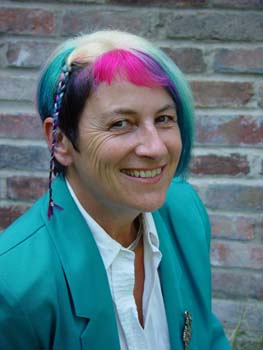
I wanted to talk with her, but she seemed (understandably, I guess) defensive and constantly surrounded by a coterie, and I chickened out from trying to strike up a conversation. Incidentally, at that time she had already adopted the multi-colored hair style you can see in the photo above and which apparently she's kept. She's attractive enough to carry it off without looking goofy.

Following her withdrawal from psychical research, I have read only second-hand reports about her new interests, but for a time it seemed she had reached a quasi-Buddhist outlook. In Buddhist psychology, there is no "I," no eternal or even temporary ego or center of consciousness that experiences things. There is only a stream of consciousness without anyone who is conscious, and the ultimate reality is described as a Void, shunyata. It can be inferred from Blackmore's New Scientist piece that she has now gone beyond Buddhism — she's not even convinced that consciousness is a continuous stream.

There does not seem to me any ground, then, for holding her up as a terrible example of materialist beliefs: Buddhism puts no stock in anything material, or even mental or spiritual in the sense those words are often used, and the same can be said for her "illusionist" take on consciousness.

Okay, but how about "nihilism" and "anti-existence"? There are various definitions of nihilism, including "a revolutionary doctrine that advocates destruction of the social system for its own sake; complete denial of all established authority and institutions; and the delusion that things (or everything, including the self) do not exist; a sense that everything is unreal." The third or fourth might conceivably apply to Blackmore's world view, depending on the interpretation of unreal, a discussion of which would take us into a lengthy digression. From the tone and context of Michael Jose's comment, though, it seems likely that it was the political meanings that he had in mind.

Personally, I don't find Blackmore's trans-Buddhist position, so to speak, much help in understanding the mystery of consciousness, of how "dead" and "unconscious" matter can become aware of itself. To suggest that consciousness may actually be intermittent in some fashion or only there when we (but what's "we"?) decide for it to be there doesn't solve the basic problem. It just kicks the can down the road a bit farther, as she herself seems to recognize in the last paragraph of her article. Whatever — we've come a long way from any kind of "nihilism" or "non-existence" that can sour a nation's pride or will to survive.

Jose has another complaint against Blackmore, although he's not too specific as to what it is, which he bases on this column. But, although I am automatically suspicious of anything published in the dreaded Guardian, and Blackmore's premise is at least debatable, nothing strikes me as philosophically or morally objectionable.

If you accept for the sake of discussion that we have damaged the planet we live on (undeniable) to the point where ecological disaster is now unavoidable (highly questionable), there is nothing wrong with considering the choices that will entail; it's highly responsible, as long as you remember the alternatives are all hypothetical. Why not discuss as rationally as we can who or what we will choose to "save" in the worst-case scenario? It's no different from emergency medical teams performing triage at a disaster site.

I guess this comes down to a defense of Susan Blackmore, whose conclusion about psychical research I don't share and whose ideas about the psychology of consciousness I can't well connect with. But it's pretty far-fetched to blame her for contributing to British dhimmitude or rejection of God.

Thursday, July 20, 2006

Radical cultural repression

Dennis Dale at Untethered quotes from a news story in The Independent (which requires payment or subscription to read the full article on line -- sod off, Independent):

A branch of one of the world's biggest banks has been found guilty of racism after a senior member of staff told a colleague she would be voting for Robert Kilroy-Silk at the last general election because she said he promised to "get rid of the foreigners".

The remark was overheard by another employee, who sued the bank, HSBC, for race discrimination. Ruby Schembri, 35, a Maltese national, reported the remark. This week an employment tribunal ruled the remark could be construed as racist and ordered HSBC and the supervisor to pay compensation. The case is one of the first to find that a comment not directly made to another person can constitute racism.

The HSBC employee had fallen afoul of one of Britain's strictures against "hate speech":

She said: "Debbie asked Rosemary if she supported the Tory or Labour Party and bluntly stated, 'I am against immigration'. My ears pricked up and then Debbie added 'I hate foreigners'. I was shocked and offended. Debbie made her statement with real conviction." Ms Johnstone had made no reply.

(...) In her witness statement, Ms Jones said that all she had said was that she would vote for Mr. Kilroy-Silk because he would get rid of immigrants. She denied using the word foreigners. But the tribunal considered her contemporaneous statement, made in 2005, when she admitted she had said she would vote for Mr. Kilroy-Silk because he "would get rid of the foreigners". The tribunal chairman said it was reasonable to infer that the remark showed a "substantial dislike of foreigners". [Emphasis added by Dennis Dale.]

Ms. Jones, the offending employee, "had since been given race awareness training," the article says. In addition, "Lawrence Davies, of Equal Justice Solicitors, ... said: 'The intention or aim of the maker is irrelevant, it is sufficient that it caused offence.'" In other words, if counsellor Davies and his ilk have their way, you can be brought up on charges or sent to a re-education camp -- excuse me, given "race awareness training" -- if you're talking with friends in a pub and a person at a nearby table takes offense at an overheard remark.

The European Union has something called the "Race Directive" that says, "The European Union rejects theories which attempt to determine the existence of separate human races." That's right, attempt to determine the existence of human races. Dale comments:

The Directive has been described by some as expanding rules against discrimination in employment mandating the European version of affirmative action, "positive action", to a broader mandate against "social discrimination", hence the apparent outlawing of "racism" in general in the U.K.

It's not hard to foresee the mammoth problems Europe is set to foist upon itself; setting up a vigorous "positive action" program while liberally importing cheap third world labor and at the same time outlawing any frank discussion of why these groups seem less amenable to education and the professional classes; all this while making no effort to assimilate a growing, intolerant Muslim underclass that isn't held to the same standards of restricted expression.
For the record, I think that Debbie Jones's remark was not appropriate in a work setting, regardless of who was or wasn't in hearing range. (In a social setting, she should have the right to speak her mind and accept any hostility she receives in return -- hostility but not punishment.) There are valid reasons why people in an office or place of business ought to stay clear of religion, politics, and extremely personal issues. If I'd been Ms. Jones's supervisor, I would have given her a private, friendly word to the wise. That's how the situation would once have been handled anywhere.

But of course, today's official speech code zealots react differently; they view such behavior like the authorities once did signs of witchcraft or heresy, so dangerous that they must be stamped out ruthlessly.

I'm not, by the way, picking on Britain or even the European Union. The whole Anglosphere is going in such a direction, although it has been carried farther in the U.K. and might not be stated quite so explicitly in the United States.

Make no mistake: this is not just more political correctness but a form of government clamp-down on the rights of free citizens. When the term "political correctness" came into vogue around 1990, it mostly referred to silly euphemisms ("differently abled," etc.) and affirmative action. The first twisted language and thought; the second was reverse discrimination, but at least it was more or less voluntary outside government agencies. Today's legal codification of matters of opinion as "racism" is something else again, a dagger driven right into the heart of individual liberty.

We really need a new expression to cover this tendency to use the force of law to suppress people's right to say what they think. Calling it "political correctness" makes it sound soft and eccentric, rather than what it is, tyranny. The infection began with political correctness, but it has spread throughout the body politic and reached this end stage in which the Western tradition of civil discourse, first developed in ancient Athens and later painfully lost and won and lost and won again, is once more on life support.

The term "cultural Marxism" has been brought to bear on the phenomenon, but I can't see that it has much to do with classical Marxism. "Cultural Stalinism" would be more to the point, but even that doesn't quite work: many Racism Inquisitors could sincerely deny any sympathy with Uncle Joe's brand of Communism.

So I suggest, for your consideration, that we call it "radical cultural repression," which doesn't link it with any established political philosophy, or even the Left per se. Many so-called conservatives, as Lawrence Auster continually points out, have made their peace with the race/ethnic grievance industry. The description "radical cultural repression" makes it clear that this is not just a position on the political spectrum that we disagree with, but an assault on fundamental human rights in a free society. As a bonus, it can be abbreviated to "RCR," which slides easily off the tongue.

Maybe there's an even better combination of words to express the idea: anyone want to have a go at it?

UPDATE 7/20: The great essayist Fjordman has thoughts along a similar line, which you can find here.

The numbers game

reyes 2

Playful art from Mathematical Imagery by Jos Leyes.

reyes 1

Most of us have no idea what brilliant mathematicians are on about when they talk of the beauty and elegance of their science. Computer visualization offers a clue.

reyes 3

Tuesday, July 18, 2006

Wong Kar-Wai's "In the Mood for Love"

A little while back, dazzled by Wong Kar-Wai's "2046," I suggested it might be "the first great film of the millennium." Now I've caught up with one of Wong's earlier films, "In the Mood for Love," made about four years earlier than "2046."

The camerawork for "In the Mood for Love" again uses a rich color palette in an odd, but striking, counterpoint to the rather sad and minor-key story. (The English title, which suggests a frivolous comedy, runs counter to the film's style — a poor translation, maybe?) There's nothing here like "2046's" science fiction inserts and time slips; although a period piece, taking place in Hong Kong in 1962 (quite interesting to see how things looked there and then), it moves forward with a stately gravity in conventional time sequence.

mood poster

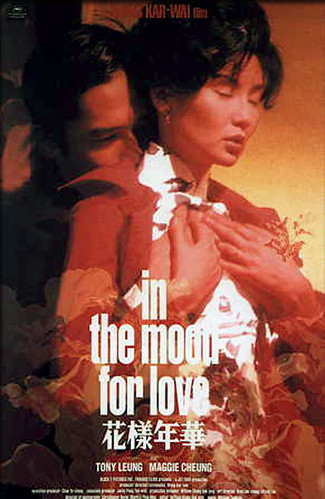
The screen belongs to its two stars, Maggie Cheung and Tony Leung. They are just about all that matters in "Mood," and they're more than able to carry it by a nuanced portrayal of reticent passion. (Here's a plot summary, if you're interested, though there's a loose, semi-improvisational feel to many scenes.) In spirit, though not technique, this is an old-fashioned and unashamedly romantic film that treats its characters' feelings in a grown-up way.

Cheung and Leung — both, apparently, big stars in Hong Kong — have the magnetism to lift a fairly ordinary story out of the ordinary, and their presence is augmented by visual radiance. (Whoever designed the seemingly dozens of gorgeous cheongsam dresses for Cheung is a true artiste.) Wong and his cinematographer, Christopher Doyle, occasionally fall into banality (they have another go at that dramatic-meeting-in-the-rain business), but more often than not their vision is fresh and pleasantly, not vulgarly, offbeat.

mood

"2046" is technically a sequel to "Mood." Tony Leung's character, Chow M0-Wan, a few years older, reappears there, and for someone who sees the first film second as I did, there are sudden flash-forwards. The door of Chow's hotel room in "Mood" is numbered … well, I don't have to tell you.

Right now a film student is probably writing a thesis on all the connections and variations in the two movies, but no big deal. If both are new to you it's probably better, but far from essential, to see them in the order they were made. "In the Mood for Love," albeit less boldly imaginative and darkly haunting than "2046," casts its own spell and will likely leave you eager for the wonders of its successor.