Friday, November 23, 2012

Meditation nation


In my house are many mansions, a teacher of mankind said; and in the Formerly United States are many nations.

All around you are subcultures you know not of. These subcultures, nations in their own right, might include your co-workers or the person ahead of you in the checkout line at the grocery or even your friends.

Shortly after moving to Tucson in the late '90s I took an unofficial (no credits toward anything worldly) course in some aspect of spiritual growth, I can't remember now what. The woman who taught it lived and taught in a mobile home in the center of the city. Tucson is like that.

I was curious to get her impressions of the city, as she'd lived there awhile and I was new to it. The part of her answer I recall went something like this: "You've got survivalists who are storing goods and ammunition for Armageddon, and you've got spiritual seekers who meditate and wouldn't go near a steak. And neither group has the slightest notion they're living next to the other." That's probably how it is in your neck of the woods also.

Okay, let's talk about the meditation nation.

It takes a lot of nerve to write anything about mediation. It's esoteric. Those who know don't speak, those who speak don't know and all that. It takes a lifetime or a carton of lifetimes to understand. You need a guru, an expert to lead you.

Well I'm no guru and no expert. I'll tell you what I know or think I know. My only qualification for saying anything about meditation is that I've been doing it more or less regularly for 25 years. Full disclosure: "more or less regularly" means once or more almost every week. Not every day. According to the Meditation Rulebook, I'm off the team.

So I defer with all due respect to the experts. Except I can't quite figure out who they are.

I've read about spiritual growth for 40 years. I've met mediation teachers, gurus even. And I'm still not sure who's an expert.

It's relatively easy to determine who knows where it's at concerning fields of study related to the physical world. Medical boards are probably pretty good deciding who in their specialty is up on the state of play. Likewise whoever administers rites of the legal profession. University departments can get a handle on who knows their subject and who has the proper politically correct opinions.

But in the realm of metaphysics, what is the test? By their fruits you shall know them, I guess, but how do you determine the fruits of the teachings of a speaker on the lecture platform or the author of a book?

First things first. Why meditate at all? It is said to be good for your health, that it will make you as calm as a cow, improve your mood and your thinking, etc. Some meditation teachers leave it at that. They belong to the "seduction" school -- attract students by offering practical rewards, in the belief that meditating will gradually lead to a desire for more spiritual ends. I think this violates truth-in-advertising standards.

The ultimate aim as far as I'm concerned is to discover new and higher levels of reality. Not just new realities -- if people have their wits about them, they encounter new realities every day -- new levels of reality. You can call these increasingly spiritual realms, but you don't have to call them anything. The experience, not the label, matters.

If you read 20 books on meditation, or sit at the feet of 20 teachers, you will be given approximately 20 different sets of instructions. You will go mad if you take them all as literal and absolute.

The closest to a common denominator in meditation branding is to concentrate on something, ignoring stray thoughts and feelings. Concentrate on what? You have a wide range of choices. A mantra. Your breathing. A Tibetan mandala. A Zen koan. The image of Jesus or another revered figure. The space between your eyes. One hand clapping. And so on, and on. Some teachers say particular words have spiritual resonance. A few naughty people suggest there's not a dime's difference what you concentrate on; you could recite a series from a random-number generator.

But you have to start somewhere. Probably the best choice is one that appeals to you. If repeating a Sanskrit phrase, however holy it may once have been to devotees in India, bores you stiff then it's not a good technique for you. (It may be ideal for someone else.) A serious meditation discipline is likely to take a lot of your time and psychic energy, so you might as well not handicap yourself with a "target" that puts you off.


There's a basic problem with concentration: you can't do it. Probably not for a long time, then only at odd moments.

Your mind -- the part of it you're acquainted with -- has almost no such experience. It's like learning any skill starting from a baseline of zero. And your lower or practical mind resists the discipline as if it's a cranky child. Before you know it, again and again, you're wandering off the object of concentration. (Some teachers make a big deal about a supposed difference between concentration and meditation. To me it's a verbal quibble not worth bothering about.)

Persist. 


What happens after that, I have no business in saying. It is unique to each person and at best almost impossible to describe. But let me mention a couple of tendencies that can hang you up, based on my own experience, that I believe almost any long-time meditator would acknowledge.

Concentration is more a matter of letting go than forcing anything. If you're working hard at it, struggling, pushing, making demands on yourself, actively resisting distractions, all that goes against the spirit of meditation. This is a gentle path.

Second, catch yourself when the urge strikes you (probably often) to monitor your "progress" while meditating. This is when you seem to be stepping outside your concentration and asking with your ordinary consciousness, "How'm I doing?" Thinking about meditating is not meditating.


My practice has convinced me that the key to meditating is aspiration. You have to really want to know your mind and reality better. Given the commitment involved, I wouldn't start on the journey because you think you ought to meditate. If your desire is sincere, you won't be held back by technical errors. (Moral lapses are something else.) Guides in the non-physical realms will see that you get any help you need.

Finally, don't believe a word I've written here -- at least, not because I've written it. Trust God. Trust yourself. Trust God in yourself. 

Monday, November 19, 2012

Wind in dry grass


This is not the end of Reflecting Light, only a metamorphosis.

When I de-accessioned political consciousness last February, it was sincere. If I have since backslid, it was because in the run-up to the recent election there seemed to be a miniature chance that at least Barack Obama could be ushered out of the flight deck, giving constitutionalists, traditionalists, and assorted reactionaries a little breathing space.

It seemed that anything I could do, even tossing electrons on a computer monitor, in aid of changing the direction of the U.S., should be done.


That temptation is finished. We are in deep waters indeed, two (or more) countries in the same geographical space. In a way it's even worse than 1860: then there was really only one issue, slavery and its extension into new states, that made us a house divided. Now we can't agree on basic principles, on what constitutes facts.

Suddenly the "s" word -- secession -- is being openly spoken. I've written several postings over at least five years suggesting that we need a constitutional amendment stating how legal and peaceful secession could take place. I'm inclined now to think that's a fantasy. For one thing, there's that geographical mash-up -- how finely can the secessionist impulse grind? States? Cities? Counties? Streets? Despite some general regional differences, people of opposite political ideologies are now often neighbors or family members.


Besides, to pass a constitutional amendment 38 states would need to ratify it. It would be asking three-quarters of the states to agree to a divorce. Impossible.

Nullification of federal overreach by individual states is slightly more realistic, but the president can order the National Guard or, I suppose if he's power-mad enough, the armed forces to crush a state.


But -- barring some circumstance I can't even imagine now -- I'm giving over political commentary on this blog, not because it's become useless (although for me it has) but because it has started to make me queasy. The U.S. political landscape is a bleached and ghastly void, a heart of darkness. It puts me in mind of T.S. Eliot's "The Hollow Men" (which of course was partly inspired by Conrad's "Heart of Darkness"):


We whisper together
    Are quiet and meaningless
    As wind in dry grass
    Or rats' feet over broken glass
    In our dry cellar
   
    Shape without form, shade without colour,
    Paralysed force, gesture without motion ...

So Reflecting Light takes on a new shape. But, I trust, it will have form, color, force, and motion.

Wednesday, November 14, 2012

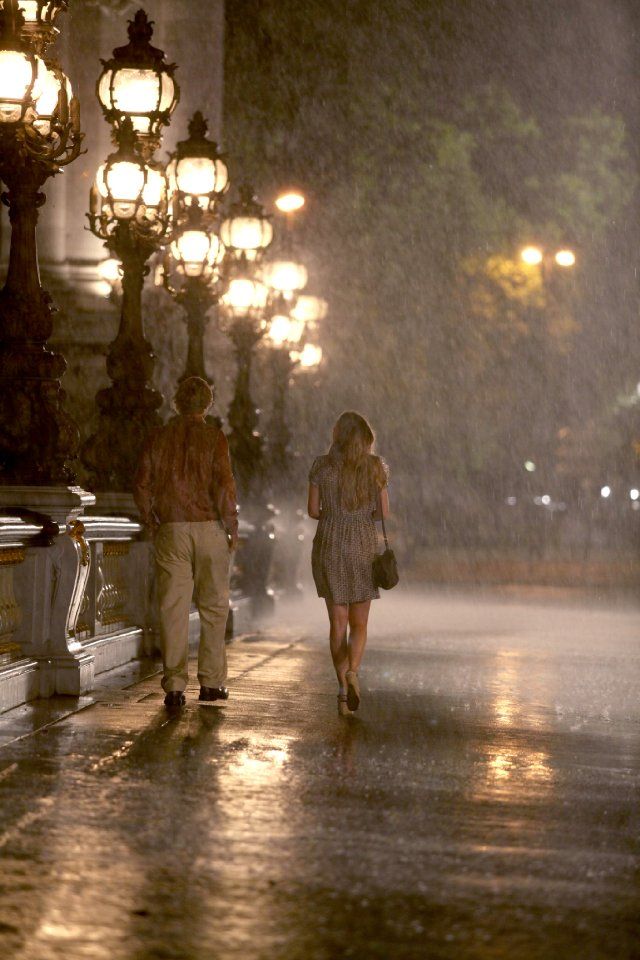
Midnight in Paris


It's midnight in the United States of America, and I only feel like writing about trivia just now. It's hard to get more trivial than Woody Allen's Midnight in Paris.

Why did I drop this gobbler in my Netflix queue? It got good reviews. Said to be romantic. Nostalgic. Cooked in Allen's brain, it would have at least a few good lines of dialogue, I figured. Wrong.

This is such a silly, ultra-"high concept" script that no producer would have taken a pitch meeting for it had anyone but Woody Allen put it on the table. He can recruit name actors and probably brings his films in on budget, and I suppose they almost all make money. 


You're to lose your heart to the City of Light, bask in the glamour of it all, and pat yourself on the back for recognizing famous literary and artistic characters from Paris's past while Allen sticks his Concept up your nose.


Concept: Goofy Hollywood screenwriter (Owen Wilson), engaged to crass socialite (Rachel McAdams), wants to prove he's a real artiste by writing a "serious" novel. On a trip to Paris with his fiancée and her stiff parents, screenwriter finds himself in time warp bouncing back to the '20s. With no trouble at all (and no suspicions from anyone about his 21st century clothing and occasional modern expressions), he's swanning about with Scott, Zelda, Cole, Pablo, Salvador, etc.


Psst, look, he's talking lit'ry matters with Ernest Hemingway, who could talk of these things and could write about love and death because he knew love and death, and to know those was to pay out a sentence straight and true like a fishing line with a great flounder at the end, so great that he had never seen such a flounder.

Hey, there's Gertrude Stein and Alice B. Toklas! Nudge-nudge, T.S. Eliot! Belmonte the Bool-Fighter who wrote poems in blood on the sand and was graceful under pressure! Few of these luminaries do or say much, but as noted, they are a form of cinematic name dropping so audiences can tell themselves how cultured they are.

The setting bounces back and forth like a tennis ball between past and present; fiancée and troglodyte parents get ever more obnoxious; screenwriter meets charming (present-day) antique gallery owner. Back in the '20s, he flirts with Picasso's (I think) abused mistress.


Not only has Picasso (I think) done her wrong, but she's nostalgic for Paris's Golden Age. The '20s, what a drag. She longs for the Belle Epoque, and through some further bit of time origami, she and the screenwriter travel back a further generation. They're in Maxim's, with can-can girls and Toulouse-Lautrec and Gauguin and Degas. But only for a brief stopover, and our poor Hollywood sap is back in today's Paris.

Well, not really. It's a fantasy too, cleaned up the better to swoon over. Other than a few graffiti here and there (surprising the film crew didn't paint them over), this is the Paris of TV perfume commercials. No veiled women, traffic jams, loud storefronts. You'd never dream the city is ringed with high-rise projects occupied by North African gangs, "no-go" areas even for the police and where the local sport is setting cars on fire.

To give Allen credit, he does have a talent for creating lovely images of vanished days. Even while you're conscious of the manipulative artifice and aware of the clichĂ©s (including the repetitive Django Reinhardt-ish riffs on the soundtrack), it's possible to captivated by the ambience, costumes, and some lovely ladies including the exquisite Marion Cotillard. 

But Allen won't even let us keep our innocent pleasure. In the end we're told by the wised-up screenwriter that all that Golden Age stuff is a crock. Every generation imagines a previous era to have been better, he says. He and Picasso's mistress (I think) were fooling themselves. We were suckers for letting Allen take us in with his nostalgic finery.


There's no point in commenting on the acting, since all anyone was asked to do was play a caricature. I'd never seen Owen Wilson before, probably because I never want to see the kind of movies he's starred in, and nothing he does here leaves me eager to re-make his acquaintance.


Saturday, November 10, 2012

Nothing to declare

I must ask the reader's indulgence if days go by before I imagine I might have something worth saying in this space.

This isn't "writer's block" (whatever that may be); more like existential dread, a hollowness inside. We have collectively entered terra incognita, sailed off the edge. Heere there bee monstyres.

Lawrence Auster chided me a little for writing that the republic is "torn and bleeding." No, he said
I disagree that it’s only torn and bleeding. In my view, it is gone and is not coming back (which I began saying a year ago). A country that accepts open homosexuality in the military, homosexual “marriage,” federal dictatorial control over health care insurance (e.g. the contraceptive mandate), a government that lawlessly topples a foreign government, kills its leader who was no threat to us, and replaces him by our mortal enemies, a government that appropriates the wealth of the orderly and productive part of the population in order to sustain and empower an alien and resentful population of parasites whose problems it blames on the orderly and productive; and, finally, a country in which a growing half of the population will never vote for a political party even half-heartedly opposing these things, is no longer the republic that was bequeathed to us by the founders.
Lawrence might be exactly right. Maybe I was doing exactly what I counseled against, taking refuge in denial, unwilling to recognize the snapping of the cord that, however frayed, seemed until last Tuesday to bind us to the vision of a constitutional republic with the national government's powers ring fenced.

I've read a lot of commentary by the Resistance in the past few days and see that many people have feelings similar to mine -- but that's a cold comfort. The impression is that lots of us are stunned, almost in the literal sense of that abused word. We have taken a knockout punch.


Again and again, commenters convey the shocked recognition of something worse than a disappointing election result. It's as if a disease that has ravished the world community for over a century, but to which we have been largely immune, has entered the household. The contagion of statism is in our national bloodstream. The country that believed fundamentally in the individual and voluntary associations of individuals has ceded the locus of control to Washington bosses.

New tactics for Resistance are already being discussed. Far be it from me to discourage anyone even further, but the first step is to fully admit to ourselves that the USA is now a country like most others, where government at every level -- federal, state, and local; executive, legislative, bureaucratic, and perhaps above all judicial -- tells us how to act, what to do, the limits to what we can say, even what we must buy (under Obamacare).


The old tactics no longer matter. Don't lose your time writing your congressman. Perhaps even demonstrations are meaningless.

What to do, then?

I don't know.

While I'm trying to get a grip, I remind myself that most people in this world live under governments of varying degrees of badness and life goes on. So it has been throughout history, and even during long bleak stretches of time, there have also been renaissances of the arts, sciences, and human achievement.

For me, there is consolation in remembering that politics, while inescapable, is not the alpha and omega of existence. The spiritual life can be -- has been -- practiced under the most difficult, even extreme, conditions. We are not here by accident, the mere product of material forces. As far as I'm concerned, we're here to lift our consciousness toward the ineffable perfection that our gross senses hide from us. Even when lost to ourselves, we are not lost to God.


Wednesday, November 07, 2012

Aftermath


Life after death has now been scientifically proven. When you die, you go to a polling place and vote for Obama.

Sorry, sometimes humor is therapeutic. Just my little joke -- it remains to be seen (or may never be known) how much of the vote counting was fraudulent. I don't doubt some was, but it probably didn't change the result.


So where are we now? We're going to have a lot to think and talk about and try to prepare for.

For me at least, it is not yet time to strategize. We must first absorb this loss, intellectually and emotionally.


We need to turn away the natural tendency to denial. American traditions, the Constitution, loyalty to any constituency beyond racial and ethnic tribes, the odds of soon rebuilding the economy, lost yesterday. Big time. This is what we have to come to terms with before anything else.


Don't look for silver linings; not to say there aren't any (although they sure are hard to spot at the moment), but right now the republic that was bequeathed to us by the greatest assembly of political philosophers in history is torn and bleeding. Deal with it.


Monday, November 05, 2012

Reward Barack Obama


The sun rises on good people and evil, rain falls on the just and the unjust. Surely we must look in our hearts for compassion toward even the present tenant of the White House.

I propose that Barack Obama be given the thanks of a grateful nation -- grateful that he will no longer guide the fortunes of wounded America.


Clearly the man does not enjoy the actual work of being president. The adulation of the mainstream media, certainly; the fantasy that he is central to a complete transformation of a country with a despicable history and a present tarnished by swamp dwellers clinging to their guns and religion; the rides on Air Force One; all the trappings of the office.
  
But the responsibility of having to make decisions with sometimes life-or-death consequences; of trying to understand how wealth is created -- as opposed to figuring out ways of siphoning it from those who have more to buy the votes of those who have less; of associating with different kinds of people, not just the Commies, Muslims, Chicago political crooks, and race-racketeers he's hung with since he was knee-high to a statue of Karl Marx; this he does not care for.


We should not insist that he carry on with such unsuitable labor.

A post-presidential career will be just the thing to restore his vanished joie de vivre. Nothing will distract him from his golf. He can enjoy his second, third, fourth, fifth homes in scenic locales. Deliver teleprompted banalities in cardboard temples, swan around with celebrities, enjoy his status as the second coming of Tutankhamun, enroll his horse in the Senate.


I, for one, am feeling generous toward ex-president Obama. He has earned his retirement benefits.