Sunday, June 02, 2013

No surrender to MP3 ... but a peace agreement


Yeah, yeah, okay.

Your blogger swore eternal enmity with compressed sound files. Quote: "... the worst invention of the new century, the Satan-inspired MP3/iPod system. It has nearly destroyed the appetite for quality. Ten out of 10 audiophiles agree that owning an iPod should be a crime. The iPod is a step backward in music reproduction, and its devotees are Cro-Magnons who should devolve as fast as possible into amoebas."

Nevertheless, the overwhelming majority of sound files available on the Web use the MP3 coding. Over time I encountered many downloadable recordings that I would have liked to listen to at a convenient time and place or, in some cases, burn to CD for keeping. Eventually I asked myself: was I being dogmatic? After all, I hadn't actually heard many MP3 files, and those were played on poor equipment.

So I began to explore the world of MP3 downloads. I needed to learn how to burn an MP3 file to a CD -- that's how ignorant I was. Before long I had to admit that MP3s played through a good sound system don't necessarily sound awful, and that there is a lot of worthwhile material available no other way.



Don't get me wrong: I am not a new convert more Catholic than the Pope. You won't catch me with wires running out of my ears to an iPod held in my lap. I don't have any funny MP3 playback gear like the ones you wear around your wrist like a watch. My listening is via my regular home sound system, or sometimes my car's CD player.

Lossy (compressed) software such as MP3 is less accurate than lossless software -- that's a fact of life. What we're talking about here is how much less accurate, and how much it matters in listening to various kinds of sources.

To keep things simple, let's categorize sources as speaking (not singing) voice, electronic music, and acoustic music.


Voice. Plenty of interviews, discussions, and dramatic readings can be downloaded ... mainly, I am sorry to say, from the dreaded BBC, particularly Radio 3 and Radio 4. The compression is not a problem; the sound of the voice may not be accurate, but in almost all cases, who cares? The only time it might make a scrap of difference is if you are hearing a John Gielgud, Laurence Olivier, or any other great actor whose nuances of speech are part of the performance.

Electronic music. This is a deliberately broad category that comprises rock, electronica, trance, anything that passes through an amplifier or tonal processor. The compressed files are less close to the original sound than with uncompressed files, but the difference is meaningless. I know what an unamplified violin or guitar sounds like, but an electric guitar (let alone a synthesizer) is capable of a Texas-sized range of auditory effects.

Here is where MP3 is most valuable. I've discovered a number of web sites with downloadable music (uncopyrighted or with a "creative commons" license), so it's perfectly legal to copy music from them. Particularly interesting is the live music archive of the Internet Archive. Apparently any musician(s) can put their stuff on this site, and you can listen to it in streaming format or save it to a compact disc, your hard drive, a flash drive, or any other storage medium.


Not surprisingly, a vast percentage of the performers and bands are unknown unknowns. I've listened to some, and most are decent but undistinguished, although I expect there is gold in them there hills if you are willing to expend the time to find it.

But a few "name" bands are represented. Naturally, the Grateful Dead (8,691 items, presumably all or most being complete concerts). Here is the modern equivalent of the cassette tapes Deadheads passed around to one another in the '80s, the main difference being that digital recordings can be reproduced any number of times without losing any fidelity, while cassette sound degenerated with each generation of copying.

I still have mixed feelings about the Grateful Dead, incidentally. When they were at the top of their game or anywhere near it (mostly in their earlier years), they were hypnotically captivating (and band members wrote some damn good songs). The Dead were about, among other things, improvisation -- then and now, rare among popular groups. They were a jazz ensemble wrapped up in a rock band.

But when their hearts weren't in it -- and let's face it, no matter how much they enjoyed playing, by their 6,000th concert some of the thrill had to be gone -- a certain sameness and playing by numbers crept in. Still, it's marvelous that their career is documented and available at this site.


Also represented are The New Riders of the Purple Sage (391 items), originally an offshoot of the Dead that took a turn toward country. And it seems they're still going strong, with concert recordings from as recently as 2009. None of the original members are in the band, but their replacement personnel are cracking fine musicians in their own right and sound a lot like the early New Riders without slavishly copying them.


Another useful site is NPR's Live in Concert series. Many of the "concerts" are only tasting menus of three or four songs, but some by well-known performers occupy an hour or more. The only drawbacks are (1) the between-numbers chatter from the stage and (2) the yelling, whooping, and loud obnoxious behavior of the audiences.

For lovers of the truly esoteric, there is last.fm, which seems to be based in the U.K. Their musical offerings are classified by descriptions such as "noise."


This posting is long enough for one go, an indication of what's out there for downloading -- and of course there are many sites I haven't mentioned. I'll save the final category, acoustic music on MP3, for the next entry.

Wednesday, May 29, 2013

Their hearts belong to Daddy


Game over.

Jim McTague had a piece recently in Barron's headed, "Why Obama's Scandals Won't Erode His Base."

Benghazi? IRS? Clandestine probes for leaks in the media's plumbing? Paste all that in your scrapbook and forget it. President for Life needn't miss a moment of partying. Not because his lovers' quarrel with the media will be patched up (although it will). Not because the citizenry has become so cynical that it can't be bothered (although it has). Not because the Stupid Party won't know how to make hay over PfL's embarrassments (although it won't). No, says McTague: it's because he has the "millennial" generation in his pocket.

McTague:
This so-called millennial generation, which includes whites, blacks, and Latinos, gave Obama the winning edge in 2008 and 2012. ...

Will the young voters tune out because of the scandals? Michael Hais and Morley Winograd, who have written three well-received books on the millennials and their impact on the Democratic Party, believe the scandals will have almost no effect on this generation. For one thing, the millennials do not share their parents' suspicions of big, intrusive government. Hais and Winograd say that the millennials see a role for the federal government to set down rules of behavior, like parents, for them to follow. 
But, but ... surely the 18-32 aged voters are at least a little uneasy about the woodworm gnawing the foundations of the Republic?
WHAT ABOUT THE JUSTICE Department's seizure of AP's phone records? Millennials don't appreciate the concept of a "fourth estate." They don't read newspapers. They glean their information from social media. ... Benghazi? They don't watch any television news, let alone Fox, which has been highlighting the topic. The IRS/Tea party story? They are pro taxes—that's why they voted for Obama. They are anti-GOP because the party stands in the way of the Obama agenda, which they supported. ...

Hais thinks the millennials have given Obama "an enormous grace period" because they are so turned off by the GOP intransigence on issues like immigration reform, gun control, taxes, gay marriage, and marijuana legalization.
You figure the Boomers now in positions of power are bad ju-ju? Wait till this lot takes its turn. They'll be dwelling in cardboard boxes -- those who don't find themselves a sinecure in Washington -- but they'll still be living up to their name. The Millennium, the Promised Land, the "Green" Time will have arrived: open borders, gun confiscation, big taxes on everything including other taxes. But they can blow pot smoke out of their ears and congratulate themselves (which they've practiced ever since they listened to self-esteem tapes while in the womb) that they made the world safe for gay marriage.

Friday, May 24, 2013

Winston's Britain inside out


We shall sell out our island, what ever the cost may be. We shall surrender at the ports, we shall surrender on the airplane landing grounds, we shall surrender in the fields and especially in the streets we are handing over to the barbarians, we shall surrender in the hills; we shall never think of victory.

-- Churchill Winston, Subprime Minister,
United Kingdom 2013

" 'At geezer, 'e 'ad it comin' like,
dis'spectin' the Religion of Peace, y'know mate?"

What a pathetic, neutered, self-defeating bunch of weenies the Brits are. I see no hope for them in our lifetimes to stand up as men and women. 

It's become such a tired and boring ritual I can hardly pay attention anymore. Exotic "youths" deliberately imported by the ruling powers in aid of population replacement, so they can have a large permanent class dependent on them, commit some new outrage. The bigfoot politicians talk tough. They declare -- you better believe it -- violence is not acceptable. White Brits are the scum of the earth, we know our great grandfathers were colonialists, but really this is a bit much.

 They may have meat cleavers,
but we have the Royal Chelsea Flower Show.

Of course nobody believes the script. The pin-striped pooh-bahs will accept the next outrage and the next, because they understand they have no choice if they don't want war in the streets. Their docile subjects know their lines: We mustn't let a few extremists destroy the smoothly functioning diversity of cool Britannia. Don't forget the Brothers Kray, white gangsters!

The media stand ever ready with their moral equivalence act. Take this chap Dan Hodges, in the  Telegraph, which passes for a conservative paper in the U.K.
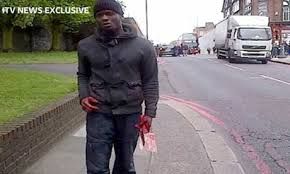
Yesterday the Ministry of Defence released a statement announcing that the soldier killed in Wednesday’s attack in Woolwich was 25-year-old Drummer Lee Rigby of the Royal Regiment of Fusiliers. It was an important moment. Lee Rigby was no longer the Unknown Soldier. Nor was he merely a discarded body lying in the middle of a south London street. He was a father, husband and son. The process of remembering him – and forgetting those who had ended his life – could begin.

That’s for those of us who want to. Yesterday, the Prime Minister made a powerful address in which he called for the nation to stand united and defiant in the face of this act of terror. But we would be kidding ourselves if we think we have responded to the events of this week as one.
This morning's Guardian carries a piece by its senior columnist Sir Simon Jenkins, in which it describes the reaction to Drummer Rigby’s murder as a form of “mass hysteria” that “only aids terrorists”. 
Sounds like Hodges is still hauling a backbone around. But not so fast. His column is actually a weaselstrike.
The reaction of much of the liberal establishment to the murder of Lee Rigby has reminded me of the reaction of much of the Right to the murder of Stephen Lawrence. There were the ritualistic words of condemnation: “This is a terrible crime”, immediately followed by the same attempts at contextualisation and minimalisation. “Murders like this happen all the time … They are a sad part of modern life.”

If you look at the campaign for justice for Stephen Lawrence that grew up after his death, the parallels become even more stark. People were “overreacting”, we were told. The whole affair was becoming a “circus” or even “an industry”. Some claimed that by focusing on the racial aspect of the crime, we were in danger of actually heightening racial tensions and exacerbating the problem.
See, in the U.K., if you utter a peep against the Cultural Marxist Establishment, you'd better follow it up with a swipe at "the Right" if you know what's good for your career. Or as our Mr. Hodges puts it, "People are correct to caution against an overreaction at times like this. But we should be just as wary of underreacting." Thank you for your insight, son. I won't overreact, but I won't underreact either. A tasteful tear or two, a memorial card, that should hit the spot. 

Stop Muslim immigration? Perish the thought!

 "We'll have less of this carry-on
or I'll slap my bouquet on your arse."

Other commentary in the Telegraph telegraphs the same message, and it ain't V for Victory. 

Alan Johnson: "We need to talk about Islamism." I am so flipping weary of this "We need to talk about ... " twaddle. No, Alan you ponce, your people are being knifed to death in the streets to the strains of Allahu Akbar, and you want to discuss political philosophy? The time is right to do something, you penny-a-liner journo.

But if talking is your thing, forget talking about Islamism. Nobody has a felt need to talk about Christianityism or Judaismism or Buddhismism. Islam is a special case. Mr. Johnson again: "Woolwich made plain that the fear and the violence and the grieving that has spilled over from what the Muslim political scientist Bassam Tibi calls 'Islam's predicament with modernity' are now also ours to bear, and they will borne also by our children and our grandchildren." In other words, get used to it.

Other headlines in the dhimmi Telegraph: "The West is fighting on behalf of ordinary Muslims -- and winning"; "The Muslim faith does not turn men to terror"; "Woolwich was a case study in the banality -- and idiocy -- of evil: There is no logic to be found in attacks like these." I'm sure that's a great comfort to the victim's family. Having his head cut off was illogical. 

No comments are allowed on the opinion pieces cited above.
Telegraph Wonder Women columnists Laura Perrins, Cathy Newman, Beverley Turner and Anna White – all mothers to children of varying ages – explain how they are talking (or not) to their young boys and girls about the Woolwich attack.
Wonder Woman Beverley Turner explains to her sprogs: "It seems that the men may have 'used' terrorism as an excuse to carry out a random act of violence. They probably weren't thinking about the hurt they would cause in the way that you, me and most of the people on the planet would. Something like this is very rare, very unusual and would have been very upsetting for all the people who watched the attack."

Could be. Might have ruined their whole day.

Tuesday, May 21, 2013

"The Most-Corrupt Administration Ever?"


I no longer write political commentary for this blog. Can't keep the pace -- one posting isn't dry on the page before a new, improved scandal clamors for attention. 

Furthermore I want to live out my remaining lifespan in something vaguely resembling domestic tranquility during which I can indulge in spiritual meditation and contemplation of the arts. "Tea Party"-like observations in this reign of Buraq H. Obama could work against my aim. I do not want my sleep disturbed by middle-of-the-night callers from our federal protective services; it could make me grumpy. I do not want the IRS demanding an account of the who, what, when, where, how and why of my every day for the last seven years.

Therefore I quote without comment a posting from Karl Denninger in The Market Ticker. I do not say I agree with it. You should compare it with an objective news source run by professional journalists with their code of ethics -- say, the New York Times or the Washington Post. I'm channeling Denninger to show how far these blogger types will go. You have been warned. 

He asks -- mark you, he's only asking -- "The Most-Corrupt Administration Ever?" (I object to the hyphen between "Most" and "Corrupt" on stylistic grounds, which in itself goes far toward undercutting the blogger's argument.) Denninger says:
Let's see how I do with the list.
  • Fast And Furious (guns for drug lords, resulting in murder of Americans and Mexicans

  • Robosigning (over 100,000 perjured affidavits filed in court cases)
     
  • IRS Tea Party and other group and individual abuse in direct violation of the law (politically-based harassment and now apparently-perjured testimony before Congress 

  • Money Laundering for terrorists and drug lords (by multiple large banks) 

  • Intentional and unlawful destruction of property rights (GM bondholders screwed for political cronies in the UAW

  • Intentional and unlawful destruction of your saved wealth (QE, QE2, QE3, QEinfinity, $1 trillion+ deficits, etc; Treasury and Federal Reserve actions 

  • Benghazi (apparent illegal arming of terrorists, then an attempt to reverse that leading to the attack on our CIA outpost and what appears to be intentional indifference and orders to stand down during the attack that had to come from the White House despite ability to respond; this amounts to conspiracy with the terrorists to kill Chris Stevens and the others who died.)
     
  • Swindles by the billions in countless schemes during the 2000s related to securitizations and other hinky deals (where despite black letter legal requirements for actual endorsement and delivery of documents banks simply did not comply and now argue there should be no penalty for not having done so, and that these defects are "mere procedural errors" despite intent to not comply.)  The result is that our land title system no longer has any resemblance of integrity. 

  • Intentional destruction of anything approaching a "free market" for health care going back 30+ years and now compounded through active conspiracy by Obama and all of the political parties to grant, protect and enforce through government monopolies and cost-shifting resulting in cost escalations of 500-1,000% or even more against market prices and now, with Obamacare, abuse of the IRS tax power to force another 100% or more increase in those expenses down your throat for the express purpose of enrichment of those in the medical industry.
I'm sure I've missed a bunch, but this is a good start.
Denninger follows with a number of wicked thoughts, including this:
... Your right to life only exists so long as you are willing and able to defend it. 
The same bottom line exists for liberty and the offense against it that is delineated in most of the above list; you have such a right only so long as you are willing to defend it.  The minute you cede that right you have consented to what you are experiencing and you lose the right to bitch about it until and unless you stand and take back that which God gave you.
Remember that Reflecting Light is now above the battle when it comes to politics. I am merely quoting. I'm sure even Denninger, when he calms down, will regret his intemperate language, such as "stand and take back that which God gave you."

Thursday, May 16, 2013

The Pre-Raphaelite Neighborhood


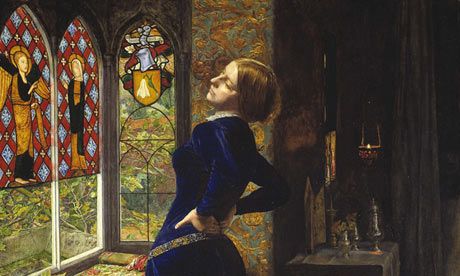
John Everett Millais, Mariana in the Moated Grange  

In the Capitol a few blocks away, the kettle was steaming over the latest revelations of the accelerating coup d’état that is turning U.S. citizens into a population under siege. Within the calm precincts of the National Gallery of Art, a special exhibit on the Pre-Raphaelite Brotherhood, so-called, was on display. If you are near Washington and want to see it, you'd better get there fast, because it closes after this weekend.

The Pre-Raphaelites represented a mid-19th century painting and crafts movement that aimed to reverse what it saw as the decadence and squalor of newly industrialized Britain. It was both openly reactionary and revolutionary, with an odd combination of ideals. It looked backward to an idealized Middle Ages, much as writers such as Tennyson and Scott were doing, when knighthood and romanticism were (they believed) in flower. But in painting technique, despite a theoretical reverence for antecedent styles -- hence the name Pre-Raphaelites -- they favored a sharply detailed and glowing palette that often resembled a fantastical, photography-like realism.


The main figures -- John Everett Millais, Dante Gabriel Rosetti, William Holman Hunt, William Morris, and Edward Burne-Jones, plus several less-known but talented colleagues -- were really more of a neighborhood than a brotherhood. Aside from their dazzling abilities in conveying the tones and textures of the visual world (which this exhibition breathtakingly exemplifies), they had individual styles. One of the many reasons I'm glad to have seen this show is that for the first time I felt that I "got" their differences.

Edward Burne-Jones, 
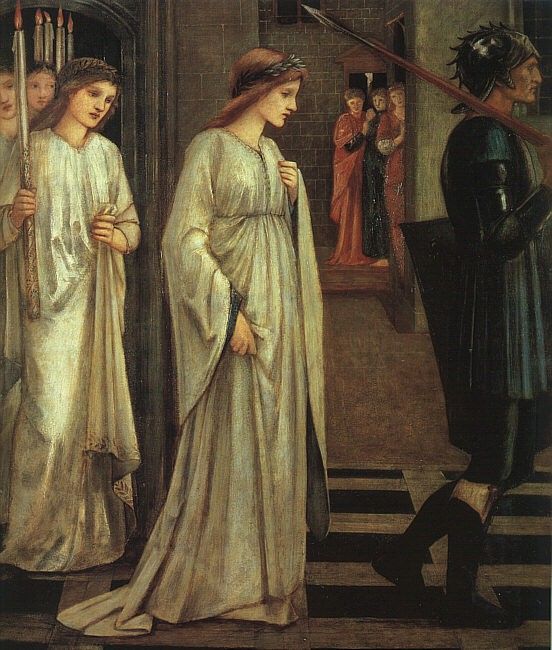
The Princess Sabra Led to the Dragon

I think Burne-Jones in his paintings of women came closest to the sweet purity of Renaissance greats like Leonardo, Botticelli, and Pinturicchio. 

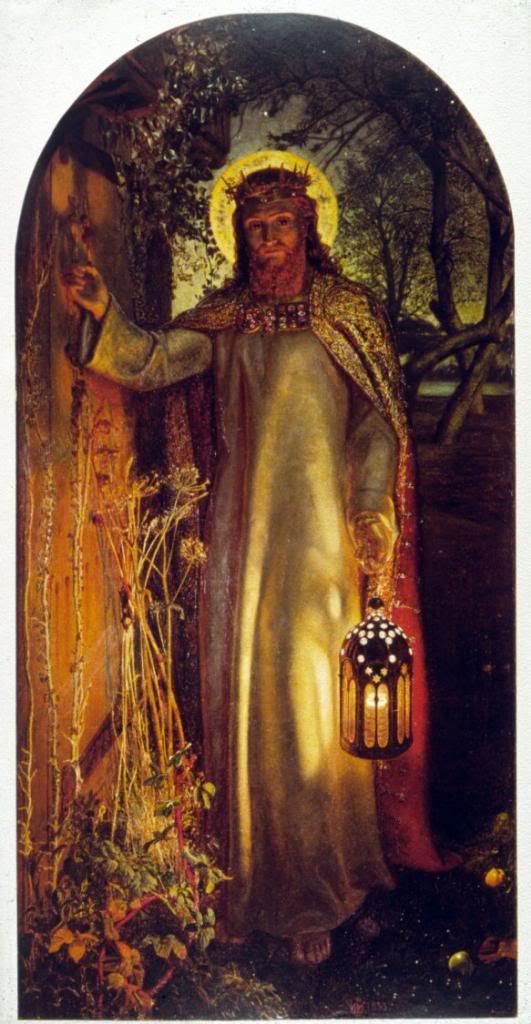
William Holman Hunt upheld the same high standards of technical virtuosity as his "brothers," but his earnest religious leanings and hopes of reforming his viewers make some of his pictures cloying. His picture of Jesus, Light of the World (below), is strikingly visualized and gloriously colored, a real traffic stopper in the gallery's display. It was so popular in his time that he made three versions of it and engravings based on it hung on the walls of Christian churches throughout the British Empire and probably in the United States. For all its spectacular hues, though, there is no touch of mystery, no echoes of unseen transcendent reality. Inner life is missing.
Rossetti was not only a painter but a poet and, well, a "character." In his later work he developed a kind of obsession with a certain female face, based on his model Jane Morris (wife of William and, perhaps, Rossetti's mistress). Canvas after canvas portrays the image: puffy Cupid's-bow lips, prominent chin, billowing hair. Compelling and sometimes lovely, but it became a personal cliché.


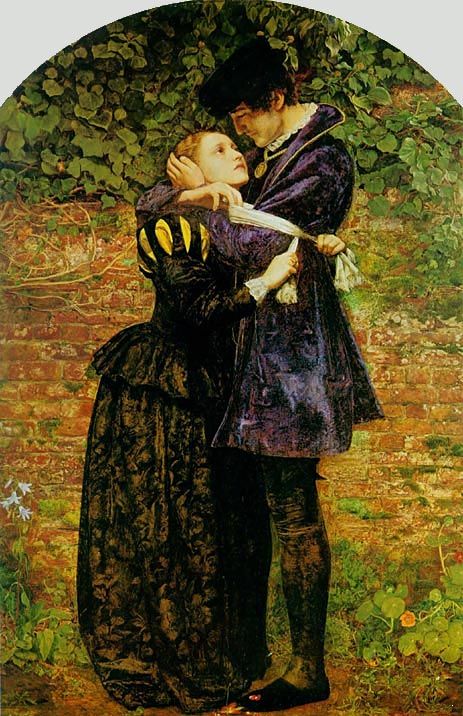
I found myself returning to Millais's paintings. They are not daydreams of a cleaned-up Middle Ages or mere pictorialism -- he melded intense beauty with psychological insight. I won't bother to include his famous Ophelia which everyone interested in art has seen reproduced many times (but the photos don't do justice to the rich colors of the original). For an example of his ability to capture a moment of intimate drama, see A Huguenot on St. Bartholemew's Day. 

It's an imaginary (presumably) incident from a real and appalling historical event: the St. Bartholemew's Day massacre in France, 1572, when thousands of Huguenots (Protestants) were murdered at the instigation of the Queen Mother, Catherine de' Medici. In the painting, the young woman is tying a white band, a false-flag symbol of Catholicism, around the her lover's arm in the hope he'll be spared. In a single gesture, he embraces her and tugs off the cloth, choosing death over renunciation of his faith. Without hyperbole or melodrama, it's an immensely touching glimpse of love, human and spiritual, and the wrenching choice tyranny has forced between them.


The Pre-Raphaelites were superb illustrators who often got carried away by their aesthetic ideologies; sometimes, they were far more than that.

Saturday, May 11, 2013

The borderline personality disorder of Jim Rogers


Anybody who follows financial and investment news knows who Jim Rogers is. Rogers is a regular guest on CNBC, and is often quoted or interviewed in the financial media, including blogs, especially those of an alternative or libertarian character.

I won't say he is a publicity hound, but Rogers just naturally seems to slide into a media role. With his usual bow tie and southern accent (his origins are in Alabama), he's instantly recognizable. With apologies to him, he always puts me in mind of Truman Capote. But Capote wrote a lot better.


We can't hold that against him, since Rogers's métier is making money. He built up a considerable fortune in trading (including short selling -- he was once George Soros's partner). He talked up commodities as the seeds of future wealth. I read his book Hot Commodities a few years ago and got the religion. Or would have, if I'd possessed the wherewithal to splash out on commodities in a big way.

Now I'm more glad than not I didn't. Back then materials, agricultural products, and all that were truly "hot." Crooks were breaking into offices and warehouses not to steal money or equipment but to nick copper wire, it fetched such a handsome price. A lot easier than cracking safes, I'd imagine, and what police detective would have the smallest idea how to trace missing copper wire?


Nowadays commodities are the plague pit of the investment world, and I see on Amazon.com you can avail yourself of a used copy of his book for US$0.01, plus 399 times that much for shipping and handling. Will commodities make a comeback? Of course -- everything that's traded makes more comebacks than Judy Garland. Probably not tomorrow morning, though. (I asked a professional commodities trader I know what he thought of Rogers's strategy. His reply: "About 15 years too late.")

Rogers has a new hand to play: he is part of what you might call the "alt-investment" movement, which warns of a coming economic debacle because of irresponsible money printing and the short-sighted ignorance of politicians and Federal Reserve. He belongs to the same club as Peter Schiff, Marc Faber, Gerald Celente, Ron Paul, Max Keiser, and his sometime buddy George Soros.


When I ran across his latest book, Street Smarts, at the library I was interested enough to check it out. Street Smarts is a sort of autobiography laced with financial commentary. Parts of it are fun. He slams the U.S. economic Establishment mercilessly:
Hank Paulson was the secretary of the Treasury when, in 2008, after the subprime crisis hit, all the bankers in New York started ringing his phone off the hook, screaming that the world was coming to an end. ... [President Bush told Paulson], 'Do what you have to do,' ceding responsibility for doing what was best for the country to the man who two years earlier had been the CEO of Goldman Sachs, one of the banks that was on hold back in Paulson's office.

In eight years as chief executive officer, it was Paulson who had presided over the feeding frenzy in which a ravenous Goldman Sachs had gorged on subprime mortgages, the same junk paper that was now impossible to pawn off and on which his colleagues at the firm were presently choking. ...

Paulson could count on the concurrence of Bernanke, the know-nothing who was instrumental in creating the catastrophe, and that of Timothy Geithner, president of the New York Fed, the institution charged with supervising the banking system that had just gone south, and obviously a man who knew even less than Bernanke. ...Geithner, rewarded for his ineptitude, was named to replace [Paulson] as Treasury secretary, pressed upon the incoming Obama administration by the New York banking community, which appreciated Geithner as the simple, little wimp sitting at the New York Fed who did whatever they asked. He was just the lackey they needed in Washington, the pushover who could be trusted to protect them when they told him the sky was falling.
I lost my respect for Jim Rogers in chapter 11, "Nations of Immigrants." Rogers has taken motorcycle trips around the world, documented in his books and on public television. He moved with his family to Singapore and has probably traveled to most of the world's countries. So it may be asking too much of him to harbor any quaint patriotic attachments. It would be reasonable, though, to expect him to show some responsibility toward those non-millionaires who, unlike him, must bear the consequences of his zest for open borders.

For Rogers, there can be no rational, principle-based case against allowing the Third World to colonize the United States (or any other country). It's just "intolerance." His description of people who believe other than he does is such a childish caricature that he debases himself in the process:
... Outsiders make for convenient scapegoats. When people are looking for people to blame, they blame the foreigners first. Their language is different, their religion is different, their skin is different, their food is different, their food smells bad -- they smell bad.
And:
America's greatest prosperity came before immigration laws were instituted. They were spawned in the 1920s, out of fear and monumental ignorance, at the instigation of the Ku Klux Klan, with a prejudice against all immigrants: Italians, Catholics, Jews, anyone remotely different. Before that our borders were open. As were borders all over the world. Marco Polo did not have a passport. Nor did Christopher Columbus.
This is so idiotic it's hardly worth replying to. But for the record, the U.S. was pretty damn prosperous in the late '40s through early '60s, when immigration was at a virtual standstill. The Ku Klux Klan did not rule the country and make its laws. So Marco Polo in the 13th century didn't have a passport -- touché! What a devastating argument for mass colonization by people who have nothing in common with the indigenous people. Christopher Columbus "immigrated" to America so he could settle down, do the jobs Americans wouldn't do (building wigwams, fletching arrows) and send most of his paycheck back to Ferdinand and Isabella in Spain.


Rogers belongs to that all-too-common species who by virtue (or vice) of their riches can insulate themselves from the costs of colonization. It's only the poor people, the little nobodies Rogers can't be bothered to think about, who have to live in crime-ridden cities surrounded by the opportunists of five continents, most of whom have no qualms about sponging off our welfare system. 

Jim Rogers is a homo economicus. Even were he right about the alleged contribution of mass immigration to prosperity (but he isn't), he doesn't know or care about human values, only monetary ones. Count your wealth, Jim. You have your reward.