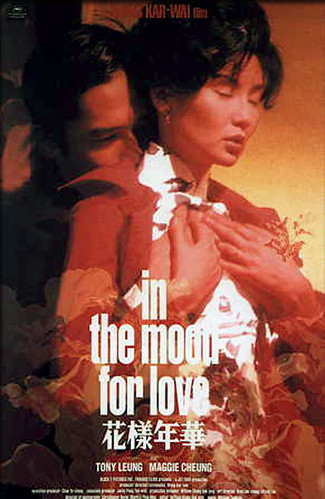
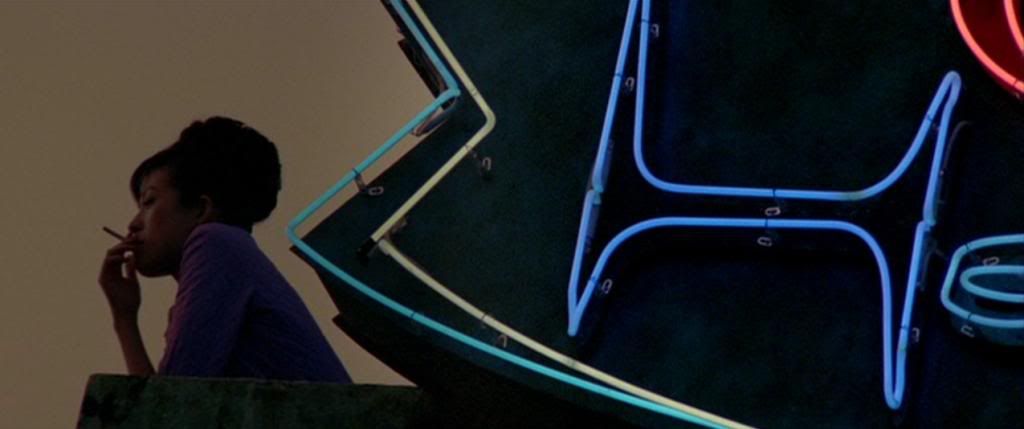
A little while back, dazzled by Wong Kar-Wai's "2046," I suggested it might be "the first great film of the millennium." Now I've caught up with one of Wong's earlier films, "In the Mood for Love," made about four years earlier than "2046."
The camerawork for "In the Mood for Love" again uses a rich color palette in an odd, but striking, counterpoint to the rather sad and minor-key story. (The English title, which suggests a frivolous comedy, runs counter to the film's style — a poor translation, maybe?) There's nothing here like "2046's" science fiction inserts and time slips; although a period piece, taking place in Hong Kong in 1962 (quite interesting to see how things looked there and then), it moves forward with a stately gravity in conventional time sequence.
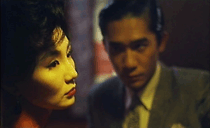
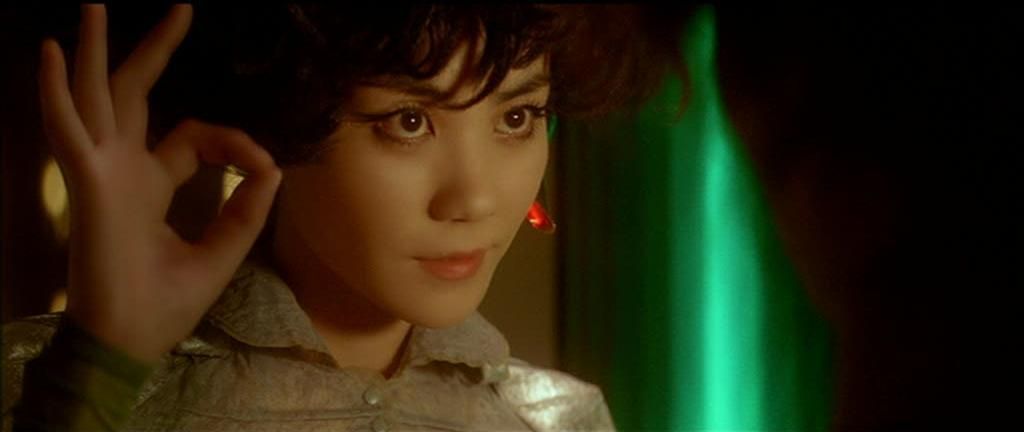
The screen belongs to its two stars, Maggie Cheung and Tony Leung. They are just about all that matters in "Mood," and they're more than able to carry it by a nuanced portrayal of reticent passion. (Here's a plot summary, if you're interested, though there's a loose, semi-improvisational feel to many scenes.) In spirit, though not technique, this is an old-fashioned and unashamedly romantic film that treats its characters' feelings in a grown-up way.
Cheung and Leung — both, apparently, big stars in Hong Kong — have the magnetism to lift a fairly ordinary story out of the ordinary, and their presence is augmented by visual radiance. (Whoever designed the seemingly dozens of gorgeous cheongsam dresses for Cheung is a true artiste.) Wong and his cinematographer, Christopher Doyle, occasionally fall into banality (they have another go at that dramatic-meeting-in-the-rain business), but more often than not their vision is fresh and pleasantly, not vulgarly, offbeat.
"2046" is technically a sequel to "Mood." Tony Leung's character, Chow M0-Wan, a few years older, reappears there, and for someone who sees the first film second as I did, there are sudden flash-forwards. The door of Chow's hotel room in "Mood" is numbered … well, I don't have to tell you.
Right now a film student is probably writing a thesis on all the connections and variations in the two movies, but no big deal. If both are new to you it's probably better, but far from essential, to see them in the order they were made. "In the Mood for Love," albeit less boldly imaginative and darkly haunting than "2046," casts its own spell and will likely leave you eager for the wonders of its successor.
Showing posts sorted by relevance for query In the mood for Love. Sort by date Show all posts
Tuesday, July 18, 2006
Sunday, January 07, 2007
Acting our age
It can easily be argued that greatness in the fine arts has come and, mostly, gone. Really: would you claim that anything being done today in sculpture rivals ancient Greece or the Renaissance? That today's "classical" music is on a par with that of the 18th and 19th centuries? That hip-hop rivals songs by Irving Berlin, Cole Porter, or Harold Arlen? That contemporary painting -- well, you get the idea.
It occurred to me -- not for the first time -- while watching a couple of movies on DVD last week that the only art form that, as a whole (not just in a few individual examples), is experiencing a genuine, 24-karat Golden Age now is film acting.
The reason for it is a mystery to me. Better acting schools? Better film directors? More demanding audiences? (Nah, not that.) I first began to notice a significant improvement during my last stint as a paid film reviewer in 1990. It wasn't a matter of a few big stars, like in previous eras. (Anyway, most of the stars of, say, the '30s and '40s just had strong personalities they could project on screen, which isn't the same as acting. There were a handful of exceptions, mostly English stage players, but most of the so-called acting in movies until recently was either dull or scenery-chewing obviousness.) More and more, I began to notice extremely professional work, in lead roles, supporting roles, even in bit parts.
Admittedly, now that I no longer watch movies and write about them as a journalist, I'm pretty selective about what I choose to see. Still, even in the mediocre films or downright turkeys that I inadvertently let myself in for from time to time, there are almost always one or more performances that leave me thinking, "Gee, too bad he (she) didn't have a better script to work with."
But lordy, what performances by the five leads, with the young Maggie Cheung first among equals. They are totally in character all the time, in synch with one another, no excess gestures or blank spots.
Where did such virtuosity spring from? I don't think that China has any tradition of naturalistic, Western-style acting. It's as though it just emerged, ex nihilo. No doubt the potential was there all the time, but it needed the right combination of circumstances, whatever those were. One reason is easy to guess: Wong Kar-Wai is a thumping good actor's director.
In the French film "Gabrielle," Jean Hervey (Pascal Greggory) introduces himself to us via a voice-over in which he self-satisfiedly glides over the past 10 years of his life: how he met his wife Gabrielle (Isabelle Huppert), decided she would be the perfect accompanist for his rise in the haute bourgeoisie -- the house has about eight maidservants -- his knack for making money, and how their dinner parties now attract the well-to-do plus some artistic types for a little spice. He arrives at their antique-laden home unexpectedly early to find a letter from Gabrielle informing him that she is leaving him to be with another man. While Jean is digesting that shock, his carefully constructed world having been torn asunder, he receives another: Gabrielle returns. She couldn't go through with it. Most of the rest of the film, based on a Joseph Conrad story, is virtually a two-hander as Jean and Gabrielle grapple with their emotional upheavals individually and together.
"Gabrielle" annoyed me straightaway. The setting, to judge by the clothing, hair, and décor styles, is Paris just before the Great War -- about 1912. But as Jean walks home from the train station delivering his smug monologue, there are two shots with automobiles dating from the late 1920s. I hate such anachronisms in period pieces. Although this was a comparatively big budget film (Isabelle Huppert doesn't exactly make minimum wage, and the thing was shot in a widescreen 2.35-to-1 aspect ratio), it's possible the production designer couldn't obtain cars of the correct vintage. In that case, though, why not just use carriages instead? There were plenty of them still on the streets, even in ritzy Paris, at the time.
The director, Patrice Chéreau, plays other silly tricks. The film switches from color to black-and-white periodically, for no discernible reason. He puts continuity information (e.g., "Le lendemain," the next day) in huge superimposed lettering, or sometimes in white type on a black background, as in a silent film. Although Chéreau has made quite a few films before, he still apparently doesn't have the confidence to do without arty gimmicks.
It's too bad, because when he does play it straight -- and, in fairness, that's most of the time -- he knows how to squeeze the maximum juice out of a scene. For one example: Gabrielle is being tended to by one of her maids, Yvonne, but is still so shaken up by her own behavior that she feels a need to reveal some of her feelings to the maid. What follows is a little masterpiece of psychological observation: Gabrielle talks to Yvonne as to another human being; then, as if she remembers their relative social positions and is ashamed at opening up to a servant, turns insolent; then, unable to help herself, asks Yvonne personal questions; again becomes haughty toward Yvonne because of her own breach of the social code. Meanwhile, Yvonne's responses are equally uncertain, from the reverse perspective, not sure how to handle such confidences from her employer.
Mostly, though, "Gabrielle" is about Jean and Gabrielle, each trying to work out what this rupture of their habitual life means to them. They wheel from anger to shame to regret and, in Jean's case, to something like pleading. And while their shifting moods aren't always different from one another's, they don't match at the same time. I don't know how much of the script comes from Conrad's story, but some of it feels bracingly authentic. Both of these characters are, in their own ways, fools for love, but neither understands how to handle love.
French films can be too subtle for their own good, especially when they consist largely of cold, intellectual dialogue. In "Gabrielle," though, the subtlety mostly pays off, because the two leading actors let you know what they're trying to say, even when they can't. And the film respects their ambivalence. It isn't a simple-minded sermon about how repressed these people are and how they'd be sorted out if only they'd learn to express their feeeeelings. Part of the reason you empathize with Jean and Gabrielle is that they continue to honor self-control and dignity, even in the breach.
Greggory is persuasive as Jean, but it's Huppert you'll remember. I must have seen her in a couple of dozen films, but she has never acted better, or been more beautiful -- although she must be well into her 50s -- than here. She delivers a performance of astonishing insight, variety, and depth. Watching her in "Gabrielle" can sometimes tear you up. I mean that, of course, as a great compliment.
It occurred to me -- not for the first time -- while watching a couple of movies on DVD last week that the only art form that, as a whole (not just in a few individual examples), is experiencing a genuine, 24-karat Golden Age now is film acting.
The reason for it is a mystery to me. Better acting schools? Better film directors? More demanding audiences? (Nah, not that.) I first began to notice a significant improvement during my last stint as a paid film reviewer in 1990. It wasn't a matter of a few big stars, like in previous eras. (Anyway, most of the stars of, say, the '30s and '40s just had strong personalities they could project on screen, which isn't the same as acting. There were a handful of exceptions, mostly English stage players, but most of the so-called acting in movies until recently was either dull or scenery-chewing obviousness.) More and more, I began to notice extremely professional work, in lead roles, supporting roles, even in bit parts.
Admittedly, now that I no longer watch movies and write about them as a journalist, I'm pretty selective about what I choose to see. Still, even in the mediocre films or downright turkeys that I inadvertently let myself in for from time to time, there are almost always one or more performances that leave me thinking, "Gee, too bad he (she) didn't have a better script to work with."
Maggie Cheung in "Days of Being Wild"
Wong Kar-Wai's "Days of Being Wild" was the first of my cinematic adventures last week. I've been seeing Wong's movies in reverse chronological order, having first encountered this director's work in his brilliant "2046." Later I caught up with the earlier "In the Mood for Love," and found it, too, exceptional, if not as stylistically and thematically powerful as "2046."
"Days of Being Wild" is from earlier still (1991). An accomplished piece of work, with (once again) the benefit of Christopher Doyle's seductive cinematography, it's nevertheless more conventional than "2046" or "Mood," a love pentangle that's only a step or two above soap opera. (I'm also getting a little tired of Wong's Old Hollywood cliché of dramatizing scenes by shooting them in buckets of rain.)
But lordy, what performances by the five leads, with the young Maggie Cheung first among equals. They are totally in character all the time, in synch with one another, no excess gestures or blank spots.
Where did such virtuosity spring from? I don't think that China has any tradition of naturalistic, Western-style acting. It's as though it just emerged, ex nihilo. No doubt the potential was there all the time, but it needed the right combination of circumstances, whatever those were. One reason is easy to guess: Wong Kar-Wai is a thumping good actor's director.
In the French film "Gabrielle," Jean Hervey (Pascal Greggory) introduces himself to us via a voice-over in which he self-satisfiedly glides over the past 10 years of his life: how he met his wife Gabrielle (Isabelle Huppert), decided she would be the perfect accompanist for his rise in the haute bourgeoisie -- the house has about eight maidservants -- his knack for making money, and how their dinner parties now attract the well-to-do plus some artistic types for a little spice. He arrives at their antique-laden home unexpectedly early to find a letter from Gabrielle informing him that she is leaving him to be with another man. While Jean is digesting that shock, his carefully constructed world having been torn asunder, he receives another: Gabrielle returns. She couldn't go through with it. Most of the rest of the film, based on a Joseph Conrad story, is virtually a two-hander as Jean and Gabrielle grapple with their emotional upheavals individually and together.
"Gabrielle" annoyed me straightaway. The setting, to judge by the clothing, hair, and décor styles, is Paris just before the Great War -- about 1912. But as Jean walks home from the train station delivering his smug monologue, there are two shots with automobiles dating from the late 1920s. I hate such anachronisms in period pieces. Although this was a comparatively big budget film (Isabelle Huppert doesn't exactly make minimum wage, and the thing was shot in a widescreen 2.35-to-1 aspect ratio), it's possible the production designer couldn't obtain cars of the correct vintage. In that case, though, why not just use carriages instead? There were plenty of them still on the streets, even in ritzy Paris, at the time.
The director, Patrice Chéreau, plays other silly tricks. The film switches from color to black-and-white periodically, for no discernible reason. He puts continuity information (e.g., "Le lendemain," the next day) in huge superimposed lettering, or sometimes in white type on a black background, as in a silent film. Although Chéreau has made quite a few films before, he still apparently doesn't have the confidence to do without arty gimmicks.
It's too bad, because when he does play it straight -- and, in fairness, that's most of the time -- he knows how to squeeze the maximum juice out of a scene. For one example: Gabrielle is being tended to by one of her maids, Yvonne, but is still so shaken up by her own behavior that she feels a need to reveal some of her feelings to the maid. What follows is a little masterpiece of psychological observation: Gabrielle talks to Yvonne as to another human being; then, as if she remembers their relative social positions and is ashamed at opening up to a servant, turns insolent; then, unable to help herself, asks Yvonne personal questions; again becomes haughty toward Yvonne because of her own breach of the social code. Meanwhile, Yvonne's responses are equally uncertain, from the reverse perspective, not sure how to handle such confidences from her employer.
Mostly, though, "Gabrielle" is about Jean and Gabrielle, each trying to work out what this rupture of their habitual life means to them. They wheel from anger to shame to regret and, in Jean's case, to something like pleading. And while their shifting moods aren't always different from one another's, they don't match at the same time. I don't know how much of the script comes from Conrad's story, but some of it feels bracingly authentic. Both of these characters are, in their own ways, fools for love, but neither understands how to handle love.
French films can be too subtle for their own good, especially when they consist largely of cold, intellectual dialogue. In "Gabrielle," though, the subtlety mostly pays off, because the two leading actors let you know what they're trying to say, even when they can't. And the film respects their ambivalence. It isn't a simple-minded sermon about how repressed these people are and how they'd be sorted out if only they'd learn to express their feeeeelings. Part of the reason you empathize with Jean and Gabrielle is that they continue to honor self-control and dignity, even in the breach.
Greggory is persuasive as Jean, but it's Huppert you'll remember. I must have seen her in a couple of dozen films, but she has never acted better, or been more beautiful -- although she must be well into her 50s -- than here. She delivers a performance of astonishing insight, variety, and depth. Watching her in "Gabrielle" can sometimes tear you up. I mean that, of course, as a great compliment.
Saturday, October 06, 2012
Who knows where the time goes?
Across the purple sky, all the birds are leaving
But how can they know it's time for them to go?
Before the winter fire, I will still be dreaming
I have no thought of time
For who knows where the time goes?
Who knows where the time goes?
But how can they know it's time for them to go?
Before the winter fire, I will still be dreaming
I have no thought of time
For who knows where the time goes?
Who knows where the time goes?
Sandy Denny,
"Who Knows Where the Time Goes?"
Speak, Memory, Nabokov titled his autobiography. His memory spoke to him right enough, but in the way it speaks to us in the latter half of our lives -- not as a connected narrative, but in flashes, images imprinted so strongly that they exert a hold on us after decades and decades.
In Nabokov's case, memories were probably especially uncoupled. The Russian revolution interrupted his youth and his family had to flee from Russia to Germany; needless to say, that required further emigration later. His father was killed by an anti-Communist Russian, in a mistaken assassination. Nabokov became the eternal re-settler.
If he wasn't just rationalizing experiences he couldn't have helped, Nabokov professed to find psychological advantages in discontinuity.
In Nabokov's case, memories were probably especially uncoupled. The Russian revolution interrupted his youth and his family had to flee from Russia to Germany; needless to say, that required further emigration later. His father was killed by an anti-Communist Russian, in a mistaken assassination. Nabokov became the eternal re-settler.
If he wasn't just rationalizing experiences he couldn't have helped, Nabokov professed to find psychological advantages in discontinuity.
I wonder, however, whether there is really much to be said for more anesthetic destinies, for, let us say, a smooth, safe, small-town continuity of time, with its primitive absence of perspective, when, at fifty, one is still dwelling in the clapboard house of one's childhood, so that every time one cleans the attic one comes across the same pile of old brown schoolbooks, still together among later accumulations of dead objects, and where, on summery Sunday mornings, one's wife stops on the sidewalk to endure for a minute or two that terrible, garrulous, dyed, church-bound McGee woman, who, way back in 1915, used to be pretty, naughty Margaret Ann of the mint-flavored mouth and nimble fingers.
The break in my own destiny affords me in retrospect a syncopal kick that I would not have missed for worlds.
Still, it's a strange business to look back on a life that seems to have been lived in water-tight compartments. There isn't a soul, aside from relatives, that I've known for more than 18 years. (At my age, that's not so long.) How much of what we "remember" is spiked by reminders from other people? From photographs and recordings?
In (I guess) my early 20s, I briefly reconnected with a high school companion. He recalled an occasion when I was giving a "speech" in class. He said I'd stood at the front of the room, mumbled for 15 minutes, then finished, "Well, uh, I guess that's all." I had completely forgotten (repressed?) that gormless performance, but I recognized my younger, even more insecure personality.
Sad, deserted shore, your fickle friends are leaving
Ah, but then you know it's time for them to go
But I will still be here, I have no thought of leaving
I do not count the time
For who knows where the time goes?
Who knows where the time goes?
Ah, but then you know it's time for them to go
But I will still be here, I have no thought of leaving
I do not count the time
For who knows where the time goes?
Who knows where the time goes?
Just the other day, in a mood of bottomless boredom, it occurred to me to see if Google could dredge up anything on the Web about my misbegotten tenure as a radio personality in Santa Fe in the '8os. It seemed unlikely -- that was, of course, pre-Internet -- but I did once find a newspaper piece about the chap who'd been my best friend in college, with whom I'd long since lost touch. It was his obituary.
Even Google, no surprise, took me through pages and pages of irrelevant and peripheral Web material. Eventually, it brought up an article in Billboard, dated July 21, 1984, quoting my good self as I was then.
Short concertos are often played complete, but symphonies rarely. Most likely just the quicker movements are aired, with largos or andantes felt to dissipate the upbeat ambience sought by the station. Some purists are displeased, confesses music director Rick Darby, but these dissenters have KHFM [an Albuquerque classical station] to listen to.
Still, says Darby, "We treat the music with respect." All selections are identified on the air, but historical analysis is eschewed. "We're not out to educate our audience," the music director adds.
What was odder than finding that on the Web was, I had zero recollection of it. You understand, in the music business, of which music radio is a part (much more in those pre-YouTube days), Billboard is the New York Times, the Washington Post, and the New Testament. How could I have obliterated all conscious traces of being interviewed for, and my words appearing in, the publication?
That brush with transient fame means nothing to me now, but how many "significant" moments vanish to some Hades from where they cannot be precipitated into the present?
Montaigne, who confessed to having a lame memory, found a benefit in time canceling the past:
I find some consolation, first because I have derived from this evil my principal argument against a worse evil, which might have taken root in me: the evil of ambition. For lack of memory is an intolerable defect in anyone who takes on the burden of the world's affairs. ..
Then, as several other examples of nature's workings show, she has generously strengthened other faculties in me in proportion as this one has grown weaker. I might easily have let my intelligence and judgement follow languidly in other men's footsteps, as all the world does, without exerting their own power, if other people's ideas and opinions had ever been present with me by favour of my memory.Physicists tell us that energy can never be created or lost, only changed in form. The Vedantic tradition of India, and its modern Western derivative of Theosophy, say the same of all past experience. We can forget, but nothing is lost: it resides forever in our individual souls and in the metaphysical Akashic Records.
And I am not alone while my love is near me
I know it will be so until it's time to go
So come the storms of winter and then the birds in spring again
I do not fear the time
For who knows how my love grows?
And who knows where the time goes?
I know it will be so until it's time to go
So come the storms of winter and then the birds in spring again
I do not fear the time
For who knows how my love grows?
And who knows where the time goes?
Occasionally when the conversation seemed to warrant it, I've mentioned the idea of the Akashic Records to people who had never heard of it. My experience is that after a moment while it sinks in, they are surprisingly open to it, as if it's a kind of archetype we all grasp by intuition. Most of our time is lost to our conscious minds down the years, but something insists that eternity has a place for it.
Friday, January 02, 2009
Flying to Byzantium

Incense burner in the shape of a church,
gilded silver, 12th century
When I arrived in London for a brief post-Christmas holiday, I learned that the Royal Academy was presenting a special exhibition of the art of Byzantium (modestly renamed Constantinople by the emperor Constantine), which has become synonymous with the Eastern Roman Empire that survived a thousand years after Rome itself fell off the edge of history. The exhibit went on my short list of things to see, and after a night's recovery from the degradation of economy class air travel, I headed straight to the historic Academy building in Piccadilly.
The half dozen or so rooms where the objects are displayed have been sensitively lit -- very subdued overhead lighting, only the art itself clearly visible. This creates an aura of mystery in keeping with the other-worldly spirit of the works, and although the space was crowded, visitors seemed to catch the mood and mostly spoke in near whispers.
The subjects of the pictorial art are familiar: they would become central to the painting and sculpture of the European middle ages. But this is Christian iconography with a difference. The Eastern love of ornament in rich colors, precious metals, and jewels dazzles the eye. No puritanical simplicity here.

Ikon of Archangel Michael
The half dozen or so rooms where the objects are displayed have been sensitively lit -- very subdued overhead lighting, only the art itself clearly visible. This creates an aura of mystery in keeping with the other-worldly spirit of the works, and although the space was crowded, visitors seemed to catch the mood and mostly spoke in near whispers.
The subjects of the pictorial art are familiar: they would become central to the painting and sculpture of the European middle ages. But this is Christian iconography with a difference. The Eastern love of ornament in rich colors, precious metals, and jewels dazzles the eye. No puritanical simplicity here.

Ikon of Archangel Michael
The spectacular elements in the religious art are intended to convey through the senses the transcendent beauty of a greater Reality than we normally know in our earthly lives. Gold was the closest they could come to suggesting Heaven's radiance.
But it's hard to doubt that the people of this Middle Eastern Rome loved brilliant materials for their own sake. The jewelry and faded remnants of costumes that make up part of the show accord very well with the mosaic portraits that have survived of those magnificent show-offs like the emperor Justinian and his empress Theodora (6th century).
In its more prosperous days -- the civilization had its ups and downs, of course -- Byzantium could well afford its flamboyance. Justinian didn't do things by halves in filling his territory with wonders of art and architecture. Will Durant writes:
Several pictures are made in a technique called micro-mosaic, which I had never even heard of. Mosaics are decorations or illustrations made entirely of fragments of colored stones, glass, and jewels; for those meant to adorn walls, the constituent bits (tesserae) are usually about thumbnail size. But the micro-mosaics are pieced together with tesserae almost as tiny as sewing stitches. The finished pieces are like cloth woven entirely of jewels.

Illuminated manuscript on parchment,
12th century
wooden mummy case, A.D. 55-70
But it's hard to doubt that the people of this Middle Eastern Rome loved brilliant materials for their own sake. The jewelry and faded remnants of costumes that make up part of the show accord very well with the mosaic portraits that have survived of those magnificent show-offs like the emperor Justinian and his empress Theodora (6th century).
In its more prosperous days -- the civilization had its ups and downs, of course -- Byzantium could well afford its flamboyance. Justinian didn't do things by halves in filling his territory with wonders of art and architecture. Will Durant writes:
He began now one of the most ambitious building programs in history: fortresses, palaces, monasteries, churches, porticoes, and gates rose throughout the Empire. In Constantinople he rebuilt the Senate House in white marble, and the Baths of Zeuxippus in polychrome marble; raised a marble portico and promenade in the Augusteum; and brought fresh water to the city in a new aqueduct that rivaled Italy's best. He made his own palace the acme of splendor and luxury: its floors and walls were made of marble; its ceilings recounted in mosaic brilliance the triumphs of his reign, and showed the senators "in festal mood, bestowing upon the Emperor honors almost divine." And across the Bosporus, near Chalcedon, he built, as a summer residence for Theodora and her court, the palatial villa of Herion, equipped with its own harbor, forum, church, and baths.Most of the large-scale artistic and architectural achievements of Byzantium have vanished or are in ruins (although the great cathedral of St. Sophia survives, as a mosque). But the collection at the Royal Academy includes some flabbergasting examples of craftsmanship.
Several pictures are made in a technique called micro-mosaic, which I had never even heard of. Mosaics are decorations or illustrations made entirely of fragments of colored stones, glass, and jewels; for those meant to adorn walls, the constituent bits (tesserae) are usually about thumbnail size. But the micro-mosaics are pieced together with tesserae almost as tiny as sewing stitches. The finished pieces are like cloth woven entirely of jewels.

Illuminated manuscript on parchment,
12th century
I don't know what it's doing there, but the Byzantium exhibit includes one of those portraits from North Africa in the heyday of the original Roman Empire that were painted on the coffins of the deceased. They are particularly fascinating because they are, as far as I know, the only surviving paintings of that era meant to represent what specific people actually looked like. The dry air of the region is said to have preserved the wood and paint that would long since have decayed elsewhere.
Roman portrait on cover of wooden mummy case, A.D. 55-70
These paintings, especially of the women, tend to look startlingly modern. As far as what is pictured of the lady above, she would not have been out of place as a spectator in the Royal Academy exhibit.
For all its longevity, Byzantium eventually weakened, for the usual reasons -- unstable politics, religious upheavals (it went through its own period of iconoclasm), and wars that drained its treasury and its best genes. Constantinople was even trashed by its fellow Christians in the fourth Crusade. The West was always suspicious of Byzantium and dithered about sending aid in times of greatest danger, including the last, when Constantinople was besieged by the Ottoman Turks. In 1453, this last descendant of Rome fell to Islam. Sic transit gloria mundi. (I don't know the Greek equivalent, but it would be more appropriate, because the Byzantines were not long in dropping the Latin which few of them could speak well and adopting Greek as the language of their empire.)
Inevitably, but appropriately, the explanatory signage in the exhibition rooms at the Royal Academy quotes from Yeats's "Sailing to Byzantium":
For all its longevity, Byzantium eventually weakened, for the usual reasons -- unstable politics, religious upheavals (it went through its own period of iconoclasm), and wars that drained its treasury and its best genes. Constantinople was even trashed by its fellow Christians in the fourth Crusade. The West was always suspicious of Byzantium and dithered about sending aid in times of greatest danger, including the last, when Constantinople was besieged by the Ottoman Turks. In 1453, this last descendant of Rome fell to Islam. Sic transit gloria mundi. (I don't know the Greek equivalent, but it would be more appropriate, because the Byzantines were not long in dropping the Latin which few of them could speak well and adopting Greek as the language of their empire.)
Inevitably, but appropriately, the explanatory signage in the exhibition rooms at the Royal Academy quotes from Yeats's "Sailing to Byzantium":
... I have sailed the seas and come
To the holy city of Byzantium.
Once out of nature I shall never take
My bodily form from any natural thing,
But such a form as Grecian goldsmiths make
Of hammered gold and gold enamelling
To keep a drowsy Emperor awake;
Or set upon a golden bough to sing
To lords and ladies of Byzantium
Of what is past, or passing, or to come.
To the holy city of Byzantium.
Once out of nature I shall never take
My bodily form from any natural thing,
But such a form as Grecian goldsmiths make
Of hammered gold and gold enamelling
To keep a drowsy Emperor awake;
Or set upon a golden bough to sing
To lords and ladies of Byzantium
Of what is past, or passing, or to come.
Sunday, February 22, 2009
Suddenly, it's 1970

There they are again, the musical luminaries of my youth, in the film Festival Express, which I watched on DVD the other night. The Grateful Dead, Janis Joplin, The Band, Buddy Guy, lots of others, playing concerts in Toronto, Winnipeg, and Calgary, with scenes shot aboard the train that carried them across the plains of Canada between gigs. (It may have been the last time in history that a band tour traveled by railroad.)
That was in July 1970, the zenith of the time we call generically the Sixties, which was actually 1967 to 1971. It looked very familiar to me. I wasn't at any of these concerts — I was a Berkeley freak at the time — but it reminded me of the Zeitgeist I'd once been so much a part of.
Let's see, summer 1970 was almost 39 years ago. Incredible. Some of you reading this weren't even born then. Whether you're old enough to remember the time or not, Festival Express isn't a bad way to immerse yourself in its vibe.
Many people today think the '60s were when it all started to come apart, a social revolution that became a social devolution eventually leading to today's reflexive political correctness, the Waterloo for civilized values. On the whole, I agree, notwithstanding my being among that generation.
But some of what went down was positive. There was the music, and … well, to try to explain what else was inspirational is probably futile if you weren't part of it. (And believe me, I'm not talking about the politics, which is what did most to corrupt the Sixties.) Yes, the music.
Festival Express was shot on 16 mm film, so the picture is a little grainy, not enough to be seriously annoying. The sound recording is remarkably good for live, outdoor venues, though, especially with the high-wind factor you can see in some shots. The you-are-there quality of the musical performances satisfies.
Dead heads will of course want to see the movie … no, undoubtedly already have seen it. This incarnation was more or less the original band, including Ron "Pigpen" McKernan. I don't think they're at their best in these performances; they're merely terrific. Ditto for The Band — the mystique of their early albums is missing. They were probably more a recording ensemble than a performing one.
Buddy Guy, the great electric blues guitarist, burns the screen up in his solos on "Money" and "Hoochie Coochie Man." The wonderful Ian & Sylvia contribute a couple of numbers. Tom Rush, from the early-'60s generation of modern folk singers, reminds us how splendid he was (is?). It's fun to see and hear the Flying Burrito Brothers again. (If you rent the DVD, be sure to watch the outtakes included as extras. They contain as much quality music as that in the theatrical release.)
And … Janis. I suppose it's possible, if you know Janis Joplin only from her albums, to wonder what all the fuss was about. Well, this is what. She's backed by her later band, Full-Tilt Boogie, much superior to the original Holding Company. Despite her well-publicized dysfunctional off-stage behavior — and the film shows her, at one of the many impromptu jam sessions on the train, blissed out with God knows what combination of extraneous chemicals bubbling in her brain — she was a serious musical artist. There is discipline amid the performance fireworks. Her songs captured here should be preserved for the wonder of future viewers.
Younger viewers will find the "hippie" looks of the audience a hoot. Having lived through the period, the sight isn't bizarre to me, but even I have to admit that a lot of the guys with their Geronimo hair, droopy mustaches, clown trousers, and love beads are dead goofy. Women, on the other hand, know how to make the most of their assets in any fashion environment. The gypsy-ish "chicks" still strike me as appealing. (And I enjoy seeing that young women today have revived the long, straight hairstyles.)
Before you decide I am wallowing in nostalgia, I note that there are aspects of Festival Express that show those days in a less admirable light. Even some of the music. The road show includes a Canadian band called Mashmakan, which I had never before heard or heard of, and hope never to again. Seatrain does a pretentious "art rock" number. But worse, and casting an ominous shadow before it, is the behavior of some of the fans.
They were outraged that they were expected to buy concert tickets. It's the people's music! It should be free, man! Never mind that the producer had to pay the bands and hire an entire train from Canadian National Railways. (He wound up taking a bath on the enterprise.) As happened so often in the days of peace and love, the anti-capitalist mood turned ugly. Police and guards hired for crowd control became targets; one policeman, we are told, received a serious head wound. To his credit, Bob Weir of the Dead is shown arguing with a militant against such thuggery.
When gate crashers threatened to create chaos, Jerry Garcia asked the crowd outside for a little time to sort the situation out. He then arranged a free Dead concert at a nearby park. That moment symbolizes what went wrong in the '60s. Jerry and his group should have used their popularity and perceived moral authority to teach the rebel children the basics of responsibility. Instead, the louts who demanded something for nothing were appeased and legitimized.
Musical, sociological, and historical interest aside, Festival Express isn't much of a movie. The recent interviews with the producer and some of the musicians are as dull as such things usually are. The director, Bob Smeaton, is a big fan of that irritating device, the split screen.
It's sad, and a little strange, to reflect on the passing of some of the people in Festival Express shown making music of such vitality. They seem so present, so "real," thanks to the ability of film to preserve the past. Jerry; "Pigpen"; Janis, who died three months after the film was shot. Delaney, of Delaney & Bonnie and Friends, who was also among the musicians on the tour, died while I was in London last December. The Telegraph had an obit of a few paragraphs for him.
Simon Gray, in his next-to-last memoir The Year of the Jouncer, writes about visiting his friend Alan Bates (the actor) in a hospital during Bates's last days. Around the same time, while channel surfing, he caught glimpses of Bates in old movies, young again, "in a bowler hat, an eyebrow raised, smiling quizzically."
Gray muses on "the contradiction that never existed before the invention of movies, of people who are long dead being visibly alive, you can see them breathe, there they are, the characters and the actors, both with futures of life and death unknown to them in the two stories they're in."
It occurs to me that the flower children grooving in those 1970 concerts are in their 50s and 60s now. Not a few have since then succumbed to illness or accident. While I believe that we survive the change called death, it would hardly be human not to feel a little knot tighten somewhere inside while thinking about those who are no longer with us.
If I were in a gloomy mood, which thankfully I'm not, I might echo the words of the 10th century Syrian poet Abu’l-Ala al-Ma‘rri (R.A. Nicholson, translator):
That was in July 1970, the zenith of the time we call generically the Sixties, which was actually 1967 to 1971. It looked very familiar to me. I wasn't at any of these concerts — I was a Berkeley freak at the time — but it reminded me of the Zeitgeist I'd once been so much a part of.
Let's see, summer 1970 was almost 39 years ago. Incredible. Some of you reading this weren't even born then. Whether you're old enough to remember the time or not, Festival Express isn't a bad way to immerse yourself in its vibe.
Many people today think the '60s were when it all started to come apart, a social revolution that became a social devolution eventually leading to today's reflexive political correctness, the Waterloo for civilized values. On the whole, I agree, notwithstanding my being among that generation.
But some of what went down was positive. There was the music, and … well, to try to explain what else was inspirational is probably futile if you weren't part of it. (And believe me, I'm not talking about the politics, which is what did most to corrupt the Sixties.) Yes, the music.
Festival Express was shot on 16 mm film, so the picture is a little grainy, not enough to be seriously annoying. The sound recording is remarkably good for live, outdoor venues, though, especially with the high-wind factor you can see in some shots. The you-are-there quality of the musical performances satisfies.
Dead heads will of course want to see the movie … no, undoubtedly already have seen it. This incarnation was more or less the original band, including Ron "Pigpen" McKernan. I don't think they're at their best in these performances; they're merely terrific. Ditto for The Band — the mystique of their early albums is missing. They were probably more a recording ensemble than a performing one.
Buddy Guy, the great electric blues guitarist, burns the screen up in his solos on "Money" and "Hoochie Coochie Man." The wonderful Ian & Sylvia contribute a couple of numbers. Tom Rush, from the early-'60s generation of modern folk singers, reminds us how splendid he was (is?). It's fun to see and hear the Flying Burrito Brothers again. (If you rent the DVD, be sure to watch the outtakes included as extras. They contain as much quality music as that in the theatrical release.)
And … Janis. I suppose it's possible, if you know Janis Joplin only from her albums, to wonder what all the fuss was about. Well, this is what. She's backed by her later band, Full-Tilt Boogie, much superior to the original Holding Company. Despite her well-publicized dysfunctional off-stage behavior — and the film shows her, at one of the many impromptu jam sessions on the train, blissed out with God knows what combination of extraneous chemicals bubbling in her brain — she was a serious musical artist. There is discipline amid the performance fireworks. Her songs captured here should be preserved for the wonder of future viewers.
Younger viewers will find the "hippie" looks of the audience a hoot. Having lived through the period, the sight isn't bizarre to me, but even I have to admit that a lot of the guys with their Geronimo hair, droopy mustaches, clown trousers, and love beads are dead goofy. Women, on the other hand, know how to make the most of their assets in any fashion environment. The gypsy-ish "chicks" still strike me as appealing. (And I enjoy seeing that young women today have revived the long, straight hairstyles.)
Before you decide I am wallowing in nostalgia, I note that there are aspects of Festival Express that show those days in a less admirable light. Even some of the music. The road show includes a Canadian band called Mashmakan, which I had never before heard or heard of, and hope never to again. Seatrain does a pretentious "art rock" number. But worse, and casting an ominous shadow before it, is the behavior of some of the fans.
They were outraged that they were expected to buy concert tickets. It's the people's music! It should be free, man! Never mind that the producer had to pay the bands and hire an entire train from Canadian National Railways. (He wound up taking a bath on the enterprise.) As happened so often in the days of peace and love, the anti-capitalist mood turned ugly. Police and guards hired for crowd control became targets; one policeman, we are told, received a serious head wound. To his credit, Bob Weir of the Dead is shown arguing with a militant against such thuggery.
When gate crashers threatened to create chaos, Jerry Garcia asked the crowd outside for a little time to sort the situation out. He then arranged a free Dead concert at a nearby park. That moment symbolizes what went wrong in the '60s. Jerry and his group should have used their popularity and perceived moral authority to teach the rebel children the basics of responsibility. Instead, the louts who demanded something for nothing were appeased and legitimized.
Musical, sociological, and historical interest aside, Festival Express isn't much of a movie. The recent interviews with the producer and some of the musicians are as dull as such things usually are. The director, Bob Smeaton, is a big fan of that irritating device, the split screen.
It's sad, and a little strange, to reflect on the passing of some of the people in Festival Express shown making music of such vitality. They seem so present, so "real," thanks to the ability of film to preserve the past. Jerry; "Pigpen"; Janis, who died three months after the film was shot. Delaney, of Delaney & Bonnie and Friends, who was also among the musicians on the tour, died while I was in London last December. The Telegraph had an obit of a few paragraphs for him.
Simon Gray, in his next-to-last memoir The Year of the Jouncer, writes about visiting his friend Alan Bates (the actor) in a hospital during Bates's last days. Around the same time, while channel surfing, he caught glimpses of Bates in old movies, young again, "in a bowler hat, an eyebrow raised, smiling quizzically."
Gray muses on "the contradiction that never existed before the invention of movies, of people who are long dead being visibly alive, you can see them breathe, there they are, the characters and the actors, both with futures of life and death unknown to them in the two stories they're in."
It occurs to me that the flower children grooving in those 1970 concerts are in their 50s and 60s now. Not a few have since then succumbed to illness or accident. While I believe that we survive the change called death, it would hardly be human not to feel a little knot tighten somewhere inside while thinking about those who are no longer with us.
If I were in a gloomy mood, which thankfully I'm not, I might echo the words of the 10th century Syrian poet Abu’l-Ala al-Ma‘rri (R.A. Nicholson, translator):
Life is a malady whose one medicine is death. …
All come to die, alike householder and wanderer.
The earth seeketh, even as we, its livelihood day by day
Apportioned; it eats and drinks of human flesh and blood. …
Meseemeth the crescent moon, that shines in the firmament
Is death’s curved spear, its point well sharpened,
And splendor of breaking day a sabre unsheathed by the Dawn.
All come to die, alike householder and wanderer.
The earth seeketh, even as we, its livelihood day by day
Apportioned; it eats and drinks of human flesh and blood. …
Meseemeth the crescent moon, that shines in the firmament
Is death’s curved spear, its point well sharpened,
And splendor of breaking day a sabre unsheathed by the Dawn.
Saturday, April 19, 2008
Mozart: The poet of Spring
Rough winds do shake the darling buds of May,
And summer's lease hath all to short a date:
Sometime too hot the eye of heaven shines,
And often is his gold complexion dimmed;
And every fair, from fair sometime declines,
And summer's lease hath all to short a date:
Sometime too hot the eye of heaven shines,
And often is his gold complexion dimmed;
And every fair, from fair sometime declines,
By chance, or nature's changing course, untrimmed ...
William Shakespeare
What Shakespeare and his contemporaries are to verse, Mozart is to music. Theirs is the poetry of transience: love that will not last, beauty erased by time, the seedling stunned by a sudden frost. Mozart lived in the late 18th century, but by temperament he was an Elizabethan. He worked within the conventions of a gilded and frivolous musical style and gave it a soul.
Even when Mozart's music is at its sunniest -- and it often is very balmy indeed, as well as galant in the best 18th century manner -- it can become sad or nostalgic in a twinkling. The sun, instantly, is veiled in clouds. It may emerge straightaway, but you cannot forget that the clouds may reappear to devour the radiance.
Mozart's music sometimes has an apparent simplicity, but it plucks every string of feeling. It can change mood almost from measure to measure -- a courtly minuet, perhaps, interrupted by a dying fall. This poignancy is stronger in Mozart than in his contemporaries, other than Haydn, who in many ways was Mozart's equal in distilling magic from sound. Beauty tinctured with sadness, a sense of the vanishing of everything, seem to impregnate many a musical phrase.
For someone of his sensitivity (musically, that is; as a man, he is said to have been charmless and vulgar), Mozart chose a poor moment to be born. In his era, composers were penny-a-liners who earned their keep by pandering to the Church or nobility. (At most courts they wore the livery of servants.) The potentates who employed them -- with some honorable exceptions, like the Esterhazys for whom Haydn worked -- wanted pretty, undemanding tunes for dances and parties.
Mozart was no musical revolutionary. He didn't break the mold like Beethoven was to do later, but he took the "givens" of his time and made them do for all time. The aristos wanted dance music? He gave them a whirl through Paradise. They wanted singing violin music, of a sort that the Italians of Vivaldi's period gave Europe a taste for? He gave the violins something worth singing.
Always, with that flavor of transience. Mozart was around during the French Revolution, but it is doubtful that it surprised him. He had sensed all along that the palaces' hundred-candle chandeliers would burn themselves to a smoky end.
In London there is a beautiful painting by Fragonard, which is nonetheless disturbing if you look closely. A richly dressed young man and woman of the 18th century are enjoying each other's company; sunlight bathes the glade in the center of the picture where they romp; pink ribbons adorn the ropes of their swing.
But the picture darkens toward the outer edges: just outside their awareness is the coming storm. Fragonard saw the guillotine at the end of the mirrored hall. Mozart simultaneously saw the shimmer and gleam of the silk, and saw it as food for the moth.
Even when Mozart's music is at its sunniest -- and it often is very balmy indeed, as well as galant in the best 18th century manner -- it can become sad or nostalgic in a twinkling. The sun, instantly, is veiled in clouds. It may emerge straightaway, but you cannot forget that the clouds may reappear to devour the radiance.
Mozart's music sometimes has an apparent simplicity, but it plucks every string of feeling. It can change mood almost from measure to measure -- a courtly minuet, perhaps, interrupted by a dying fall. This poignancy is stronger in Mozart than in his contemporaries, other than Haydn, who in many ways was Mozart's equal in distilling magic from sound. Beauty tinctured with sadness, a sense of the vanishing of everything, seem to impregnate many a musical phrase.
For someone of his sensitivity (musically, that is; as a man, he is said to have been charmless and vulgar), Mozart chose a poor moment to be born. In his era, composers were penny-a-liners who earned their keep by pandering to the Church or nobility. (At most courts they wore the livery of servants.) The potentates who employed them -- with some honorable exceptions, like the Esterhazys for whom Haydn worked -- wanted pretty, undemanding tunes for dances and parties.
Mozart was no musical revolutionary. He didn't break the mold like Beethoven was to do later, but he took the "givens" of his time and made them do for all time. The aristos wanted dance music? He gave them a whirl through Paradise. They wanted singing violin music, of a sort that the Italians of Vivaldi's period gave Europe a taste for? He gave the violins something worth singing.
Always, with that flavor of transience. Mozart was around during the French Revolution, but it is doubtful that it surprised him. He had sensed all along that the palaces' hundred-candle chandeliers would burn themselves to a smoky end.
In London there is a beautiful painting by Fragonard, which is nonetheless disturbing if you look closely. A richly dressed young man and woman of the 18th century are enjoying each other's company; sunlight bathes the glade in the center of the picture where they romp; pink ribbons adorn the ropes of their swing.
But the picture darkens toward the outer edges: just outside their awareness is the coming storm. Fragonard saw the guillotine at the end of the mirrored hall. Mozart simultaneously saw the shimmer and gleam of the silk, and saw it as food for the moth.
My favorite Mozart symphony is no. 40, in G minor. In the opening movement, a triplet phrase in the strings tumbles over itself, trying ever more insistently to force the lock of heaven. Another orchestral phrase answers, a dialogue ensues in varying inflections; the answer has the last word, but it does not seem absolute.
The second, slow movement is a "pastorale," but though it suggests summer, clouds are boiling up over the mountain. The music could be a background for a dalliance in the fields, but something tugs at the edge. Why can't this beauty last? What is being hinted at, and why?
Then comes a minuet. We are at a grand ball, the quintessential one that transcends any particular event. This is what Napoleon's minister Talleyrand was talking about when he said that only those who had lived before the Revolution knew the true sweetness of life. In the candlelight, with these musical strains in the air, all the women are beautiful, and the men genteel. It should go on forever, but will be dead with the dawn.
Now the finale, and utter glorious urgency, summed up in a phrase choired by the strings, caressed by the woodwinds. Triumph ... mixed with doubt. Is beauty truth?
Mozart is this season's poet. His music is for Spring because it contains the world, dying to be born; the earth dressing for its yearly tryst with the sun; the buds telling us that we, too, will be born again. And the rough winds.
The second, slow movement is a "pastorale," but though it suggests summer, clouds are boiling up over the mountain. The music could be a background for a dalliance in the fields, but something tugs at the edge. Why can't this beauty last? What is being hinted at, and why?
Then comes a minuet. We are at a grand ball, the quintessential one that transcends any particular event. This is what Napoleon's minister Talleyrand was talking about when he said that only those who had lived before the Revolution knew the true sweetness of life. In the candlelight, with these musical strains in the air, all the women are beautiful, and the men genteel. It should go on forever, but will be dead with the dawn.
Now the finale, and utter glorious urgency, summed up in a phrase choired by the strings, caressed by the woodwinds. Triumph ... mixed with doubt. Is beauty truth?
Mozart is this season's poet. His music is for Spring because it contains the world, dying to be born; the earth dressing for its yearly tryst with the sun; the buds telling us that we, too, will be born again. And the rough winds.
Sunday, September 07, 2008
Wong Kar Wai's My Blueberry Nights
Wong Kar Wai has made his first American film, My Blueberry Nights.
Having been impressed with his Days of Being Wild, In the Mood for Love, and particularly his near-masterpiece 2046 -- all of which I caught up with on DVD -- I was keen to see his latest opus in a real movie theater. Normally, I prefer DVDs (unless I can see a movie in a technically superb theater, like Hollywood's ArcLight Cinema), but Wong is such a strong visual director that I figured it was worth it to endure the hassles and expense of a trip to the bigger screen of the cineplex. But My Blueberry Nights lingered at my local semi-art-house theater for only a week, and I missed it. But at least it was quickly released on DVD.
Probably wisely, Wong didn't try for a tour de force like 2046 while getting his bearings in the American idiom. Nights is a leisurely paced, gorgeously tinted adult fairy tale -- shallow but engaging. It follows Norah Jones (the delightful singer and songwriter) as Elizabeth, who wanders into a New York cafe owned by Jeremy (Jude Law) after breaking up with her boyfriend. It soon develops that he, too, is nursing a wounded heart from a relationship cutoff. When he offers her a slice of blueberry pie, the running metaphor starts.
Fortunately, the script doesn't settle into pop psychology clichés about two lonely people finding each other (not for most of the film, anyway). Elizabeth bolts from New York, spends some time in a Tennessee city working as a waitress in a restaurant and bar, later heads out to Nevada for more of the same. Along the way she becomes involved in the personal dilemmas of other characters she meets in her job.
Wong wrote the script along with the crime novelist Lawrence Block, presumably recruited to add some authentically American spice to the dialogue. Nights has a few islands of drama, effectively directed and acted, but it's mostly an exercise in atmosphere. Its cinematography is typical of Wong's films, with hot, saturated colors (red and, naturally, blue predominating somewhat). When the plot energy droops, the movie's stimulating painterly qualities are often enough to keep you immersed in it. There are moments, though, when even the candy store colors seem like an effort to fill in for ideas that aren't there.
At least Wong avoided one of his mannerisms -- there aren't any long takes of characters talking while soundstage rain drenches them. (A couple of cultural bloopers, though: people in Tennessee cities don't build streetcorner shrines with flowers and a photograph of the deceased; and a Las Vegas hospital shouldn't look like a middle-sized department store, with opening and closing hours stenciled on the window.)
Having been impressed with his Days of Being Wild, In the Mood for Love, and particularly his near-masterpiece 2046 -- all of which I caught up with on DVD -- I was keen to see his latest opus in a real movie theater. Normally, I prefer DVDs (unless I can see a movie in a technically superb theater, like Hollywood's ArcLight Cinema), but Wong is such a strong visual director that I figured it was worth it to endure the hassles and expense of a trip to the bigger screen of the cineplex. But My Blueberry Nights lingered at my local semi-art-house theater for only a week, and I missed it. But at least it was quickly released on DVD.
Probably wisely, Wong didn't try for a tour de force like 2046 while getting his bearings in the American idiom. Nights is a leisurely paced, gorgeously tinted adult fairy tale -- shallow but engaging. It follows Norah Jones (the delightful singer and songwriter) as Elizabeth, who wanders into a New York cafe owned by Jeremy (Jude Law) after breaking up with her boyfriend. It soon develops that he, too, is nursing a wounded heart from a relationship cutoff. When he offers her a slice of blueberry pie, the running metaphor starts.
Fortunately, the script doesn't settle into pop psychology clichés about two lonely people finding each other (not for most of the film, anyway). Elizabeth bolts from New York, spends some time in a Tennessee city working as a waitress in a restaurant and bar, later heads out to Nevada for more of the same. Along the way she becomes involved in the personal dilemmas of other characters she meets in her job.
Wong wrote the script along with the crime novelist Lawrence Block, presumably recruited to add some authentically American spice to the dialogue. Nights has a few islands of drama, effectively directed and acted, but it's mostly an exercise in atmosphere. Its cinematography is typical of Wong's films, with hot, saturated colors (red and, naturally, blue predominating somewhat). When the plot energy droops, the movie's stimulating painterly qualities are often enough to keep you immersed in it. There are moments, though, when even the candy store colors seem like an effort to fill in for ideas that aren't there.
At least Wong avoided one of his mannerisms -- there aren't any long takes of characters talking while soundstage rain drenches them. (A couple of cultural bloopers, though: people in Tennessee cities don't build streetcorner shrines with flowers and a photograph of the deceased; and a Las Vegas hospital shouldn't look like a middle-sized department store, with opening and closing hours stenciled on the window.)
Natalie Portman in My Blueberry Nights
Norah Jones conveys the kind of sweet openness that she projects in her music, and it's not inappropriate for the part. Unfortunately for her, she doesn't hold the screen as well as the more professional actors in the cast -- Law, Rachel Weisz, David Strathairn, and Natalie Portman. Weisz and Portman make a meal out of their flamboyant parts, and the always-impressive Strathairn does a superb turn as an emotionally shattered policeman Elizabeth meets in the bar where she serves and he drinks.
There is no reason to doubt that Wong has further exceptional films in him. Meanwhile, My Blueberry Nights is an enjoyable divertimento. It's superior to almost anything widely available and publicized in movie theaters this year, a sad commentary on audience and media tastes.
Monday, March 20, 2006
The Road to Eleusis
I'm just back from a trip to Athens, Greece. Wait! Stay thy hand! Don't click away. This is not going to be a travel-bore posting on the lines of "Wednesday I visited the Parthenon, what a mess, when are they ever going to finish it? Wandered down to the Plaka where I got legless on ouzo in a quaint little taverna ... ."
In fact, it was a business trip, not a holiday, and I didn't even go to the bloody Parthenon. Want to make something of it? If you are interested in the artistic legacy of Greece, you are much better off at the National Archeological Museum. It's a bit away from the tourist trail, and you will have no crowds to compete with, except for the inevitable school groups. The exhibits are of a very high quality, and in some cases breathtaking.
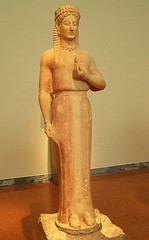
There is, for example, a kore (female-figure sculpture from the pre-classical age) that I could hardly part from. The elegance of form, the innocent half-smile as if she were enjoying some private joke or delightful memory, the curtain-like braided hair were to wonder at. Even the designs on her clothing — flowers and geometrical accents — seemed perfectly in keeping with the mood evoked. (The colors of the paint were still faintly visible in places.) The artist or artists who created her more than 2,500 years ago had known what it was to love, I feel sure.
I awarded myself two days after I had concluded my work for sightseeing, which included, besides the archeological museum, several Byzantine and Greek Orthodox religious sites, including an 11th century monastery enfolded on the lower slope of Mount Hymettos. All were impressive, despite being (to contemporary eyes) remarkably small — remnants of a time before overpopulation encouraged gigantism in everything from airliners to shopping malls. In the Greek Orthodox churches, the lighting was dim and the old wood dark, which set out dramatically the intensely colored icons and gold and silver ornaments.
One such church was incongruously located in a city-center shopping precinct, surrounded by every allure that modern marketing can devise. These shops and boutiques are our religous sites, pilgrims in endless procession visiting them in search of baptism by glamour, salvation by ownership. A few people, almost all women — some, to my pleased surprise, as young as those queueing outside the Hard Rock Cafe — entered the church while I was there, made the sign of the cross, kissed the icons. The old rituals are not quite gone, not yet.
The rituals of Eleusis are gone. For two thousand years it was the scene of Mystery Rites that were, apparently, as close as the ancient Greeks and Romans came to mysticism in pre-Christian times, except perhaps in the Isis cult. Each year, many citizens of Athens, rich and poor, later augmented by visitors from the Roman Empire, celebrated the Eleusinian rites on nine days set aside for them. They walked from Athens to Eleusis on the Sacred Way.
Because the Mysteries were secret, no one knows precisely what happened during the ceremonies undergone by the initiates. There are many accounts, all speculative to a degree. It is generally agreed that the rites took their theme from the legend of Demeter and Persephone, although I suspect that was only their outermost aspect, which could be understood on some level by the masses. Those who were admitted into the innermost mysteries had a direct experience that enabled them to know death and rebirth.
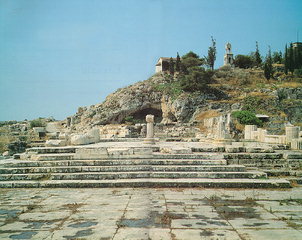
The driver I hired to take me to the archeological site of Eleusis (located in Elefsina, a dreary modern Athenian suburb) said that in his dozen years of conveying tourists I was only the fourth who had asked to go there. The site was practically deserted, inhabited at the time by a ticket seller, a caretaker, and four or five dogs lounging where philosophers, emperors, and people of modest circumstances had sought knowledge of the Reality behind appearances. I saw two other visitors while I walked around.
Eleusis is a collection of ruins, but with the help of signs and a guidebook, you can get the general picture of what was where. It surprised me to learn how much the venue had been expanded and rebuilt by the Romans once they ruled Greece. Clearly it was an important place for many of them, including apparently the emperor Hadrian — known much more for his military and political interests than any religious beliefs.
I really hadn't expected much from Eleusis; it was just something I wanted to see for what it had been in ancient times. And I had no mystical experiences there (not that I'd expected any). Yet it did feel that I was in a place touched by eternity, although that may have been purely an intellectual response. I don't know if I would have felt the same if I hadn't known the locale's history. But it was oddly affecting to be walking on the ground from which had once risen the Telesterion, the large central building, where millennia ago the hierophants had led seekers to the most profound Knowledge.
It was cloudy and cool there that day. At times, though, the clouds shrank from the sun, and a bright, intense Mediterranean light revealed the world anew. Perhaps that was the only metaphor today's world could offer of what the Mysteries had once given to those who had walked the road to Eleusis.
In fact, it was a business trip, not a holiday, and I didn't even go to the bloody Parthenon. Want to make something of it? If you are interested in the artistic legacy of Greece, you are much better off at the National Archeological Museum. It's a bit away from the tourist trail, and you will have no crowds to compete with, except for the inevitable school groups. The exhibits are of a very high quality, and in some cases breathtaking.
There is, for example, a kore (female-figure sculpture from the pre-classical age) that I could hardly part from. The elegance of form, the innocent half-smile as if she were enjoying some private joke or delightful memory, the curtain-like braided hair were to wonder at. Even the designs on her clothing — flowers and geometrical accents — seemed perfectly in keeping with the mood evoked. (The colors of the paint were still faintly visible in places.) The artist or artists who created her more than 2,500 years ago had known what it was to love, I feel sure.
I awarded myself two days after I had concluded my work for sightseeing, which included, besides the archeological museum, several Byzantine and Greek Orthodox religious sites, including an 11th century monastery enfolded on the lower slope of Mount Hymettos. All were impressive, despite being (to contemporary eyes) remarkably small — remnants of a time before overpopulation encouraged gigantism in everything from airliners to shopping malls. In the Greek Orthodox churches, the lighting was dim and the old wood dark, which set out dramatically the intensely colored icons and gold and silver ornaments.
One such church was incongruously located in a city-center shopping precinct, surrounded by every allure that modern marketing can devise. These shops and boutiques are our religous sites, pilgrims in endless procession visiting them in search of baptism by glamour, salvation by ownership. A few people, almost all women — some, to my pleased surprise, as young as those queueing outside the Hard Rock Cafe — entered the church while I was there, made the sign of the cross, kissed the icons. The old rituals are not quite gone, not yet.
The rituals of Eleusis are gone. For two thousand years it was the scene of Mystery Rites that were, apparently, as close as the ancient Greeks and Romans came to mysticism in pre-Christian times, except perhaps in the Isis cult. Each year, many citizens of Athens, rich and poor, later augmented by visitors from the Roman Empire, celebrated the Eleusinian rites on nine days set aside for them. They walked from Athens to Eleusis on the Sacred Way.
Because the Mysteries were secret, no one knows precisely what happened during the ceremonies undergone by the initiates. There are many accounts, all speculative to a degree. It is generally agreed that the rites took their theme from the legend of Demeter and Persephone, although I suspect that was only their outermost aspect, which could be understood on some level by the masses. Those who were admitted into the innermost mysteries had a direct experience that enabled them to know death and rebirth.
The driver I hired to take me to the archeological site of Eleusis (located in Elefsina, a dreary modern Athenian suburb) said that in his dozen years of conveying tourists I was only the fourth who had asked to go there. The site was practically deserted, inhabited at the time by a ticket seller, a caretaker, and four or five dogs lounging where philosophers, emperors, and people of modest circumstances had sought knowledge of the Reality behind appearances. I saw two other visitors while I walked around.
Eleusis is a collection of ruins, but with the help of signs and a guidebook, you can get the general picture of what was where. It surprised me to learn how much the venue had been expanded and rebuilt by the Romans once they ruled Greece. Clearly it was an important place for many of them, including apparently the emperor Hadrian — known much more for his military and political interests than any religious beliefs.
I really hadn't expected much from Eleusis; it was just something I wanted to see for what it had been in ancient times. And I had no mystical experiences there (not that I'd expected any). Yet it did feel that I was in a place touched by eternity, although that may have been purely an intellectual response. I don't know if I would have felt the same if I hadn't known the locale's history. But it was oddly affecting to be walking on the ground from which had once risen the Telesterion, the large central building, where millennia ago the hierophants had led seekers to the most profound Knowledge.
It was cloudy and cool there that day. At times, though, the clouds shrank from the sun, and a bright, intense Mediterranean light revealed the world anew. Perhaps that was the only metaphor today's world could offer of what the Mysteries had once given to those who had walked the road to Eleusis.
"Blessed is he who has seen these things
before he goes beneath the earth;
for he understands the end of mortal life,
and the beginning (of a new life) given of God."
— Pindar
before he goes beneath the earth;
for he understands the end of mortal life,
and the beginning (of a new life) given of God."
— Pindar
Saturday, November 30, 2013
Screen shots
Money-back guarantee: Not a word about President Obama-Jarrett!
Notes on three DVDs fetched from Netflix recently:
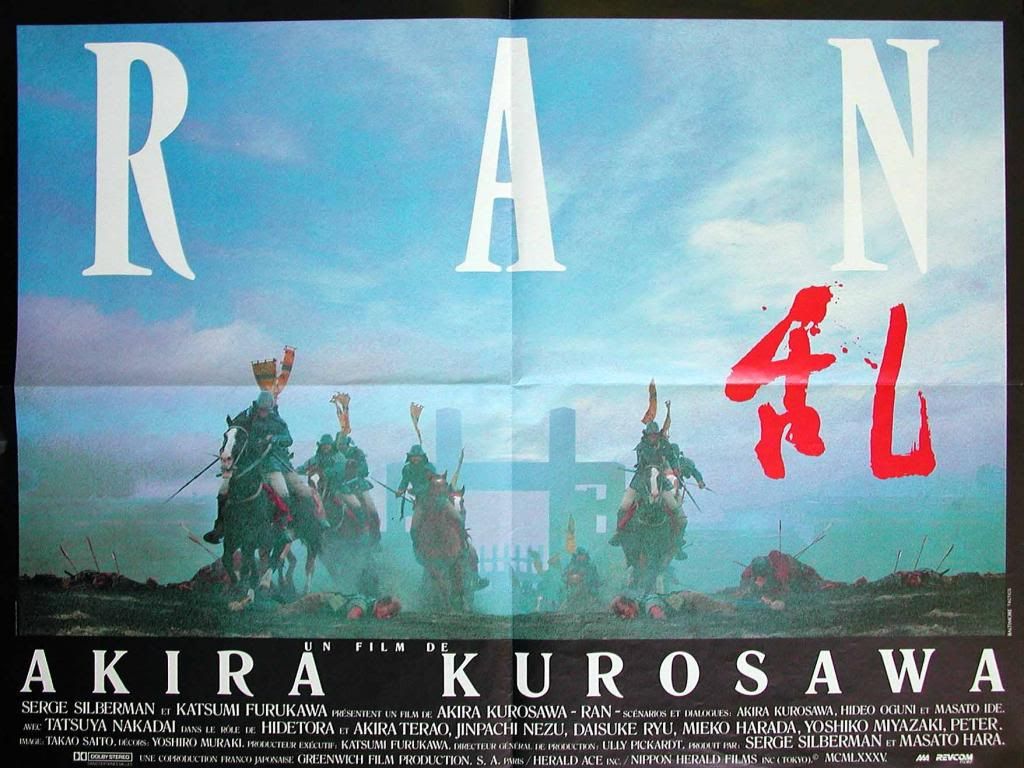
Kurosawa's 1985 Ran may be an art film enclosing a commercial film, or a commercial film enclosing an art film. Let's just call it arty commercial.
Of course Ran has ingredients that make cinéastes indulge in fawning contests. It's foreign (unless you're Japanese); set in remote times; plenty of picturesque violence; goes on and on and then on some more; and boasts a solid literary antecedent, King Lear by the unknown author who goes by the name Shakespeare.
This being old Japan, the warlord/Lear can't give his kingdom to three daughters, which would have been unthinkable in that time and place, so they are transgendered. Presumably to keep the film from being suffocatingly masculine, Kurosawa and his screenwriters introduce a seductive woman, Lady Kaede (Mieko Harada), to goad the Bad Son now on his father's throne into indulging in affirmative vicious action. Maybe Kurosawa got King Lear confused with Macbeth. Even in antique high fashion and makeup that look bizarre to modern Western eyes, she's a lovely viper. Once she wraps herself around Villain 1, it's Kaede bar the door.
Indeed there are impressive things in Ran. Kurosawa has a good eye for visual composition; when things get otherwise tedious there's usually something worth your attention in the background. He shoots and edits action well; the scene of the fiery attack on a castle is gripping. There are also compelling, quiet moments (but not enough). Toru Takemitsu's music score provides effective commentary.
"Shakespeare's" Lear opens a window into all the contradictions of human life: power and powerlessness, the wisdom of age and geriatric misjudgment, the bonds of love snapped in an instant by death's sharp tug, and so much more. Kurosawa, however, presents the theme as stilted, schematic -- disloyalty to your father is wicked, war is hell.
The acting is all over the place stylistically. The leaders of the various armies lined up for battle chew the beautiful scenery. Tatsuya Nakadai, as the Lear figure Lord Hidetora, is curiously artificial. Just say Noh? The androgynous Fool -- I thought at first he was a woman -- camps it up mercilessly but undeniably holds the attention. Yet other characters, including Lady Kaede, are played naturalistically.
Ran is no ran-of-the-mill film -- it's clearly a director's "statement," for good and ill.
Oliver Stone's Alexander may be a commercial film enclosing an art film, or an art film enclosing a commercial film. Let's just call it ... never mind.
This DVD was (I think) the "Final Version" of Stone's epic, which has at least three iterations, the other two being the "Theatrical Version" and the "Director's Cut." I'd seen the (I think) "Theatrical Version" (the shortest), also on DVD. Despite its faults, I had found it interesting enough to be curious about what had been left out. In this latest version, it would seem nothing much was omitted, as it ran (or walked, or stumbled) for well over three hours.
While his politics are not mine, Stone has directed some strong films including Salvador, Wall Street, Born on the Fourth of July, The Doors, Nixon, and the underrated Heaven & Earth.
In an extra-features introduction, Stone says something to the effect that if you liked the short version you'll like this even more, and if you hated the short version you'll hate this even more. I found that I liked and disliked both in about the same proportion. Starting here I'll be talking about the maybe-ultimate-final Alexander I watched most recently.
It was chance that I saw it right after Ran -- they happened to succeed one another in my Netflix queue. But that made me notice some surprising resemblances. Both are big on battle scenes. Both have father-son conflict, although Alexander tosses in for good measure a semi-incestuous mother-son relationship, as well as an implied homosexual one.
Like Kurosawa, Oliver Stone is a highly visual director -- one of his keenest talents, which he doesn't get enough credit for. The shots of the Macedonian and Persian armies, the long march through Asia to India, the court scenes are highly intensified by their pictorial quality. Like Kurosawa, Stone uses nature to heighten mood.
There are two huge battle set pieces, one in Persia and one in India. That in Persia -- Gaugamela -- is presented convincingly and powerfully, but at exhausting length. Once the action begins, onscreen titles helpfully inform us when we are viewing the Macedonian right, left, and center lines. The trouble is, the charging soldiers in the right look quite a bit like those in the left, and both strongly resemble those in the center.
Gaugamela seems like an all-day engagement, not just in 331 BC but in the movie. The cross-cutting between different parts of Alexander's army starts to bring up thoughts of military history writing where General X's cavalry "wheels around" to attack General Y's left flank while Count Z's artillery forces advance slowly against heavy resistance, etc.
One virtue of the extended version is that we get to hear more of Anthony Hopkins's voice-over narration (carnage recalled in tranquility). Not only does Hopkins help us understand the events better, but it's a pleasure just to hear a first-rate actor.
But whatever clarity Hopkins provides in sabotaged by Stone's insatiable urge for flashbacks and flash-forwards. Again the onscreen titles tell us where and when we are, but the jumping between past and present (which accelerates later in the movie) becomes annoying. We don't watch a picture like Alexander to sit in as Dr. Freud analyzes the childhood and youth of the Macedonian king, stretched out on the couch.
A lot of Stone's cinematic past suggests he is an excellent director of actors, but his ability along that line deserted him here. Colin Farrell (Alexander) lacks the magnetism and range of inflections to carry such a huge part, although it should be said that Stone's insensitivity to words -- his greatest weakness, as usual -- doesn't give Farrell a lot to work with. Val Kilmer as the father, Philip of Macedonia, is cartoonish. In the big roles, only Angelina Jolie, as Alexander's slyly loving mother, holds the screen.
The long-haul version of Alexander, presumably assembled to Oliver Stone's own specifications, shows again that enough is enough and too much is too much.
When I reviewed Wong Kar-Wai's 2046, I headed the posting "The first great film of the millennium?" On a second viewing, I find I agree with myself. I still know of none better.
The second time around was even more enjoyable than the first. Although not authored in Blu-ray (unlike the others discussed here), the color palette was even more sensuous than I remembered, possibly because I now have a different DVD player and monitor.
2046 is a work of brilliant imagination as well as craft. Because of retaining a general overview of the story, I didn't have to spend as much time trying to understand its fluid complexity (although there are still a few puzzling bits). I was able to concentrate more on the acting, and do not believe it is exaggerating to call it profound. What the performers give us puts to shame the posturing in Alexander.
Wong Kar-Wai has made other fine movies, some of which I've written about in this blog. But 2046 remains his masterpiece.
This being old Japan, the warlord/Lear can't give his kingdom to three daughters, which would have been unthinkable in that time and place, so they are transgendered. Presumably to keep the film from being suffocatingly masculine, Kurosawa and his screenwriters introduce a seductive woman, Lady Kaede (Mieko Harada), to goad the Bad Son now on his father's throne into indulging in affirmative vicious action. Maybe Kurosawa got King Lear confused with Macbeth. Even in antique high fashion and makeup that look bizarre to modern Western eyes, she's a lovely viper. Once she wraps herself around Villain 1, it's Kaede bar the door.
Indeed there are impressive things in Ran. Kurosawa has a good eye for visual composition; when things get otherwise tedious there's usually something worth your attention in the background. He shoots and edits action well; the scene of the fiery attack on a castle is gripping. There are also compelling, quiet moments (but not enough). Toru Takemitsu's music score provides effective commentary.
"Shakespeare's" Lear opens a window into all the contradictions of human life: power and powerlessness, the wisdom of age and geriatric misjudgment, the bonds of love snapped in an instant by death's sharp tug, and so much more. Kurosawa, however, presents the theme as stilted, schematic -- disloyalty to your father is wicked, war is hell.
The acting is all over the place stylistically. The leaders of the various armies lined up for battle chew the beautiful scenery. Tatsuya Nakadai, as the Lear figure Lord Hidetora, is curiously artificial. Just say Noh? The androgynous Fool -- I thought at first he was a woman -- camps it up mercilessly but undeniably holds the attention. Yet other characters, including Lady Kaede, are played naturalistically.
Ran is no ran-of-the-mill film -- it's clearly a director's "statement," for good and ill.
Oliver Stone's Alexander may be a commercial film enclosing an art film, or an art film enclosing a commercial film. Let's just call it ... never mind.
This DVD was (I think) the "Final Version" of Stone's epic, which has at least three iterations, the other two being the "Theatrical Version" and the "Director's Cut." I'd seen the (I think) "Theatrical Version" (the shortest), also on DVD. Despite its faults, I had found it interesting enough to be curious about what had been left out. In this latest version, it would seem nothing much was omitted, as it ran (or walked, or stumbled) for well over three hours.
While his politics are not mine, Stone has directed some strong films including Salvador, Wall Street, Born on the Fourth of July, The Doors, Nixon, and the underrated Heaven & Earth.
In an extra-features introduction, Stone says something to the effect that if you liked the short version you'll like this even more, and if you hated the short version you'll hate this even more. I found that I liked and disliked both in about the same proportion. Starting here I'll be talking about the maybe-ultimate-final Alexander I watched most recently.
It was chance that I saw it right after Ran -- they happened to succeed one another in my Netflix queue. But that made me notice some surprising resemblances. Both are big on battle scenes. Both have father-son conflict, although Alexander tosses in for good measure a semi-incestuous mother-son relationship, as well as an implied homosexual one.
Like Kurosawa, Oliver Stone is a highly visual director -- one of his keenest talents, which he doesn't get enough credit for. The shots of the Macedonian and Persian armies, the long march through Asia to India, the court scenes are highly intensified by their pictorial quality. Like Kurosawa, Stone uses nature to heighten mood.
There are two huge battle set pieces, one in Persia and one in India. That in Persia -- Gaugamela -- is presented convincingly and powerfully, but at exhausting length. Once the action begins, onscreen titles helpfully inform us when we are viewing the Macedonian right, left, and center lines. The trouble is, the charging soldiers in the right look quite a bit like those in the left, and both strongly resemble those in the center.
Gaugamela seems like an all-day engagement, not just in 331 BC but in the movie. The cross-cutting between different parts of Alexander's army starts to bring up thoughts of military history writing where General X's cavalry "wheels around" to attack General Y's left flank while Count Z's artillery forces advance slowly against heavy resistance, etc.
One virtue of the extended version is that we get to hear more of Anthony Hopkins's voice-over narration (carnage recalled in tranquility). Not only does Hopkins help us understand the events better, but it's a pleasure just to hear a first-rate actor.
But whatever clarity Hopkins provides in sabotaged by Stone's insatiable urge for flashbacks and flash-forwards. Again the onscreen titles tell us where and when we are, but the jumping between past and present (which accelerates later in the movie) becomes annoying. We don't watch a picture like Alexander to sit in as Dr. Freud analyzes the childhood and youth of the Macedonian king, stretched out on the couch.
A lot of Stone's cinematic past suggests he is an excellent director of actors, but his ability along that line deserted him here. Colin Farrell (Alexander) lacks the magnetism and range of inflections to carry such a huge part, although it should be said that Stone's insensitivity to words -- his greatest weakness, as usual -- doesn't give Farrell a lot to work with. Val Kilmer as the father, Philip of Macedonia, is cartoonish. In the big roles, only Angelina Jolie, as Alexander's slyly loving mother, holds the screen.
The long-haul version of Alexander, presumably assembled to Oliver Stone's own specifications, shows again that enough is enough and too much is too much.
When I reviewed Wong Kar-Wai's 2046, I headed the posting "The first great film of the millennium?" On a second viewing, I find I agree with myself. I still know of none better.
The second time around was even more enjoyable than the first. Although not authored in Blu-ray (unlike the others discussed here), the color palette was even more sensuous than I remembered, possibly because I now have a different DVD player and monitor.
2046 is a work of brilliant imagination as well as craft. Because of retaining a general overview of the story, I didn't have to spend as much time trying to understand its fluid complexity (although there are still a few puzzling bits). I was able to concentrate more on the acting, and do not believe it is exaggerating to call it profound. What the performers give us puts to shame the posturing in Alexander.
Wong Kar-Wai has made other fine movies, some of which I've written about in this blog. But 2046 remains his masterpiece.
Sunday, May 29, 2011
Beethoven's Fidelio
Whenever you read about Fidelio, it is invariably followed by the words "Beethoven's only opera." For years I thought the piece was titled Fidelio, Beethoven's Only Opera. Just kidding.
Recently a friend sent me a wonderful gift: a DVD of a live performance of Fidelio. I am embarrassed to admit that I had never even heard the music, much less seen a performance. Well, this DVD has filled the deficit, and in a thrilling way.
This is more than only a splendid production, but it is that. What an eye-opener for me.
The story takes place in Beethoven's own time, the early 19th century. I'll simply copy the program notes from the booklet accompanying the DVD:
Leonore, wife of the high-born Spanish state official Florestan, believes that his sudden disappearance two years earlier was the result of political machinations which he was determined to expose. Florestan's friends, among them the Minister of State Don Fernando, are convinced that he has been murdered by his enemies, but Leonore refuses to accept this, despite its near certainty, and goes in search of her missing husband.
The few remaining clues have led her near Seville, to a state prison, whose governor is Don Pizarro. Leonore suspects that it was Pizarro's crimes that Florestan was intending to reveal. With no one to help her, led by instinct, courage and her unshakeable love for Florestan, she has managed to gain admittance to the prison: disguised as a young man, named Fidelio, she has persuaded the jailer Rocco to take her on as his assistant.
That is not, of course, the end of the story. Leonore/"Fidelio" insinuates herself into the confidence of the jailer, Rocco, and eventually manages to free her imprisoned husband, whom Don Fernando marked for death, as well as other political prisoners in the stony depths of the underground cells.
I've often heard and appreciated Gundula Janowitz on recordings; Karajan cast her several times. But it never got through my head that she was an opera star, a singing actress. Probably her voice was a little past its prime in this 1977 staging, but it is still fine, and she characterizes the role movingly.
I've also heard René Kollo (who plays Florestan) on recordings, never saw him. He, too, is impressive as the devastated prisoner who is on the verge of his last breath, resigned -- perhaps -- never to see his loving wife again. The supporting roles, including Lucia Popp as Marzelline, the jailer's daughter, are well sung and played.
Leonard Bernstein conducted this performance in Vienna. I've always found him exhilarating and annoying in almost equal measure. His immense musical talent can't be denied, and sometimes it works in favor of the music, sometimes only for showing off and interpretative eccentricity. This is a video, so you get to see his podium histrionics. For me, they are entertaining and sometimes enhance the mood, sometimes over the top. But I have no complaints about him here. He does the score proud.
I have to confess I've never thought much of Beethoven's music for voices. It's been a while since I've heard his Missa Solemnis, and I guess it says something that I've not been keen to revisit it. Maybe I just haven't heard the right performance. As for his famous choral finale to the Ninth Symphony, give me a break. It's high-class circus music. People go bonkers for it because of its "message."
Yet ... hearing the quartet early in the first act involving Marzelline, Leonore, Rocco, and Marzelline's admirer Jacquino, it was clear that Beethoven could command multiple voices as brilliantly as Verdi, Puccini, or ... even Richard Strauss!
It was obvious to me even on first viewing that Fidelio is a masterpiece, and not only because of its sonic beauty. I'm not an opera buff, so I could be wrong about this, but this is the only opera I know that goes beyond, way beyond, the conventions of any music drama before or since. This isn't another retelling of a story from classical antiquity, of the sort that was popular in the 18th century and well into Beethoven's time. Nor is it a melodrama of sexual passion in the later Italian/French mode.
Beethoven won't settle for that. He deals with the timeless themes of human life. Injustice. Freedom. The loyalty and love between a man and woman.
The scene where the prisoners are briefly allowed out of the dark cavernous cellar where they have been chained for what must have seemed forever to them, to briefly taste sunshine and space so long denied them before being returned to their confinement, is enough to rake your heart with pity. As is their ultimate liberation.
I emerged from this immersion into a great work of art with a new appreciation of Gundula Janowitz, René Kollo, the Vienna State Opera, and Leonard Bernstein. As well as, of course, Beethoven.
Oh, and I had never realized that the accomplished Slovak soprano, Lucia Popp -- who died long before her time should have been up -- was so cute.
Saturday, July 21, 2007
Absolutely Sweet Marie
Well, your railroad gate, you know I just can't jump it
Sometimes it gets so hard, you see
I'm just sitting here beating on my trumpet
With all these promises you left for me
But where are you tonight, sweet Marie?
Well, I waited for you when I was half sick
Yes, I waited for you when you hated me
Well, I waited for you inside of the frozen traffic
When you knew I had some other place to be
Now, where are you tonight, sweet Marie?
Sometimes it gets so hard, you see
I'm just sitting here beating on my trumpet
With all these promises you left for me
But where are you tonight, sweet Marie?
Well, I waited for you when I was half sick
Yes, I waited for you when you hated me
Well, I waited for you inside of the frozen traffic
When you knew I had some other place to be
Now, where are you tonight, sweet Marie?
What could there possibly be left to say about Bob Dylan's 1966 album Blonde on Blonde at this late date? Well, for one thing, the album meets one definition of a masterpiece: there's always something new to discover in it.
But more than that, Blonde on Blonde (like most of the Dylan discography) has been remastered by Sony -- successor to the original Columbia label -- for better sound quality. As usual, I'm late to the party, since the new edition has been out since 2003, but I'd never heard the sonically refurbished CD before.
It's been remixed three ways, although they're on different layers of the same disc: 5.1 Super Audio CD, stereo SACD, and plain old stereo. But whichever way your sound system permits listening to it, it's almost guaranteed you've never heard it in such clarity and detail.

But more than that, Blonde on Blonde (like most of the Dylan discography) has been remastered by Sony -- successor to the original Columbia label -- for better sound quality. As usual, I'm late to the party, since the new edition has been out since 2003, but I'd never heard the sonically refurbished CD before.
It's been remixed three ways, although they're on different layers of the same disc: 5.1 Super Audio CD, stereo SACD, and plain old stereo. But whichever way your sound system permits listening to it, it's almost guaranteed you've never heard it in such clarity and detail.

Dylan's nasal, midwestern-flat voice, occasionally leavened with country-ish vowels, is no more beautiful than it ever was, but its unique quality (as a friend of mine once said in its defense, "Well, it's Dylan's voice") is reproduced with greater accuracy. But it's the freshness and etching of the backing instruments that really grabs you. None of the session musicians are big names, except Al Kooper, who's on only a few tracks, and Robbie Robertson of The Band fame (credited on the original cover as "Jaime Robertson").
But wow, do they cook, and wow, can you hear them now. Details you probably never noticed consciously in the old record and CD versions get out there and strut. It's the aural equivalent of having your dusty and bug-splattered windshield cleaned -- the environment becomes more colorful and involving.
Originally issued as a two-record package, Blonde on Blonde seems to me one of the two supreme Dylan albums -- Highway 61 Revisited is the other. Sadly, he afterward went into a musical decline from which he has never recovered. John Wesley Harding, which followed Blonde on Blonde, had two or three great songs in a very different style and mood; Nashville Skyline was a pleasant trifle; after that, forget it. He still comes out with a new disc every few years, and the '60s fossils on NPR ritualistically fawn over it before it sinks into obscurity. I'll say this for Dylan, the man: at least he doesn't pretend to be an Important Force anymore. He seems to have found some kind of peace, keeps a low profile and doesn't go around heading benefit concerts to cool off the world.
But it 1966, Dylan was at his creative peak. Blonde on Blonde was a perfect amalgam of compelling songs and teasing lyrics.
When I acquired the remastered disc recently, I went right to my favorite song on it: "Absolutely Sweet Marie." It's not one that music critics, or even Dylan fanatics, seem to dote on. I've never heard a band do a cover version of it, and it's not remotely as famous as the lovely "Sad-Eyed Lady of the Lowlands," another album highlight. But although every track is memorable, "Marie" still impresses me as first among equals for its melodic virtuosity and wild, surrealistic words.
But wow, do they cook, and wow, can you hear them now. Details you probably never noticed consciously in the old record and CD versions get out there and strut. It's the aural equivalent of having your dusty and bug-splattered windshield cleaned -- the environment becomes more colorful and involving.
Originally issued as a two-record package, Blonde on Blonde seems to me one of the two supreme Dylan albums -- Highway 61 Revisited is the other. Sadly, he afterward went into a musical decline from which he has never recovered. John Wesley Harding, which followed Blonde on Blonde, had two or three great songs in a very different style and mood; Nashville Skyline was a pleasant trifle; after that, forget it. He still comes out with a new disc every few years, and the '60s fossils on NPR ritualistically fawn over it before it sinks into obscurity. I'll say this for Dylan, the man: at least he doesn't pretend to be an Important Force anymore. He seems to have found some kind of peace, keeps a low profile and doesn't go around heading benefit concerts to cool off the world.
But it 1966, Dylan was at his creative peak. Blonde on Blonde was a perfect amalgam of compelling songs and teasing lyrics.
When I acquired the remastered disc recently, I went right to my favorite song on it: "Absolutely Sweet Marie." It's not one that music critics, or even Dylan fanatics, seem to dote on. I've never heard a band do a cover version of it, and it's not remotely as famous as the lovely "Sad-Eyed Lady of the Lowlands," another album highlight. But although every track is memorable, "Marie" still impresses me as first among equals for its melodic virtuosity and wild, surrealistic words.
Well, I got the fever down in my pockets
The Persian drunkard, he follows me
Yes, I can take him to your house but I can't unlock it
You see, you forgot to leave me with the key
Oh, where are you tonight, sweet Marie?
While Dylan's muse was still working full time, he had an uncanny gift for verse that's way-out-there quirky without being pretentiously absurdist. A constantly turning kaleidoscape of metaphors, his verses seem to make some higher, or at least poetic, sense. In fact, the literary figure Dylan (in the period that included Blonde on Blonde) reminds me of most is the early T.S. Eliot ("He laughed like an irresponsible foetus"; "Hidden under coral islands / Where worried bodies of drowned men drift down in the green silence / Dropping from fingers of surf").
The Persian drunkard, he follows me
Yes, I can take him to your house but I can't unlock it
You see, you forgot to leave me with the key
Oh, where are you tonight, sweet Marie?
There's even a touch of classic, old-fashioned song format. Dylan varies the meter by including bridges between the choruses:
Well, I don't know how it happened
But the riverboat captain, he knows my fate
But everybody else, even yourself
They're just gonna have to wait.

But the riverboat captain, he knows my fate
But everybody else, even yourself
They're just gonna have to wait.

While Dylan's muse was still working full time, he had an uncanny gift for verse that's way-out-there quirky without being pretentiously absurdist. A constantly turning kaleidoscape of metaphors, his verses seem to make some higher, or at least poetic, sense. In fact, the literary figure Dylan (in the period that included Blonde on Blonde) reminds me of most is the early T.S. Eliot ("He laughed like an irresponsible foetus"; "Hidden under coral islands / Where worried bodies of drowned men drift down in the green silence / Dropping from fingers of surf").
Now, I been in jail when all my mail showed
That a man can't give his address out to bad company
And now I stand here lookin' at your yellow railroad
In the ruins of your balcony
Wond'ring where you are tonight, sweet Marie.
That a man can't give his address out to bad company
And now I stand here lookin' at your yellow railroad
In the ruins of your balcony
Wond'ring where you are tonight, sweet Marie.
Do I overrate Blonde on Blonde because it was part of the soundtrack to my young life, a leitmotif that returned again and again in those heady days in 1960s Berkeley? Maybe: it was the best and the worst of times -- although in the end, it was mostly the worst of the '60s that contributed to today's toxic waste dump of popular culture -- but the music comprised a lot of the best. It was still possible, then, to imagine that rock music and psychedelic drugs would send the old rotten world on its way and bring in a new one of love and peace. Foolish, yes, but the young must be given a modest allowance of foolishness, if only so that they later (if they're smart or lucky) get in the habit of learning from experience the difference between fashionable fantasy and how things actually are.
Hearing the disc again after so long -- I don't think I'd listened to even a track of it for 15 years; I didn't make the effort because I thought I knew it so well -- I found it still to be a rare and glorious experience. But, admittedly, it's hard to factor out (not that I want to) my time in the counterculture, so long ago now. The past is another country and all that. Where are you now, Alexandra? Tim and Karen? So many others? And where are you tonight, sweet Marie?
Subscribe to:
Posts (Atom)