That's the headline of an interview in Newsweek with Vice Admiral (ret.) John Scott Redd, who heads the government’s National Counterterrorism Center. I must admit I can't keep straight all the various security agencies this country relies on to help us stay in the land of the living, but I presume the top banana at an organization with this title must be in the loop. Admiral Redd says:
We’ve got this intelligence threat; we’re pretty certain we know what’s going on. We don’t have all the tactical details about it, [but] in some ways it’s not unlike the U.K. aviation threat last year. So we know there is a threat out there. The question is, what do we do about it?
He then answers his question:
And the response was, we stood up an interagency task force under NCTC leadership. So you have all the players you would expect: FBI, CIA, DHS, DIA, DoD, the operators—the military side comes into that—participating in an integrated plan, but integrated in a much more granular and tactical way than we’ve ever done before.
I don't know what a granular plan is, but I know a task force when I see one. That all these alphabet agencies are trying to play from the same score is good, but is it really the most effective way to protect the country?

I will give you good odds that when we are "hit again," as Admiral Redd is convinced will happen, the participants in the plot will turn out to have no evident connection with Al-Qaeda. They will be "regular guys" like the perpetrators of 7/7 in London. They'll have baseball teams they root for, good driving records, no criminal background.
It's worth noting that the last two intended terrorist plots that were prevented (Fort Dix, JFK) were stopped because of a snitch and a tip-off, respectively. Fine. We need all the help we can get, and the police and security agencies involved are entitled to take a bow for exemplary action using the sources they had.
There's no way to guarantee that, either, but there's something that would be a giant step forward. I'm sure you see where this is leading. We should stop Muslim immigration. Period. And check out very thoroughly any visitor from a Muslim country or a country with a large Muslim population, or who has an Arabic name, or who for any other reason arouses suspicion. That is feasible. Infiltrating every sleeper cell isn't.
Of course, it's drastic. Of course, it will inconvenience many innocent people. But nobody has a right to immigrate here, so would-be Muslim immigrants have no legitimate complaint. And if someone doesn't want to put up with questioning about why they are visiting, for how long, where they're going, and whatever else we want to ask them, they don't have to come here.
Naturally the ACLU and its acolytes will go off their heads. Discriminatory! Well, yes. That's the point. We're not up against a gang called Al-Qaeda, as though they were the Mafia or drug smugglers. We are, as the admiral admits, in a war. One with, as he puts it delicately, "a strong ideological content." Which is as close as he can come to saying out loud that Islam is a totalitarian system with a top layer of religion, and it's coming to get us.Most Muslims aren't terrorists, but terrorists can easily pass for "moderate" Muslims. The next "hit" is being planned at this moment, and the planners will be trying for a grand slam. It's a point of honor for these blokes to raise the score each time. Admiral Redd says, "We have come a long way. But these guys are smart. They are determined. They are patient. So over time we are going to lose a battle or two. We are going to get hit again, you know, but you’ve got to have the stick-to-itiveness or persistence to outlast it." Sorry, sir, but that's not good enough. I don't want to outlast an enemy that would like to take the lives of thousands or tens of thousands of us. I want to make it as close to impossible for them to succeed as we can. And it will be a lot harder for them to succeed if they're not here.
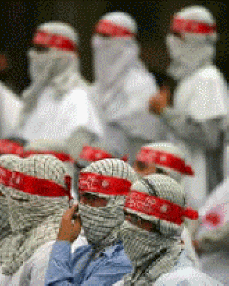 Lambeaters, the famous guards at the Tower of Londonistan, pose for tourist photos.
Steve, a commenter to a recent entry here, suggested that I was "obviously afraid of something called 'Islamization of Europe', a artificially installed fear by all the right wingers and Anti-EU guys all over Europe. Please, relax as there is nothing like 'Islamization' in the EU."
I was glad to hear it. I had been worried there for a few minutes.
Steve, please reassure Daniel Johnson as well. We need to scupper this artificially induced fear before more people start believing it.
The past isn't always another country. Sometimes it hangs around, living on spare change and turning in bottles for deposit refunds, and they don't do things differently there. They just do the same repeatedly, like the spook in a haunted house who poses on the staircase again night after night.
Gerard van der Leun at American Digest went to a latter-day counterculture event in the park, and came back with photos of species some of us thought were extinct, like the rediscovery of the coelacanth.
 I gotta be me
Flashing, man! Am I drowning or having some other kind of near-death experience and undergoing a life review? I'm in Berkeley, 1968. Smoke gets in my eyes. I've been to more of these festivals than a reindeer has had hot dinners.I've said before, and I'll no doubt say again (because I have only a limited store of ideas, and don't want to use them up too quickly) that there were good things about the '60s counterculture. The music, a lot of it. The un-ironic romanticism. The skepticism about technology. The — well, I don't want to get too personal.So in that respect, I guess I'm different to most of today's cultural conservatives. But almost all of what was good about the '60s counterculture washed out, especially after it became politicized, and everything that was toxic survived and evolved into the political correctness of the Baby Boomer generation, or what I think of as the National Public Radio generation.
What seems to me saddest about van der Leun's photos isn't the woman shown above who's doing the hippie hippie shake without quite having the … style to go with it. The distressing bit is the younger people, in the age group I was in as a Berkeley freak. Whatever you say about the original hippies (a tag we had contempt for: we called each other heads or freaks), you have to admit that they created a genuinely new subculture, including art forms like the psychedelic-inspired Fillmore posters, clothing, slang.These poor kids (poor in imagination; I expect few are financially poor, which some of the original counterculture kids made it a point of honor to be) who think they're so cool, so out there, so dangerous, have invented sod-all. The only thing they seem to know how to do is copy what we did 40 years ago, with the possible exception of the tattoos and metal studs.I think young people should have a culturally rebellious streak. (So should older people, for that matter.) We need to have our cage rattled from time to time. But these Haight-Ashbury re-enacters aren't introducing anything. They're just playing at being part of what they imagine was a Golden Age of transgressiveness, and thanking themselves for their daring.
A few years ago, before Time magazine went into terminal irrelevance, it ran a thoughtful story about how the hip icons, from the Beat Generation to the bikers to James Dean to Jim Morrison, had been co-opted into the standard off-the-shelf popular culture. The headline asked something like, "If Everybody's Hip, Is Anybody Hip?"A good question. One thing I'll take my oath on: these young people channeling the stoned dropouts who created their template aren't hip. They've turned on, but they've tuned in to their parents. Some rebels. But I would not give you false hopeOn this strange and mournful dayWhen the mother and child reunionIs only a motion away
— Simon and Garfunkel

Striking modern art.
 Love those blues.
 Like a heavenly flower.
 Museum quality.
If you happen to be an oncologist, you know what I'm going to say next. Yes, these gorgeous items are cancer cells. From top to bottom, breast cancer; unspecified; unspecified; brain cancer.
I've read that even amid the horrors of war, soldiers have sometimes found beauty to admire: tracer bullets and phosphorus like fireworks, smoke billowing from an explosion. It would seem that nature likes to tease us by making some of its worst phenomena pleasing to the eye. There might be a philosophical lesson in this, but if so, don't ask me what.
Here is a satellite photo of Hurricane Dean:
UPDATE 9/2: Speaking of visual beauty in weapons of war, I ran across the following description in Elizabeth Bowen's The Heat of the Day. It's a nighttime air raid in World War II London (Bowen had lived there throughout the war):
Harrison, back again, stood in the middle of a street, otherwise empty, illuminated by a chandelier flare. During the pulse of silence between the overhead throbbing and the bark of the guns, the flare made the street like a mirrored drawing-room. Above where Harrison stood peering at something jotted on an envelope, white-green incandescence flowed from the lovely shapely symbol, which slowly descended as it died -- the sky to the east reflected flamingo-pink nobody could have taken to be the dawn, the west was jagged with flames.
A site called Honest Thinking, based in Norway, recently posted a manifesto (shouldn't we retire this word, with its Marxist associations?) about immigration. (Tip of the hat: Gates of Vienna)
The two editors responsible encourage others to reproduce the manifesto, so long as it is complete and verbatim. Right, then, here it goes:
The immigration policies currently in vogue in most Western countries show increasing signs of being unsustainable, and the associated problems are likely to grow ever more severe in the coming years. This is one of the largest ethical dilemmas of our time. We therefore believe the entire foundation for the prevailing regime needs to be reconsidered, and submit this manifesto as a starting point for reasoning about these challenges.
1. It is a moral duty to promote human rights all over the world.
2. The concept of human rights must not be confused with any particular legal implementation or formulation of that concept, since such explications could contain internal inconsistencies or imply consequences that would cause conflict with the previous tenet.
3. The worth of a human being is independent of his or her gender, religion, ethnic background, sexual preferences, culture, language, and other such markers.
4. Cooperation across cultural, language, religious, and ethnic borders is desirable and necessary.
5. Even so, culture, language, religion, and ethnicity are instrumental in establishing each individual’s identity, and thus central in forming his or her sense of belonging and loyalty. Any policy aimed at sustainability must take this into account.
6. It is therefore legitimate for any sovereign state to implement restrictions towards non-citizens in such a way that control over its demographic development is retained.
7. It is unacceptable, without foregoing careful consideration and proper democratic processes, that political dispositions be made to alter the demographic composition of a state in such a way that its stability, its inner cohesion, and the mutual loyalty of its population be threatened.
We are apprehensive of individuals, organizations, and other legal entities that try to quench free and open debate on the above issues, and regard such political actors as having little or no legitimacy in questions of democracy and human rights. Moreover, ideologies and political movements whose goals are irreconcilable with the above tenets should be considered devoid of moral and intellectual integrity, unless they are able to justify said discrepancy.
It's a strange mixture of conventional liberal pieties and daring (for Eurabia) nonconformity.
The former are contained in items 1,3, and 4. We need not detain ourselves with this boilerplate.
Item 2 is kind of overcast, but it seems to be saying that claiming it's for "human rights" does not automatically justify a law or policy. That's a very crucial point; too bad the authors couldn't shake off their legal or academic backgrounds enough to state it plainly.
Item 5 — "Culture, language, religion, and ethnicity are instrumental in establishing each individual’s identity, and thus central in forming his or her sense of belonging and loyalty" — is not helpful. All those factors play a role in a person's psychological makeup, but are they instrumental and central, which implies that everyone's essence consists of tribal loyalties? Politically, this is inadequate: it leaves out understanding arrived at by thinking. It also ignores nationality, apparently still a dirty word for the manifesters.
Item 5 is also deficient philosophically because it appears to give no place to an individual's spirit or soul. For some people, even today, spiritual truth as they perceive it is far more important than culture, etc. (True, the item does include religion, but in context it is very likely that this means formal religious doctrine, not an inner calling.)
As long as people are perceived, or perceive themselves, as a bunch of inherited or indoctrinated qualities glued together, with no "belonging and loyalty" to any higher truth, we will continue to have sectarian and ethnic strife.
Item 6 is very good.
So is item 7, except that "without foregoing careful consideration and proper democratic processes" sounds too much like an escape clause. Careful consideration by whom? Lots of multi-culti partisans working overtime for ethnic replacement believe they have carefully considered its advantages.
The postscript seems to be a ringing defense of free speech, but it too is a little wet. "We are apprehensive of individuals, organizations, and other legal entities that try to quench free and open debate on the above issues, and regard such political actors as having little or no legitimacy in questions of democracy and human rights" — so they might have a little legitimacy? "Ideologies and political movements whose goals are irreconcilable with the above tenets should be considered devoid of moral and intellectual integrity, unless they are able to justify said discrepancy" — now there's a weaselly pronouncement any politician could be proud of. In other words, such ideologies and political movements are unjustifiable, except when they're justified.
But I'll still give these gentlemen one thumb up. In Norway, this is pretty courageous stuff, even with its hedging. The Resistance is getting bolder in Europe, even as political correctness becomes harsher.