For some of us, going on a trip without a computer or access to one is like having our brain cells deprived of oxygen. Until the last two days of my California visit (see entries below), when I finally found a guest-use computer in the hotel lobby, I had no sources of information other than my senses, newspapers and TV.
How disconcerting is that? If you're used to spending at least some time every day on the Web, it's like being on a desert island. An intellectual vacuum. A space station orbiting Pluto.
Not that there isn't an overplus of information available on the conventional media — TV in particular will immerse itself to the utmost depths of trivia in search of "content" to fill up a 24/7 schedule — but the mental world that bloggers of almost any persuasion inhabit is gone. Instead, the mainstream media delivers a kind of Cheez-Whiz reality, processed and processed until it resembles an industrial material rather than anything organic. Whatever truth might be contained in news or feature stories has been pre-masticated by producers and editors and regurgitated, like a cow's cud.

For regular Web surfers, it can come as a shock to see how bland and one-dimensional the mainstream media are. Newspapers either rely on the politically leftist Associated Press for copy or, like the Los Angeles Times and the wretched San Francisco Chronicle, are flagrantly PC. Even in oppressed Britain, there's far more divergence of thought in the daily papers.
Two media especially represent American news coverage, such as it is: USA Today and CNN. They are ubiquitous. USA Today is America's Pravda. Not only does it print only the official liberal line, but (much more disquietingly) it ignores any event or shade of opinion that doesn't fit its ideological template. It's the default paper, the one the hotel puts outside your door in the morning or stacks next to the breakfast buffet, the one in the waiting room, the one found at every node of newspaper vending machines.
CNN is the video equivalent, found wherever TV is forced on the public (more and more places, alas). You go into a restaurant and if the TV over the bar isn't tuned to ESPN, it's on CNN.
We bloggers ought to be even more worried than we are about the blandness and lack of intellectual variety of the mainstream media. We flatter ourselves that the Web has broken the eyeball monopoly, and it has, but we tend to overestimate the coverage of the blogosphere. In a society spinning faster and faster, most of the gainfully employed barely have time to catch the TV news over breakfast or glance at a newspaper designed, like USA Today, to offer bite-size stories à la TV. They get a sliver cut from the whole spectrum of political and social thought that exists on any issue, and of course with PC filtering there are certain ideas and even facts that can't be mentioned, even for debate.
An unfree society doesn't have to have laws abridging the freedom of the press. It just needs a compliant Fourth Estate that passes along the Liberal Establishment's views and pitches to the lowest common denominator among its audience. We don't have hundreds of newspapers and TV stations in this country: we have one of each, with lots of different names.

I don't want to take up your time telling you things you already know about the racial and ethnic situation in California. My visit (see also the preceding posting) probably didn't introduce me to any facts I was previously unaware of, but it's one thing to know them, another to experience them. If you don't live in California or haven't been there in a while, a brief first-hand account might interest you.
Basically, the state of play is this: California is already the multi-ethnic society that our liberal masters want. It varies by area, of course: much more in the big cities, quite a bit in farming areas, not too much in rich people's turf like lovely Santa Barbara.

But when you look at the whole picture, you can see that mega-diversity is a fait accompli. Turn on the cable TV in your hotel room and you can find stations with programming in Spanish, Chinese, Korean, whatever-the-hell … Filipino, Urdu, I don't know, I got tired of channel surfing. Clement Street in San Francisco, where I lived for a short time in the '80s, is now overwhelmingly Asian, a second (or third or fourth) Chinatown. At Los Angeles airport, every announcement is made in English and Spanish, which makes the message feel as long as a speech by Fidel Castro. At the Monterey aquarium, it seemed like half the kids in the school groups were talking to each other (and their teacher) in Spanish. I won't go on multiplying examples — well, just one more because it seemed to me to symbolize at least one aspect of the multi-culti value sysem:
We got off the 101 freeway to drive through Oxnard, for no very good reason except that we were taking Route 1 all the way north on the coast and it seemed fitting to stay on it where it first diverges from 101 n0rth of Los Angeles. Oxnard is the center of an agricultural area, and the old downtown is basically Mexico with a generous helping of the universal culture of poverty: taquerias, grocerias, everything-erias, payday loans, car-repair shops for cars that have served their time. Not threatening, just sad. Other than the Mexican flavor, pretty much Grapes of Wrath.
I was ready to let it go at that -- annoyed, but not at the Mexicans, rather at the corporate overlords (with their court jesters in Washington) who have decided that our economy (i.e., their profits) require us to import poverty. But what I read in the Los Angeles Times the next day painted a bleaker picture (sorry, no link):
A state appellate court has affirmed almost all of Ventura County's injunction against a violent gang in Oxnard, objecting only to a provision that called for an overnight curfew. In a ruling Monday, the 2nd District Court of Appeal took exception with a provision that barred members of the Colonia Chiques who had been served with a copy of the injunction from being in public from 10 p.m. to dawn. The three-judge panel called this portion of the injunction "unconstitutionally vague." ... The injunction, announced in March 2004, established a 6.6-square-mile safety zone ... within which members of the gang were banned from assembling, flashing gang signs, fighting, possessing weapons, wearing gang colors or having an open container of alcohol.
Members of the Colonia Chiques, the county's largest gang with more than 1,000 members, have been suspects or victims in more than 40 homicides since 1992, authorities said. Oxnard Police Chief John Crombach has said gangs are responsible for 20% to 40% of all violent crime in the city and that the injunction has helped cut the number of homicides and aggravated assaults in the first half of 2007.
So here is the insanity that Open Borders has brought us to: instead of refusing these thugs admission to the country or giving them the bum's rush when they wind up in the clutches of the law, we let them in, then do back flips to try to establish a "safety zone" where they supposedly can't be their homicidal selves. We waste a good chunk of the municipal budget on hundreds of hours of the police's, prosecutors', and appellate judges' time to impose a curfew -- a bad precedent in a free society, and an admission that it can't touch the cause of trouble, only try to curtail its worst effects.
Is Oxnard atypical, the Colonia Chiques just a minor fringe phenomenon? Oxnard is only a small backwater. The article says that the Los Angeles City Attorney has obtained injunctions against 50 street gangs.
Given the plenitude of ethnic and racial diversity in California, I suppose it is arguable that it "works"; other than the incessant warfare between Mexican and black gangs in LA, there isn't a great deal of outright violence between groups. What I saw suggests that in ordinary, mainly work-related situations, people get along pretty well. I'll buy it that that is evidence of a certain goodwill. (Then again, my wife and I traveled in relatively ritzy areas like Santa Monica, Santa Barbara, the Marina District in San Francisco, not out of snobbery but because that's where the best scenery and accommodations, plus relative safety, are to be found. Possibly it's a different story in less affluent real estate.)
But a society needs more than just people managing not to knife or insult each other when they're thrown together. It needs genuine social interaction and a baseline of shared values. I don't think you find that much in California. The blacks and whites and Mexicans and Chinese and Koreans and Vietnamese and the other hundred-odd cultures stick within their own tribes outside of working hours. They each have their own neighborhoods, their own stores, their own entertainment venues, their own ... well, just about everything.
Maybe this is, as our Diversity Gruppenfuhrers insist, the way of the future. Maybe eventually, in a few hundred years, it will work itself out into something no better but no worse than most human societies have experienced. But I have to say this: California is no longer part of the United States in any meaningful sense. It's a giant petri dish, a laboratory experiment to see whether a multi-cultural state can manage on any basis other than every tribe looking out for itself, and one (or more) tribes finding themselves at the bottom of the food chain.
I won't try your patience by putting it all in one posting. Here, I'll talk about the general environment and a few experiences in the areas my wife and I visited or passed through, Los Angeles to San Francisco and back again. (The trip has a day and a half to go yet as I begin this entry, in the lobby of the Ambrose Hotel in Santa Monica.)Break, break. Yes, I know California is much more than the southern and central coast. Other areas are different and also California. Still, let's not be pedantic. When people talk about California, the epicenter of everything that's new and cool, a state of mind, this is what they mean.
One reason that the state hasn't yet been paved over is wine. I was amazed to see how much of the area between LA and SF is now devoted to the vine. Fields that used to grow artichokes or went uncultivated are now hustling to produce the grape. I read that California wineries numbered a thousand in 1990, now four thousand. Boutique vineyards abound, and you can taste your way to oenophile heaven if you so desire. California even has, like France, its own "appellations" such as Monterey and Arroyo Seco. For many people the enjoyment seems to be in the talking as much as the drinking, and they'll bang on about "artisan wines," "dry-farmed organic grapes," "controlled tonnage and canopy management," soil rich in "crushed fossilized sea shells." Whatever. Seems to me it's gilding the lily and making a Heidelberg philosophy discipline out of one of life's simple pleasures.
Along the central coast, wave-branched California Live Oaks dot the hills. Here in the south, the landscaping does a good imitation of the tropics, even though most of the exotic flora have been transplanted. Red-purple sparks of bougainvillea blossoms leap from walls, feathery fronds of royal palms catch the breeze. Grandes allées of stately eucalyptus wait patiently for koala bears from their Australian ancestral home to sup on their silvery leaves. The sun falls on the just and the unjust alike, butters the stucco walls, puts a fairy tale sheen on even the big glass high-rises.
Of course, although it goes against the "green" ideology so prevalent here, nature is not necessarily a friend to man. It is morally neutral, the Hindu trinity in one: Brahma the Creator, Vishnu the Preserver, Shiva the Destroyer.
Shiva was having a field day. Quite a bit of Southern California was being eaten by fire while I was there. I didn't see the fires themselves, but an ominous blanket of smoke hung in the sky. If a big earthquake had happened to show up at the same time as the fires, the consequences would have been unthinkable. I've also been in Los Angeles when it was raining like stair rods for days on end, the kind of rain that sends five-million dollar houses sliding down hillsides to deconstruct one-million dollar houses below, where the peasants live.
Californians will continue to build where expertise and common sense insist they shouldn't. It is foolish. But also a sign of an unquenchable optimism and faith that the western edge of North America nurtures.
 A tale of two cities.
I ought to detest Los Angeles. There are more things wrong with it than I have time to write or you to read. Traffic -- farewell the tranquil mind. Worship of over-amped celebrities. Obsession with fashion. Media hype.
All of that is there, but it's by no means the whole story. There are still plenty of Angelinos who have both feet on the ground. And there's more artistic talent and creativity per capita than anywhere else in the country, or probably the world. It certainly isn't always used to good ends, but there is an undeniable buzz to the place that can open your senses wide. There's even -- so help me -- creative retailing. About five blocks of Melrose Avenue are lined with wacky, one-of-a-kind independent shops, thumbing their noses at the malls and chain stores.
Even the fashion consciousness has its upside. There is no place I know of better for people watching. Contrary to the stereotype, it isn't about big sunglasses and tons of jewelry -- that's for Las Vegas and New York's Upper East Side. LA women tend to be almost Parisian in their abundance of chic -- that sense of style that enables them to make the most of their assets through the personal, even slightly eccentric, touch.
For an enormous city, its citizens are surprisingly pleasant in day-to-day interactions. I don't think all of it is acting for commercial purposes. In Santa Monica, a municipal grounds keeper astonished me by saying "Excuse me" as I passed while he swept the pavement.
To be sure, I am talking here mainly about the tony West Side, from West Hollywood to the ocean. There are parts of the city to be avoided, where the welcome is unlikely to be warm. Still, it seemed to me that many Angelinos were taking enough pleasure in life to have a little to spare for others. They are by nature positive and optimistic ... a good thing, because with all the stress in their environment, they need to be.

San Francisco is everybody's favorite city. Except mine. I think it's a cold (in more senses than one), second-rate tourist catchment area.
True, the natural setting is extraordinary, bounded by the ocean, the bay, the mountains. Looking down the roller-coaster streets from Pacific Heights can be breathtaking. And ... and ... well, that about sums up San Francisco's virtues.
Once it was exotic and bohemian. In the '60s and '70s it sold out to corporations and tourism, and -- I was about to write, "never looked back," but looking back is mainly what it does, selling nostalgia for something that is gone. North Beach? Give me a break. Sure, there are still Italian restaurants, real authentic, like, with like cute names and laminated menus, where you can sink $80 on a bottle of wine and feel yourself, like, a connoisseur. Some have pitchmen out in front to lure the tourists, which even in the '60s would have been considered brazenly offensive. The three or four remaining beat hangouts have a few old timers playing at being "characters" and sharing the space with tourists and kids from the suburbs sniffing the air for "atmosphere." There's also a Beat Museum -- that'll be ten dollars, please, don't miss the jar top Jack Kerouac used as an ashtray on May 17, 1955.
Telegraph Avenue in Berkeley, where I put in time during my mis-spent youth, is now downright seedy. There's nothing indigenous about it, like there was in my time. Just the trappings of commercialized rebellion -- stores selling T-shirts printed with rock album covers and naughty messages, tattooing (although tattooing is so last year: the cool thing now is getting designs hennaed on your skin), punk jewelry and costumes, tacos and other foodstuffs from the world's authentic people. Everybody drives cars, including fancy new models, but they've put concrete barriers on residential streets to make you detour -- it symbolizes Berkeleyans' disdain for the automobile and Big Oil, while doing nothing whatever to reduce traffic, since it just means the cars in the blockaded streets must be force fed into others. The barriers themselves are concrete bollards, made even more ugly by the inevitable spray painting.
I do not find San Franciscans, as a rule, friendly. They are all in a hurry. They are squeezed together in some of the densest real estate this side of Hong Kong, and you are just another person in the queue, another one in the way. Like New Yorkers, they talk too loudly in restaurants.
San Franciscans imagine that they stand for culture, as opposed to those vulgarians down in -- gah -- LA. They are wrong. My wife and I went to the Palace of the Legion of Honor, an art museum ("world class" according to the publicity) in a justifiably renowned setting in a park near the bay. It has been completely renovated since I was there last, but it still has the same third-rate collection, almost its only standouts a couple of Watteaus, three typically exquisite Fantin-Latours, and a splendid Courbet. Lots of Rodin sculptures if that turns you on; it doesn't me. Otherwise, miles of Baroque hackwork.
There wasn't time to see the rebuilt De Young, but I would bet its collection too is as mediocre as it used to be. (Greater Los Angeles has five art museums that beat San Francisco's all hollow: LACMA, the two Gettys, the Huntington, and the Norton Simon in Pasadena.)
What was I doing in San Francisco in the first place, since I had lived there and already knew what to expect? My wife had never been and wanted to see it. She did. By the end of the second day she had caught on and was ready to split. We left a day earlier than planned, to my relief.
A tale of two museums.The aquarium at Monterey is probably the biggest tourist draw anywhere between LA and SF, understandably. It has two huge tanks, one for shore marine life, another for ocean life. Very impressive.I guess I'm a born sourpuss, though, because I get sick of having everything explained over and over, in signs (English/Spanish, natch), videos, lectures. When did museums become classrooms? Maybe when classrooms became political indoctrination centers and stopped teaching. The true purpose of a museum should be to engage the viewer's interest. Places like the Monterey aquarium leave nothing to the imagination. They tell you more than you can possibly absorb and keep diverting you from the wonder of the life forms on display.Of course the aquarium is also an indoctrination center. You are warned over and over about the potential loss of species, global warming drying up shore habitats, etc. There is even a life-size reproduction of a restaurant where filmed characters enact customers and waiters, and you learn what seafood to order and what not to order because it's supposedly endangered. I can accept that a little bit of environmental education is a legitimate function of an aquarium, but all this goes way over the top. Incidentally, the towel dispensers in the rest room have signs that read: TOWEL = TREE. Hey, did you know that? The Dictatorship of Virtue. Pu-lease!Let me end on an up note. The Getty Malibu, a spectacular and occasionally scandal-ridden museum of antiquity, reopened last year after a five-year rebuilding and redesign. I'm happy to say the museum got it right. The exhibits are beautifully displayed and lit, with just the right amount of information about each (i.e., presumed date, subject, and occasionally a little about the use to which it was probably put). No video whoop-de-doo. No touchy-feely exhibits. Two marvelously painted and landscaped peristyles, or open spaces surrounded by colonnades like in an ancient Italian domus.Plus a reasonably priced cafe with some of the best food we had on the trip.California at its best.In the next (probably) posting, I'll have more to say about the politics and sociology of the state.
Reading the news has put me, as usual, in a sour mood. I'm fit to write the earth a bad review. How can people be so
... sorry for the interruption, that was my nurse -- nice Greek lady, Mrs. Peristalsis I think her name is -- always bang on time with my meds and insists I take them, even if I'm in the middle of writing a blog post. She brought with her a note from Dr. Ouija. Let's see ... well, this is quite a turn-up! He's written me a prescription for two weeks in California. Tells me to get some sunshine, drive up the coast, see a few waves (thanks, Doctor, how about you waive a few fees?).
Two weeks, give or take, in California is likely to induce (a) exhilaration, (b) depression, or -- this would be my prediction -- (c) both.
I will probably not be posting during the trip; I don't own a laptop, which limits the opportunities for taking one. Look for this blog to resume production after October 26, assuming a fault line doesn't open and cause me to disappear into a crevasse. Who needs it? I have enough faults already.
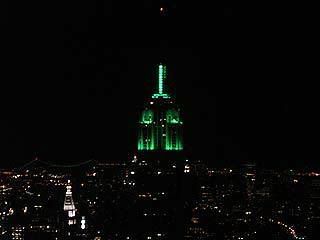 The Empire State Building, a couple of miles from Ground Zero,
lit up to celebrate the Muslim holiday Eid.
Not even a direct attack to its own heart by devotees of a fanatical politico-religious cult can stay New Yorkers from their precious multi-culturalism.
Next time I hope the suicide bombers sink the whole bloody island.
I don't mean that. Not quite. Not yet.
Bordeaux. Aix-en-Provence. Arles. Nice. Paris, City of Light and all that. How they capture the imagination. History, architecture, wonderful food and wine, civilization and its refinements.
Only, they and more than 700 other cities and towns in France include what are called Zones Urbaines Sensibles (ZUS). No, not "sensible urban areas." Sensible translates more accurately as "sensitive." That is, n0-go areas for police and non-North African, non-West African, or non-Muslim French people.
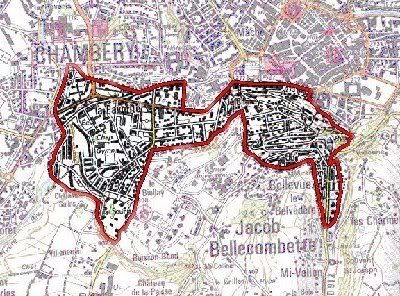
ZUS at Chambéry outlined in red.
According to Daniel Pipes, they are "places in France that the French state does not control. They range from two zones in the medieval town of Carcassone to twelve in the heavily Muslim town of Marseilles, with hardly a town in France lacking in its ZUS. The ZUS came into existence in late 1996 and according to a 2004 estimate, nearly 5 million people live in them."
This information was published late last year, but in case you missed it (as I did), it's worth taking a look. I had no idea how extensive these enclaves are.
These ZUS aren't just a journalistic or popular name. They're officially recognized by the French government. Here is a link to an interactive list. They are ordered by départements, jurisdictions more or less equivalent to English counties or Canadian provinces. To see any of the maps, click on carte to the right of the location name. You can then zoom in to a fairly detailed resolution. The red-bordered area in each map is the ZUS.

I looked at the map for Arles, famous for Van Gogh. I was surprised during my visit to see so many North Africans there, but that was before I knew much about France's demographics. They were in the greatest numbers, so far as I could tell, in the run-down area by the port that was bombed heavily in World War II and never recovered economically. According to the map, Arles's ZUS isn't in that section, though, but just across the railroad tracks from Les Alyscamps, the atmospheric ancient Roman cemetery where Van Gogh liked to sketch and which he painted.
All these ZUS represent sociological land mines throughout France. Their residents are almost completely alienated from traditional France — because of French prejudice, or because they are incapable of assimilating, or both. We saw several of the zones in the suburbs of Paris explode a couple of years ago, and I have no doubt that under not-unimaginable circumstances, they could all blow up.

The French government is pursuing various schemes to win the allegiance of those who live in these outlaw areas. Theodore Dalrymple seems to believe they are beyond the reach of government, however well intentioned (although the intentions probably stem from fear as much as benevolence).
French officialdom is trying to fix the problem with the usual social amelioration programs, job creation, affirmative action, and so on. It's probably useless to expect anything else from a European government — it's the only language they know. But North and West African Muslims are unlikely to integrate into the French system, other than in the most superficial ways. Maybe even that will be enough to keep a damper on violence, and the country will be reconciled to having two permanently separate cultures. But if the standard liberal remedies don't work out, France needs an alternate plan, and had best be prepared to carry it out.


