Saturday, May 29, 2010

Lest we forget

Photobucket

Memorial Day, 2010. Most of the country will enjoy a day off work, a family get-together, a picnic. Some will remember what the day is about. That doesn't include our president, but he has more important things on his mind than attending the ceremony at Arlington National Cemetery. He's in Chicago, getting together with the boys in the 'hood. What did you expect? He's not one of us. He Is the World, although the world's people who should fear us are laughing at us, and him.

Most of those who remember those we honor on Memorial Day will be thinking of Iraq and Afghanistan, as they should. But history looms above and behind us as well.

For instance, February and March 1945.

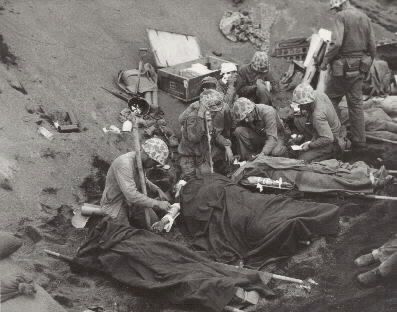
Iwo, by Richard Wheeler, was published in 1980. It describes the assault on Iwo Jima, the next-to-last in the series of Japanese-held islands that American strategists determined were necessary to take in the prelude to the expected invasion of Japan. Wheeler himself was with the Fifth Marine Division on Iwo -- a member, in fact, of Easy Company, some of whose soldiers were caught in AP photographer Joe Rosenthal's famous shot of the flag raising on Mount Suribachi.

As World War II fades into cozy nostalgia, we need from time to time to recall the grim reality. It took a month to capture Iwo. During that time, the island was unsecured, the Marines advancing with heavy losses, a few yards at a time.

Here are a few examples from many of what "unsecured" meant to the Marines whose job was to destroy the enemy, quoted from Wheeler:
Resistance to the landing activities had grown since [Easy Company] had come ashore. The beach was receiving steady artillery and mortar fire, and a chain of destruction was being forged at the water's edge. Useless landing vessels, trucks, jeeps, and other pieces of equipment were settling haphazardly into the surf-soaked sand. The scene included lifeless bodies, many badly torn, reddening the water than lapped about them.

Photobucket

A man on the beach in the 4th Division zone who watched one of the tanks start inland later related: "It was trying to edge over the first terrace when it was hit by a mortar that blew off its right tread. Marines began trying to get out of the turret. Another mortar lit right on the turret. The tank spread apart a little. All the Marines were killed."

Photobucket
Says [Gunnery Sergeant Hap] Mowrey: " ... We approached a bunker. Almost in a detached way I saw a yellow arm flick out and vanish. In an instant I felt the impact of the grenade. I was thrown off my feet, my helmet spun away, and my rifle and bayonet flew out of my hands. I got the feeling I had been cut in two. ... I had multiple wounds, chest and abdomen. I believe the chest cavity was rapidly filling with blood, because breathing became extremely difficult and I could no longer walk. Four men from the company volunteered to take me to an aid station. There were no stretchers, so a poncho was used."

Photobucket

Even as the Marines advanced to the north, they faced two miles stocked with the main forces of the Japanese commander, General Kuribayashi.

The terrain itself, described by an American newsman as looking "like hell with the fire out," was made up of barren plateaus, craggy hills, cliffs, twisting ravines and gullies, crumbling boulders, and struggling brushwood. The defenses numbered in the thousands, many of them mutually supporting. There were blockhouses, bunkers, pillboxes, caves, tunnels, trenches, mortar pits, rocket pits, machine gun nests, spider traps, dual-purpose antiaircraft positions, stationary tanks, antitank ditches, minefields, and booby traps.

Photobucket

It was all a deeply sobering business: trying to advance against an ingeniously concealed enemy, receiving fire not only from the front but from bypassed defenses on the flanks and even in the rear, suffering casualties and more casualties. If you remained unhurt you nevertheless knew you might take a savage blow at any second. You hoped fervently the wound would not be fatal. Huddling in a hole during a barrage, you tried to protect those parts you worried about most, holding an elbow across your face or positioning a rifle stock as a shield for your genitals. You began to realize that you would be willing to give up an arm or a leg for the privilege of staying alive.

Throughout the ordeal, you were obliged to watch the mutilation and destruction of others, often at a range so close that you were splashed with blood. While attacking at your side, your best friend might be disemboweled by a shell fragment, clutching at the cascading viscera and looking up at you with a plea for aid you could not give, his eyes soon glazing over and closing forever.
The Marines didn't want to die for us. They wanted to uphold the esprit de corps, win the war and go home. But we owe
the kind of Memorial Day that we can enjoy this year in part to them and many like them. Lest we forget.

Photobucket

Thursday, May 27, 2010

Another blog posting; women, minorities hardest hit

It is astonishing how the lame-brain media never get the joke that they have become. They are still self-crowned Napoleons on St. Helena island, issuing orders to legions that have long since deserted them.

One of their favorite tropes, now so old it should be in a museum of journalism, is that whatever the subject, it's more of a problem or issue for women and minorities, those two sacred cows of the captive media. I'm sure you've heard the joke, itself now elderly: "Asteroid to destroy earth tomorrow; women, minorities hardest hit."

True to form, USA Today says:

'Don't ask, don't tell' affects women, minorities more

Does the left-lurching giant USA Today not have a single copyeditor who can grasp how foolish this repetitive, mindless tic makes the paper of stuck record sound?

Photobucket

Wednesday, May 26, 2010

Washington has finally listened to me

On May 31, 2007, I wrote a posting headed:

Needed: a troop surge in Tucson

In today's New York Times:

Obama to Send up to 1,200 Troops to Border

Was it only a week ago that Barack "They Don't Have to Show You No Stinkin' ID" Kenyatta was embracing his pal Calderone? When Democrats in Congress gave El Jefe Mexicano standing applause when he spanked Arizona for resisting the spread of the Aztlan Empire? It's a good job Barack finally caught up with my 2007 entry or he might be in bigger trouble with "his" country than he is already.

Of course "up to" means up to, like maybe a few hundred National Guard quartermasters and jeep mechanics. Of course it's no more than a symbolic gesture that Kenyatta and his handlers hope will take some of the heat off them. ("The troops will be stationed in the four border states for a year, White House officials said. It is not certain when they will arrive, the officials said.")

I think U.S. patriots have won a round. This has got to be a root canal for the open borders advocates. Regardless of his motivations, a president has been forced to acknowledge that the Mexican Invasion is real and enough of a danger to send in the National Guard.

Back when I wrote the first posting, Generalissimo Jorge W. Bush and his ruling junta were still babbling about the Mexican colonists bringing family values, honest toil, and better tortillas to El Norte.

Things have gotten a lot worse since then. But to everyone who has stood fast against population replacement: congratulations. This isn't by any means a final victory, but it's a victory.

Photobucket

Tuesday, May 25, 2010

Some say government's drug addiction needs less funding

From the Washington Post, May 24:

Some say government's new strategy to fight drug addiction needs more funding
Overall, the White House has asked Congress to increase spending next year by 3.5 percent on the broad spectrum of drug-control activities -- from curbing drugged driving and expanding drug courts to subsidizing opium and coca farmers in other countries to switch to legal crops. That increase is less than the 4.1 percent increase that President George W. Bush sought to combat drug abuse in 2002, the year his administration developed its first national drug-control strategy.

Moreover, even drug-policy experts who like the new plan's tone say they are disappointed that about two-thirds -- about the same proportion as under Bush -- of the $15.5 billion proposed for drug control in 2011 would be used to try to cut the supply of illegal drugs rather than to lessen people's desire for them.

"The rhetoric is different but the money is essentially the same," said Joseph A. Califano Jr., director of the National Center on Addiction and Substance Abuse at Columbia University.

No, brother. The money is different but the rhetoric is essentially the same. The endless war on drugs is no more winnable the way we're fighting it than the endless war in Afghanistan. The "new strategy to fight drug addiction" is in fact the same old story that plays out daily in countless ways: money borrowed from China and squeezed out of productive citizens so bureaucrats can run midnight basketball schemes.

Photobucket

It's depressing to think that probably 90 percent of federal officials— not just elected ones, but the vast behind-the-scenes legions of administrative drones — could read that article and see nothing wrong with it, or even questionable.

What, am I in favor of drug addiction?

No, I want to cure it. The country's biggest drug addict is the United States government, hooked on debt. This is one blue ribbon junkie, all right. The Lords of Washington don't have to burglarize your house to feed their habit. They can issue more Treasury bills (in other words, IOUs). They can print as much money as they like. (With modern technology, I understand, they don't actually have to print anything. It's all done with a few computer keystrokes.) They can tax you in more ways than you could dream of. Actually you might prefer a burglary; you can insure against that. You can't insure against an out-of-control government.

Photobucket

But what's wrong here is more than just a full employment scheme for state-supported parasites, a political plum for left-voting interest groups, or even money thrown away on fantasy programs ("the plan would pay for experiments in which a network of communities would try to apply the best research evidence to prevent teenagers from starting to use drugs"). It even goes beyond the folly of spending for frivolous projects when the national government is heading for bankruptcy.

There's more.

Photobucket

Psychotherapists have a term: "learned helplessness." Some people, for one reason or another, come to disbelieve they can do anything good for themselves without an enabler: a mate, friend, relative, therapist, protector.

Drug "education" and research on drugs to treat drug addiction sell helplessness. They are self-sabotaging: they send the message to the drug user that addiction is primarily someone else's problem, viz., the state's, and hope lies in state intervention.

Photobucket

Recovering from hard drug addiction is more likely with medical and psychological therapy. While I don't think anyone has a "right" to such help, a humane society should make the effort to provide it. But before they can be helped, addicts need motivation from within. They need to know that ultimately, the responsibility is theirs. And that understanding is hard to summon up in an environment where their country's government is a terrible role model — it can't wean itself from the kick of spending money it doesn't have. And teaches, by example, that people are slaves to their own foolish behavior.

Photobucket

Sunday, May 23, 2010

The Vortexas Rangers

Photobucket

One place I spent some time in on my recent visit to Arizona doesn't seem to be obsessing about the Mexican reconquista. Maybe Sedona doesn't much identify itself with Arizona, or the United States. In some cases, it doesn't identify itself with this world.

Sedona -- about an hour and a half's drive northwest of Phoenix -- has two claims to fame. The first is its visual richness: fantastically shaped, huge cliffs and buttes in layered colors, from brick red to somber gray to luminous. Throw in Oak Creek and you've got cracking scenery almost everywhere you look.

Photobucket

Unsurprisingly, Sedona first attracted visual artists as residents. Max Ernst, one of the two or three greatest surrealist painters, made the town his home in the 1940s.

The second wave of migrants to Sedona, as residents and visitors, came with "New Age" believers. It was discovered that, they say, the area has a half-dozen or so "vortexes" where lines of spiritual energy coalesce and create particularly strong psychic and healing powers. And that's the aspect of Sedona that's most evident nowadays.

Photobucket

Like most towns that have a special attraction for people, Sedona has been developed into a kind of theme park. Vortex World. While the area's natural beauty is certainly part of its allure and helps keep motels and resorts
afloat, it's the psychic business that forms the town's economic backbone.

On the two main commercial highway strips, the standard T-shirt and souvenir shops are almost outnumbered by outlets for psychic reading and healing, crystals, massage, vortex tours in jeeps, yoga centers, a few New Age bookstores, rounded out with tattoo parlors. Other psychics work from their homes. The sheer proliferation of these businesses must make for some jolly intense competition. How do they all pay the rent? Does everyone who lives or passes through Sedona receive wisdom from Illuminated Masters, get healed, get a massage, and add a tattoo daily?

The psychic chamber of commerce distributes maps showing the location of the vortexes. My wife and I drove up Airport Road to find one of them, but oddly, no sign that we could find marked the exact location. I believe that is national forest land, and the government can't quite bring itself to acknowledge the Vortexas Rangers.

Photobucket

For someone
-- such as your blogger -- who accepts the reality of psychic phenomena, including clairvoyance, mediumship, and psychic healing the spectacle presented by the psychic industry in Sedona gives rise to mixed feelings.

While earnest merchandising of "spiritual" goods and services can seem a little crass, there is no reason why crystals with various declared benefits or, for that matter, healing shouldn't cost. Spirituality + capitalism = New Age. Or perhaps, spirituality + New Age = capitalism.

Photobucket

A more serious concern, in my view, is the trendiness of the psychic trade. How many providers are just trying to cash in on the boom? If we limit the discussion to people who claim psychic powers, my experience in Sedona and elsewhere tells me that almost all are sincere in believing that their unusual talents are for real.

It also tells me that some are fooling themselves, and that most find that their mediumship and healing abilities come and go unpredictably. When they're hot, they're hot; not, not. Gamblers and baseball players know when they're on and when they're in a slump. But a baseball player who scores a hit one out of three times is considered an excellent team member. No one accuses him of being a fraud for striking out on two-thirds of his visits to the plate.

Photobucket

And when the mental gateways to the higher spiritual planes steadfastly refuse to open, does a psychic hand the client back the money and say, "Sorry, my guides have taken the day off"? If any ever did, it would be nearly unique. No, they just wing it.

Ever since the fad for spiritualism in the 19th century, there has been heated debate about whether psychics are for real or faking it. But most are both.

Arthur Koestler, the novelist who devoted the latter part of his life to psychical research, wrote:
When I was hunting gurus in India, I came back enriched with one insight. It was: "Never ask whether 'that holy man' is a charlatan or really holy. Just ask to what extent he is a charlatan and to what extent holy. Never apply an all-or-nothing criterion."

Showmanship comes in the moment you get into the eye of the public. Exposed to the public eye of unlimited numbers of followers, you have to apply some showmanship. On bad days, when nothing works, you would be superhuman if your would not resort to 'corriger la fortune' by a few tricks. (Parapsychology Review, May-June 1973.)
When consulting psychic workers in Sedona or anywhere, it is wise to keep in mind that:

1. Some are more talented than others. There is no foolproof way to determine which is which in advance.

2. Even the best are inconsistent.

3. Keep an open mind.
Record the session if you can. Sometimes information you receive via a medium that seems to make no sense or be wrong will be valuable later. My experience with healing is limited -- I did have one session in Sedona -- but I'd say remember this: the healing takes place with subtle energies and works on the non-physical or "etheric" body that your physical body manifests on the material plane. The results might not be dramatic or immediate.

Photobucket

Friday, May 21, 2010

Orderly conduct

With a presidential memorandum signed in the Rose Garden, Obama also ordered federal agencies that have already brought out new standards for cars and light trucks for the 2012-2016 model years to begin work on even stronger rules for 2017 and beyond.

— Associated Press, May 21

Photobucket

What's with this "Obama ordered" phrase that seems to be popping up more and more frequently?

What is a presidential memorandum and what gives Barack "Kingfish" Obama the power to tell the government to get busy writing "even stronger rules"?

Do federal agencies now exist only to carry out diktats from the Holy Office at 1600 Pennsylvania Avenue?

We are entering a dark forest, and the light is seeping from the sky.

Photobucket