
Samuel Johnson described a second marriage as a triumph of hope over experience.
This headline illustrates another such hope:
Islam Urged to Accept Enlightenment
Friday, January 12, 2007


Wednesday, January 10, 2007
Provincial reconstruction
Bush is expected to announce plans to double the number of provincial reconstruction teams and call for big new job and loan programs and a renewed reconstruction effort. … Senior U.S. officials are calling for an increase in civilian workers to accompany the expected addition of up to 20,000 troops.
Los Angeles Times, January 10, 2007
With Democrats now in charge on Capitol Hill, a 700-mile fence that swept through the previous Republican-controlled Congress is apt to come under a scathing re-evaluation amid reports of skyrocketing costs and widening opposition along the U.S.-Mexican border. … The growing outcry from local officials parallels renewed concerns over costs following a report that the price tag for building and maintaining the fencing could reach nearly $50 billion over a 25-year period.
"We've been relying too much on the National Guard to protect Mexican migrants seeking a better life in Mexico del Norte," said Bush-Gonzales in a speech to the National Aztlan Conference of Hidalgos. "Even with 20,000 additional troops being dispatched to the area to counter the dead-ender American loyalists, we need to look at the big picture. This plan will deal with the root causes of disorder — lack of Spanish-language proficiency, Anglo extremists who recruit young men in schools funded by Australians, entire urban blocks without a single taqueria."
The Bush-Gonzales initiative calls for major civilian involvement, including 100,000 social workers to provide counseling and administer welfare payments to the unemployed, who have grown to 90 percent of the state population since the Amnesty Bill (officially called the Guest Worker Bill) was passed in 2007. In addition, they will perform outreach in remote areas of Old Mexico and Central America where residents may not be fully aware of the opportunities up north.
"It isn't enough that our new Mexican Americans aren't doing the work that Americans won't not do," Bush noted. "We need to make sure there aren't underserved populations that are denied the opportunity to not do the work that Mexican Americans are not doing that Americans won't do."
Family values don't stop at the border, the president said, "because there is no border."
Critics scoffed at the idea of building a fence around Southwest Mexico del Norte to prevent intrusions by American militants. "We blew 468,677,200,299,218,348.204.98 Ameros trying to bring hearts and minds to Iraq," said Alberto Q. Indigenos, El Jefe de Ciudads Unidos de Calexico. "Now we need to look after our homies. We must provide jobs programs for gringos so there will be more work they won't do, so there will be more work for our people to not do."
Sacramento Bee, January 10, 2007
Tucson, Mexizona, Cinco de Mayo, 2015 — President Jeb Bush-Gonzales has announced a 20 trillion Amero ($50 billion) plan, to be implemented over the next 25 years, to counter the insurgency by Americans in the lawless regions of Southwest Mexico del Norte."We've been relying too much on the National Guard to protect Mexican migrants seeking a better life in Mexico del Norte," said Bush-Gonzales in a speech to the National Aztlan Conference of Hidalgos. "Even with 20,000 additional troops being dispatched to the area to counter the dead-ender American loyalists, we need to look at the big picture. This plan will deal with the root causes of disorder — lack of Spanish-language proficiency, Anglo extremists who recruit young men in schools funded by Australians, entire urban blocks without a single taqueria."
The Bush-Gonzales initiative calls for major civilian involvement, including 100,000 social workers to provide counseling and administer welfare payments to the unemployed, who have grown to 90 percent of the state population since the Amnesty Bill (officially called the Guest Worker Bill) was passed in 2007. In addition, they will perform outreach in remote areas of Old Mexico and Central America where residents may not be fully aware of the opportunities up north.
"It isn't enough that our new Mexican Americans aren't doing the work that Americans won't not do," Bush noted. "We need to make sure there aren't underserved populations that are denied the opportunity to not do the work that Mexican Americans are not doing that Americans won't do."
Family values don't stop at the border, the president said, "because there is no border."
Critics scoffed at the idea of building a fence around Southwest Mexico del Norte to prevent intrusions by American militants. "We blew 468,677,200,299,218,348.204.98 Ameros trying to bring hearts and minds to Iraq," said Alberto Q. Indigenos, El Jefe de Ciudads Unidos de Calexico. "Now we need to look after our homies. We must provide jobs programs for gringos so there will be more work they won't do, so there will be more work for our people to not do."
Tuesday, January 09, 2007
The list, updated again
Sunday, January 07, 2007
Acting our age
It can easily be argued that greatness in the fine arts has come and, mostly, gone. Really: would you claim that anything being done today in sculpture rivals ancient Greece or the Renaissance? That today's "classical" music is on a par with that of the 18th and 19th centuries? That hip-hop rivals songs by Irving Berlin, Cole Porter, or Harold Arlen? That contemporary painting -- well, you get the idea.
It occurred to me -- not for the first time -- while watching a couple of movies on DVD last week that the only art form that, as a whole (not just in a few individual examples), is experiencing a genuine, 24-karat Golden Age now is film acting.
The reason for it is a mystery to me. Better acting schools? Better film directors? More demanding audiences? (Nah, not that.) I first began to notice a significant improvement during my last stint as a paid film reviewer in 1990. It wasn't a matter of a few big stars, like in previous eras. (Anyway, most of the stars of, say, the '30s and '40s just had strong personalities they could project on screen, which isn't the same as acting. There were a handful of exceptions, mostly English stage players, but most of the so-called acting in movies until recently was either dull or scenery-chewing obviousness.) More and more, I began to notice extremely professional work, in lead roles, supporting roles, even in bit parts.
Admittedly, now that I no longer watch movies and write about them as a journalist, I'm pretty selective about what I choose to see. Still, even in the mediocre films or downright turkeys that I inadvertently let myself in for from time to time, there are almost always one or more performances that leave me thinking, "Gee, too bad he (she) didn't have a better script to work with."
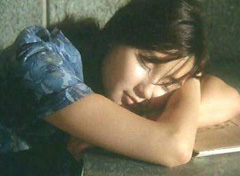
But lordy, what performances by the five leads, with the young Maggie Cheung first among equals. They are totally in character all the time, in synch with one another, no excess gestures or blank spots.
Where did such virtuosity spring from? I don't think that China has any tradition of naturalistic, Western-style acting. It's as though it just emerged, ex nihilo. No doubt the potential was there all the time, but it needed the right combination of circumstances, whatever those were. One reason is easy to guess: Wong Kar-Wai is a thumping good actor's director.

In the French film "Gabrielle," Jean Hervey (Pascal Greggory) introduces himself to us via a voice-over in which he self-satisfiedly glides over the past 10 years of his life: how he met his wife Gabrielle (Isabelle Huppert), decided she would be the perfect accompanist for his rise in the haute bourgeoisie -- the house has about eight maidservants -- his knack for making money, and how their dinner parties now attract the well-to-do plus some artistic types for a little spice. He arrives at their antique-laden home unexpectedly early to find a letter from Gabrielle informing him that she is leaving him to be with another man. While Jean is digesting that shock, his carefully constructed world having been torn asunder, he receives another: Gabrielle returns. She couldn't go through with it. Most of the rest of the film, based on a Joseph Conrad story, is virtually a two-hander as Jean and Gabrielle grapple with their emotional upheavals individually and together.
"Gabrielle" annoyed me straightaway. The setting, to judge by the clothing, hair, and décor styles, is Paris just before the Great War -- about 1912. But as Jean walks home from the train station delivering his smug monologue, there are two shots with automobiles dating from the late 1920s. I hate such anachronisms in period pieces. Although this was a comparatively big budget film (Isabelle Huppert doesn't exactly make minimum wage, and the thing was shot in a widescreen 2.35-to-1 aspect ratio), it's possible the production designer couldn't obtain cars of the correct vintage. In that case, though, why not just use carriages instead? There were plenty of them still on the streets, even in ritzy Paris, at the time.
The director, Patrice Chéreau, plays other silly tricks. The film switches from color to black-and-white periodically, for no discernible reason. He puts continuity information (e.g., "Le lendemain," the next day) in huge superimposed lettering, or sometimes in white type on a black background, as in a silent film. Although Chéreau has made quite a few films before, he still apparently doesn't have the confidence to do without arty gimmicks.
It's too bad, because when he does play it straight -- and, in fairness, that's most of the time -- he knows how to squeeze the maximum juice out of a scene. For one example: Gabrielle is being tended to by one of her maids, Yvonne, but is still so shaken up by her own behavior that she feels a need to reveal some of her feelings to the maid. What follows is a little masterpiece of psychological observation: Gabrielle talks to Yvonne as to another human being; then, as if she remembers their relative social positions and is ashamed at opening up to a servant, turns insolent; then, unable to help herself, asks Yvonne personal questions; again becomes haughty toward Yvonne because of her own breach of the social code. Meanwhile, Yvonne's responses are equally uncertain, from the reverse perspective, not sure how to handle such confidences from her employer.
Mostly, though, "Gabrielle" is about Jean and Gabrielle, each trying to work out what this rupture of their habitual life means to them. They wheel from anger to shame to regret and, in Jean's case, to something like pleading. And while their shifting moods aren't always different from one another's, they don't match at the same time. I don't know how much of the script comes from Conrad's story, but some of it feels bracingly authentic. Both of these characters are, in their own ways, fools for love, but neither understands how to handle love.
French films can be too subtle for their own good, especially when they consist largely of cold, intellectual dialogue. In "Gabrielle," though, the subtlety mostly pays off, because the two leading actors let you know what they're trying to say, even when they can't. And the film respects their ambivalence. It isn't a simple-minded sermon about how repressed these people are and how they'd be sorted out if only they'd learn to express their feeeeelings. Part of the reason you empathize with Jean and Gabrielle is that they continue to honor self-control and dignity, even in the breach.
Greggory is persuasive as Jean, but it's Huppert you'll remember. I must have seen her in a couple of dozen films, but she has never acted better, or been more beautiful -- although she must be well into her 50s -- than here. She delivers a performance of astonishing insight, variety, and depth. Watching her in "Gabrielle" can sometimes tear you up. I mean that, of course, as a great compliment.
It occurred to me -- not for the first time -- while watching a couple of movies on DVD last week that the only art form that, as a whole (not just in a few individual examples), is experiencing a genuine, 24-karat Golden Age now is film acting.
The reason for it is a mystery to me. Better acting schools? Better film directors? More demanding audiences? (Nah, not that.) I first began to notice a significant improvement during my last stint as a paid film reviewer in 1990. It wasn't a matter of a few big stars, like in previous eras. (Anyway, most of the stars of, say, the '30s and '40s just had strong personalities they could project on screen, which isn't the same as acting. There were a handful of exceptions, mostly English stage players, but most of the so-called acting in movies until recently was either dull or scenery-chewing obviousness.) More and more, I began to notice extremely professional work, in lead roles, supporting roles, even in bit parts.
Admittedly, now that I no longer watch movies and write about them as a journalist, I'm pretty selective about what I choose to see. Still, even in the mediocre films or downright turkeys that I inadvertently let myself in for from time to time, there are almost always one or more performances that leave me thinking, "Gee, too bad he (she) didn't have a better script to work with."
Maggie Cheung in "Days of Being Wild"
Wong Kar-Wai's "Days of Being Wild" was the first of my cinematic adventures last week. I've been seeing Wong's movies in reverse chronological order, having first encountered this director's work in his brilliant "2046." Later I caught up with the earlier "In the Mood for Love," and found it, too, exceptional, if not as stylistically and thematically powerful as "2046."
"Days of Being Wild" is from earlier still (1991). An accomplished piece of work, with (once again) the benefit of Christopher Doyle's seductive cinematography, it's nevertheless more conventional than "2046" or "Mood," a love pentangle that's only a step or two above soap opera. (I'm also getting a little tired of Wong's Old Hollywood cliché of dramatizing scenes by shooting them in buckets of rain.)
"Days of Being Wild" is from earlier still (1991). An accomplished piece of work, with (once again) the benefit of Christopher Doyle's seductive cinematography, it's nevertheless more conventional than "2046" or "Mood," a love pentangle that's only a step or two above soap opera. (I'm also getting a little tired of Wong's Old Hollywood cliché of dramatizing scenes by shooting them in buckets of rain.)
But lordy, what performances by the five leads, with the young Maggie Cheung first among equals. They are totally in character all the time, in synch with one another, no excess gestures or blank spots.
Where did such virtuosity spring from? I don't think that China has any tradition of naturalistic, Western-style acting. It's as though it just emerged, ex nihilo. No doubt the potential was there all the time, but it needed the right combination of circumstances, whatever those were. One reason is easy to guess: Wong Kar-Wai is a thumping good actor's director.
In the French film "Gabrielle," Jean Hervey (Pascal Greggory) introduces himself to us via a voice-over in which he self-satisfiedly glides over the past 10 years of his life: how he met his wife Gabrielle (Isabelle Huppert), decided she would be the perfect accompanist for his rise in the haute bourgeoisie -- the house has about eight maidservants -- his knack for making money, and how their dinner parties now attract the well-to-do plus some artistic types for a little spice. He arrives at their antique-laden home unexpectedly early to find a letter from Gabrielle informing him that she is leaving him to be with another man. While Jean is digesting that shock, his carefully constructed world having been torn asunder, he receives another: Gabrielle returns. She couldn't go through with it. Most of the rest of the film, based on a Joseph Conrad story, is virtually a two-hander as Jean and Gabrielle grapple with their emotional upheavals individually and together.
"Gabrielle" annoyed me straightaway. The setting, to judge by the clothing, hair, and décor styles, is Paris just before the Great War -- about 1912. But as Jean walks home from the train station delivering his smug monologue, there are two shots with automobiles dating from the late 1920s. I hate such anachronisms in period pieces. Although this was a comparatively big budget film (Isabelle Huppert doesn't exactly make minimum wage, and the thing was shot in a widescreen 2.35-to-1 aspect ratio), it's possible the production designer couldn't obtain cars of the correct vintage. In that case, though, why not just use carriages instead? There were plenty of them still on the streets, even in ritzy Paris, at the time.
The director, Patrice Chéreau, plays other silly tricks. The film switches from color to black-and-white periodically, for no discernible reason. He puts continuity information (e.g., "Le lendemain," the next day) in huge superimposed lettering, or sometimes in white type on a black background, as in a silent film. Although Chéreau has made quite a few films before, he still apparently doesn't have the confidence to do without arty gimmicks.
It's too bad, because when he does play it straight -- and, in fairness, that's most of the time -- he knows how to squeeze the maximum juice out of a scene. For one example: Gabrielle is being tended to by one of her maids, Yvonne, but is still so shaken up by her own behavior that she feels a need to reveal some of her feelings to the maid. What follows is a little masterpiece of psychological observation: Gabrielle talks to Yvonne as to another human being; then, as if she remembers their relative social positions and is ashamed at opening up to a servant, turns insolent; then, unable to help herself, asks Yvonne personal questions; again becomes haughty toward Yvonne because of her own breach of the social code. Meanwhile, Yvonne's responses are equally uncertain, from the reverse perspective, not sure how to handle such confidences from her employer.
Mostly, though, "Gabrielle" is about Jean and Gabrielle, each trying to work out what this rupture of their habitual life means to them. They wheel from anger to shame to regret and, in Jean's case, to something like pleading. And while their shifting moods aren't always different from one another's, they don't match at the same time. I don't know how much of the script comes from Conrad's story, but some of it feels bracingly authentic. Both of these characters are, in their own ways, fools for love, but neither understands how to handle love.
French films can be too subtle for their own good, especially when they consist largely of cold, intellectual dialogue. In "Gabrielle," though, the subtlety mostly pays off, because the two leading actors let you know what they're trying to say, even when they can't. And the film respects their ambivalence. It isn't a simple-minded sermon about how repressed these people are and how they'd be sorted out if only they'd learn to express their feeeeelings. Part of the reason you empathize with Jean and Gabrielle is that they continue to honor self-control and dignity, even in the breach.
Greggory is persuasive as Jean, but it's Huppert you'll remember. I must have seen her in a couple of dozen films, but she has never acted better, or been more beautiful -- although she must be well into her 50s -- than here. She delivers a performance of astonishing insight, variety, and depth. Watching her in "Gabrielle" can sometimes tear you up. I mean that, of course, as a great compliment.
Friday, January 05, 2007
Visa lottery: Free tickets to the Promised Land!
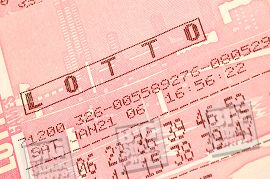
U.S. Department of State Form 062236394652,
Notice of Prize: U.S. Citizenship.
Odds of winning: 50,000 out of 6.4 million.
Notice of Prize: U.S. Citizenship.
Odds of winning: 50,000 out of 6.4 million.
The U.S. Department of State reported that it received more than 6.4 million entries for the 50,000 visas available through [the] 2008 Diversity Visa Lottery. … Adding entrants' family members, more than 10 million people are trying to get permanent residence through this year's lottery. The largest number of applicants were from Bangladesh (more than 1.7 million applicants), followed by Nigeria (684,735) and Ukraine (619,584).In other words, the U.S. government believes the country is so lacking in diversity that it must hand out 50,000 "citizenships" plus thousands of additional "citizenships" for the lucky winners' families every year. I put "citizenships" in quotes because using this terminology turns the very concept of citizenship into a joke: a lottery prize, based on nothing whatever except the desire of millions of people deemed sufficiently diverse to come soak up whatever they can from the legacy of wealth created by earlier generations of Americans. It's a better deal than an Irish Sweepstakes ticket, which you have to pay for (and pay taxes on your winnings).
When I was in New York last week, I rode the city buses and subways. Of the conversations I overheard, perhaps one of five was in English. True, some of the people I heard may have been tourists from non-English speaking countries, but it cuts both ways: some of the English speakers might have been English-speaking, or English-as-a-second-language-speaking, American tourists.
But maybe Bangladeshis, Nigerians, and Ukranians were, as the liberal quota hawks like to say, "underrepresented" in the subway crush. So, based on the logic of social engineering, we must hand out "citizenship" so that every nationality is found in the United States in strict proportion to its percentage of the world population. If, let us say, Madagascar has 0.35 percent of the people on earth, we must send out a dragnet to bring in enough Madagascarans to make them 0.35 percent of the United States population.
A few dozen more Diversity Visa Lotteries and the quaintly termed United States will be … wait for it … the whole world in microcosm! We are the world! All we need to add to the mix is to lure Kofi Annan out of retirement (we can easily offer him a rakeoff to top what he skimmed from UN programs) as our leader, with a few dozen old Brussels hands to write our laws, triple the number of government agencies and quangos, and Heaven on Earth is ours.
Play the planetary lottery. You could win a country as a prize. Hey, you never know.
Thursday, January 04, 2007
(Micro)soft in the head
In today's Wall Street Journal, personal technology guru Walter S. Mossberg kicks off the Great Leap Forward re-education camp on behalf of Microsoft Office 2007's "bold redesign." He's in Mr. Softee's amen chorus, but even he says of Office's "radical revision":
Ah, but we persisted; the prospect of becoming technologically unemployed concentrates the mind wonderfully. We learned what we needed, and came to appreciate some of it. I can't imagine a writer whose quality of life hasn't been improved by word processing.
And now, instead of being permitted by Mr. Softee to relax and enjoy our hard-won computer skills, we're going to be sent back to basic training. More classes fronted by drill sergeant instructors ramming new technobabble into our heads. More hours heads-down in manuals that explain what's supposed to be so much easier to use. More newspaper and magazine columns answering questions from Office Nought Seven newbies reduced to plaintive desperation: "Every time I go to Level Three on the Ribbon, activate the System Articulation and select Flow Screen, the program spawns Triple Witching Frames and downcompensates a Message Analogue that indicates I have encountered a baseless time error and tells me to come back after lunch. What can I do to correct this problem before the boss gets in a 8 a.m. tomorrow and wants my report?"
Even Mr. Mossberg, the very model of the Digital Wiz, who approves Microsoft's No User Left Unconfused initiative, confesses: "It [the redesign] requires a steep learning curve that many people might rather avoid. In my own tests, I was cursing the program for weeks because I couldn't find familiar functions and commands, even though Microsoft provides lots of help and guidance."
Technology company managers and software designers have a steep learning curve of their own, and a goodly number of them are flat where the curve should be. They never seem to figure out that what 95 percent of users want is not Quantum Leap no. 34, a Bold New Interface, hundreds of new functions, or vast new opportunities to make bits and bytes zip this way and that. Normal people who get out in the sunlight more often than computer techies tend to do want programs that let them perform a few desirable tasks in a manner that is simple, predictable, and consistent from year to year.
Sure, existing Microsoft programs have various irrational characteristics (what bright spark decided that Word's "Shut Down" should be on the "Start" menu?), but anybody who's used the Office software for a while has either learned to deal with the oddities or developed work-arounds. Besides, it's a dead cert that the New, Improved Office with Miracle Ingredient Q-SPRM 475TG will have just as many senseless features and require as many patches as Joseph's coat.
Virtually everyone who works regularly with the old Office suite is comfortable with it and finds that it meets their needs just dandy. Wouldn't it be a real great leap forward if consumers treated Mr. Softee's latest war against people as though its every installation disc had been aged in botulism?
I hope Office '07 turns out to be Microsoft's New Coke.
I don't use the word "radical" lightly. The entire user interface, the way you do things in these familiar old programs has been thrown out and replaced with something new. In Word, Excel and PowerPoint, all of the menus are gone — every one. None of the familiar toolbars have survived, either. In their place is a wide, tabbed band of icons at the top of the screen called the Ribbon. And there is no option to go back to the classic interface.Got that? Remember how you struggled to grasp Microsoft's new programs and operating systems when they began to fence in the range in the early '90s? All those classes and tutorials and remedial reading — "how to" books you paid for to help you understand what was supposed to be so "intuitive" and user friendly with "Help" menus that would leap to your aid the second you typed in a question? (Maybe you found the whole brain circus exhilarating, but quite a few of us turned prematurely gray or had to be gently led off, gibbering, to a care facility for slipped hard disk victims.)
Ah, but we persisted; the prospect of becoming technologically unemployed concentrates the mind wonderfully. We learned what we needed, and came to appreciate some of it. I can't imagine a writer whose quality of life hasn't been improved by word processing.
And now, instead of being permitted by Mr. Softee to relax and enjoy our hard-won computer skills, we're going to be sent back to basic training. More classes fronted by drill sergeant instructors ramming new technobabble into our heads. More hours heads-down in manuals that explain what's supposed to be so much easier to use. More newspaper and magazine columns answering questions from Office Nought Seven newbies reduced to plaintive desperation: "Every time I go to Level Three on the Ribbon, activate the System Articulation and select Flow Screen, the program spawns Triple Witching Frames and downcompensates a Message Analogue that indicates I have encountered a baseless time error and tells me to come back after lunch. What can I do to correct this problem before the boss gets in a 8 a.m. tomorrow and wants my report?"
Even Mr. Mossberg, the very model of the Digital Wiz, who approves Microsoft's No User Left Unconfused initiative, confesses: "It [the redesign] requires a steep learning curve that many people might rather avoid. In my own tests, I was cursing the program for weeks because I couldn't find familiar functions and commands, even though Microsoft provides lots of help and guidance."
Technology company managers and software designers have a steep learning curve of their own, and a goodly number of them are flat where the curve should be. They never seem to figure out that what 95 percent of users want is not Quantum Leap no. 34, a Bold New Interface, hundreds of new functions, or vast new opportunities to make bits and bytes zip this way and that. Normal people who get out in the sunlight more often than computer techies tend to do want programs that let them perform a few desirable tasks in a manner that is simple, predictable, and consistent from year to year.
Sure, existing Microsoft programs have various irrational characteristics (what bright spark decided that Word's "Shut Down" should be on the "Start" menu?), but anybody who's used the Office software for a while has either learned to deal with the oddities or developed work-arounds. Besides, it's a dead cert that the New, Improved Office with Miracle Ingredient Q-SPRM 475TG will have just as many senseless features and require as many patches as Joseph's coat.
Virtually everyone who works regularly with the old Office suite is comfortable with it and finds that it meets their needs just dandy. Wouldn't it be a real great leap forward if consumers treated Mr. Softee's latest war against people as though its every installation disc had been aged in botulism?
I hope Office '07 turns out to be Microsoft's New Coke.
Subscribe to:
Posts (Atom)