Monday, June 11, 2007

Don't tread on us

On my observing to him that a certain gentleman had remained silent the whole evening, in the midst of a very brilliant and learned society, “Sir, (said he,) the conversation overflowed, and drowned him.”

James Boswell, Life of Johnson

About the so-called comprehensive immigration bill, I was starting to feel like that poor gentleman who found himself in the eloquent company of Samuel Johnson and his circle. Practically every blogger who mattered to me took up the subject, often with more knowledge and sharper logic than I could bring to the table. What could I add?

Writers hate to repeat themselves. How many different ways can you point out that venal politicians, from the president on up, were determined to give the benefits of American citizenship to millions of people who had done nothing to earn it – who had, in fact, entered the country and remained in it illegally and criminally, and who would bring with them an unstoppable chain of relatives and followers? Who would degrade the quality of American life through further overpopulation and demands on social services; most of whom had no desire to assimilate with our culture or contribute anything to it; whose only motivation was to milk the system for whatever they could?

Then, for a few magic hours, the clouds parted. The bill to transition the U.S. into the Third World was stopped in the Senate on a prcedural issue, but there was a sense that — other than the usual incorrigibles — legislators were beginning to wonder whether voting for such a bill would be a wise career move. Even the New York Times had to acknowledge that this pseudo-compromise over immigration didn't fool most of the people most of the time, and that the much invoked but rarely heard from "grassroots" voters had finally made themselves known.

The Bush-Kennedy-McCain Axis of Weevils had lost. We'd won. How sweet it was.


That's not the end of the story, of course. Mexico's ambassador to the United States, George W. Bush, was offended that mere citizens had taken it upon themselves to stand in the way of his Master Plan for "solving" the problems caused by virtually unrestricted immigration (problems for which he was more responsible than anyone). What a nerve.

"Amigos, we've got to do something about these little people who think family values stop at the Rio Grande. Get Linda Chavez on the phone and tell her to do another column about how opponents of My edict, er, bill are bigoted racists. Tell what's-his-name, that Reid character, to put a cork in all the other business and get back to pushing My Legacy. Set up a prayer meeting at the Capitol between Me and all the Republicans you can round up. We'll promise 'em they'll get knighthoods or medals or girls or boys or whatever, just make sure they've got the picture. It'll be in the bag by lunchtime tomorrow."

I don't know, any more than anyone else, how far our obsessive-compulsive leader of the free world will go in aid of his Master Plan. It would not surprise me if he is at this moment meeting with constitutional lawyers, probing the possibility of some sort of executive order (we're at war, remember) he could sign that would bypass the inconvenience of legislation and erase the borders with a stroke of the pen. Maybe that's what he actually had in mind with "see you at the signing." Or maybe he was thinking of miraculous signs in the sky that would show him the way to victory — in hoc signo vinces.

He's not going to quit till we do.

Still, I think the political equation has changed. Millions of previously quiescent voters found that they could make themselves heeded on something that mattered enough. The whole immigration issue is now under the spotlight and is going to stay that way; no more chances to sneak amnesty through at night in proceedings illuminated only by a poacher's moon. Bush's self-inspired determination to ignore the voice of the people is now plain to see.

Americans have gotten a taste, perhaps for the first time in their lives, of what it means to overcome the corporate interests and their running dogs in Congress, the Democrat immigrant-vote harvesters, and the social work bureaucracy itching to magnify its client base with a grand influx of new case fodder.

It's not the neocon all-purpose elixir, democracy, which doesn't poll well in Iraq and which has been notably missing from the immigration controversy. Call it the revival of a concept so unfashionable that the very word is hardly ever used in political discourse any more: liberty. Meaning, among other things, people taking back the responsibility for their own condition. At the time Samuel Johnson was dazzling his listeners in London, some Americans designed a flag. It said, Don't Tread on Me.

Wednesday, June 06, 2007

Tying shoelaces: Yes you can!

Fathers should strip off their shirts before holding their newborn babies to aid the "bonding" process, says a booklet funded by the Government.

The pamphlet, which has prompted accusations about interference from the nanny state, also recommends that they should gaze into their baby's eyes for short periods to develop the child's brain. It also suggests that fathers should be rewarded with gift vouchers if they attend antenatal classes.

The booklet, Including New Fathers: A Guide for Maternity Professionals, has been published by Fathers Direct, a publicly funded charity that advises the Government on fatherhood.

The Telegraph, June 5


Yes You Can! A Guide to Tying Shoelaces
Pamphlet #127-16-345B-12
Prepared by Shoes You Can Use
With the Kind Support of Her Majesty's Government

Many of our new residents in today's multi-cultural Britain have little or no experience with tying shoelaces. After all, sandals have no shoelaces, and nor do yakskin boots! In fact, you may not be entirely familiar with the concept of shoes. So let's start at the beginning, shall we?

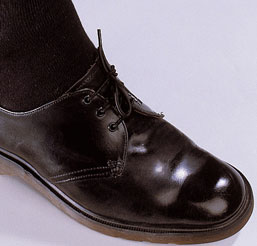
Take a look at Figure 1.

elshlacew_la
Figure 1. Shoe.

Now, this may not be the kind of shoe you and your mates are familiar with. This is somewhat different from the athletic shoes you are used to robbing people for or nicking from Marks & Spencers. These are what are called — don't laugh please — dress shoes. Not what you think. They're called that because you may sometime be expected to wear them when you "dress up" as the expression goes, such as if you should get a job in an office, or burglarise an office and do not want to call attention to yourself.

The thing about it is, these shoes don't wrap themselves tightly around your feet (see pamphlet #129-75-BH-16, "Recognizing Common Body Parts") unless you tie something to stop them coming loose. That something is called shoelaces (Figure 2).

225px-Shoelaces_20050719_001
Figure 2. Shoelaces.

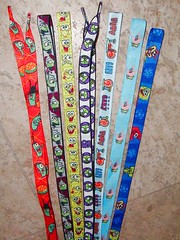
Do not be confused if you run across shoelaces that don't look like this at all. They come in all colours, even multiple colours on the same laces (Figure 3).

shoelaces-spongebob-lg
Figure 3. Cool shoelaces.

The chances are, when you buy a new pair of shoes that need to be laced, most of the bother will have been done for you already. The laces will have already been inserted in the proper holes. All you need to do is tie the ends together in a knot, typically a bow knot.

Still with us, mate? Right, then. Here's how you tie your laces in a bow knot.

Pass one shoelace end under the other and pull both of them smartly. Now, keeping the crossed lace ends tight, take one end and loop it. Take the other end and wrap it around the base of the loop.

Next, take that other end and pass it under — no, hang about. Pass it through — er, wait just a tick.

Let's see, you've got one end looped, the other end wrapped around the bottom of the loop … now … blimey.

Look mate, we're not kidding you up. You really can tie shoelaces. For the rest of the dish on how to get on with it, consult pamphlet #433-34-DS-33RM, "Advanced Course: Exxtreme Shoelace Tying."

Best of British luck to you, mate!

Monday, June 04, 2007

Lucky this time

Terrorism Plot

U.S. counterterrorist forces have done themselves proud again in rolling up the Muslim plotters who intended to blow up a fuel pipeline servicing JFK airport in New York, which if successful would have caused almost inconceivable harm. From the information released, it sounds like a beautifully run sting operation by the authorities, who deserve credit and our gratitude. Maybe this country is finally getting its heretofore abysmal counterterrorist act together.

I hate to be a wet blanket, but while justly celebrating this success, we are to keep a few important points in mind.

The plot was infiltrated by an informant. The details are a little unclear, but apparently the convicted drug dealer either went to the police or FBI in exchange for a deal, or was already involved, caught, and "turned." The AP story said:
Tom Corrigan, a former member of the FBI-New York Police Department Joint Terrorism Task Force, said the Kennedy airport case and the recent plot to attack Fort Dix illustrated the need for inside information. Six men were arrested in a plot to attack soldiers at the New Jersey military base after an FBI informant infiltrated that group. "These have been two significant cases back-to-back where informants were used," Corrigan said. "These terrorists are in our own backyard. They may have to reach out to people they don't necessarily trust, but they need - for guns, explosives, whatever."

Without informants, Corrigan said, investigators are often left with little more than educated guesswork. "In most cases, you can't get from A to B without an informant," said the ex-NYPD detective.
No doubt true — and the trouble is, there's not always going to be an informant. A lot of these jihadists don't seem to be among God's brighter children, but that won't always be the case, either. Especially now that the authorities have twice (in this and the Fort Dix plot arrests) revealed their modus operandi. You can figure that the sleeper cells or freelance terrorists already working on the next plan are going to be twice as suspicious and on the lookout for double agents.

In my view, the U.S. counterterrorism agencies should keep absolute radio silence on their tactics. They should be revealed only in court in closed sessions. In this life-and-death game, you don't send memos to your opponents about your methodology. That is, you shouldn't. A few years ago, in a lead front page story in USA Today, a whole batch of politically appointed birdbrains in airport security positions explained exactly what behavioral clues they were looking for among passengers.

Once again, the plotters this time were militant Muslims (including one who had resided in this country for 30 years). The USA, the world's no. 1 sucker, not only accepts but encourages immigration by Muslims. The Multi-Culti Establishment thinks the country would be nothing if not constantly nourished by immigrants from anywhere and everywhere, as long as they're Third World countries.

So we wave them in with nary a passing thought, and some turn to plans for carnage, and those plans may issue in action. Thus our counterterrism agencies, whatever their skills and resources, must particpate in a perpetual game of hide-and-seek.

No more Muslims should be admitted to the United States except for the briefest of visits (with their exits monitored and enforced) until their religio-political system learns to work and play well with others.

Severe? Yup. Want to think about more severe still? Try to imagine the JFK plot succeeding.

Because one of these days something like it will. The cell leader will be real smart. All the participants will be checked out six ways from Sunday and any double agent will be executed. And there won't be any slip-ups that time. As the IRA said to Prime Minister Margaret Thatcher after they nearly killed her with a bomb at a party conference: "You were lucky this time. But you need to be lucky every time. We only need to be lucky once."

We were lucky this time.

Thursday, May 31, 2007

Needed: a troop surge in Tucson

illegal

I lived in Tucson, Arizona, for three years. No compelling reason. It was by choice, even though I knew the employment opportunities there weren't great (and that turned out to be too right). I liked the landscape, the Spanish and Pueblo style architecture, and the general laid-back friendliness of the people.

Today, thanks to our criminally irresponsible president and politicians who collude with him, Tucson is about to become a war zone, according to one local observer.
Northern Mexico is in a state of war. Who is fighting? That’s hard to say. Officially, it is the drug- and people-traffickers against each other and the government. But in Mexico, you can’t tell the players even with a program. You cannot assume the police or the Army are loyal to their commands. Many are working on their own. …

It is not too much to say there is a war going on right across the border. It’s not a hot war with firefights all the time. It is not a cold war, either, with posturing and press releases. Let’s call it a warm war. Violence breaks out from time to time for reasons unknown to us, but completely unpredictable.

And here’s the part you don’t want to hear. Violence has spread across the border and has resulted in several deaths of Americans residents and visitors. Most such crimes are reported as isolated incidents. But the violence in northern Mexico is not stopping at the border. It’s headed this way and a lot of Tucsonans know it.

Are these the words of some militiaman crank? I wish. But in fact they were published in — are you ready for this? — Inside Tucson Business. That's right; a business newspaper. Not the sort of forum where you find wild-eyed fanatics spewing paranoia.

The writer, Lionel Waxman, wants his readers to face reality.

You can’t learn about it in most media, but the whispers around town are people saying they are thinking of getting out. It looks like war and it’s coming here. No government has acted to protect Americans living in Southern Arizona. Our federal government is in full collapse as far as the southern border is concerned. All we get from them is talk. The only action we see is toward integrating Mexico into the U.S. and Canada.

What will it mean when the border is actually abandoned and anybody is free to enter without inspection? It will mean that Southern Arizona, specifically Tucson, could become like Cananea [where five policemen and two residents were assassinated] and other parts of northern Mexico. Violence will overtake local police. State and federal authorities will look the other way. …

The federal government should put troops on the border to defend the United States and its citizens. The troops should be given orders to use as much force as necessary to accomplish that task. No soldiers should be detailed to do paperwork and forbidden to fire on violators. This is another war and if we don’t act like it, we will lose this one too.

This war isn’t on the other side of the world. This is for our homes, our homes, our homes.

If you don't happen to live near the Mexican border, you have no reason to be complacent.

Once George W. Bush and his devil-spawned collaborators get their precious immigration "reform" bill passed, there will be no border, and Mexico — in all its corruption, violence, and poverty — will overflow. A huge area of Los Angeles has already been lost to Mexican gang warfare. You might still keep the war from where you live, but only if you spike the plans of Bush, Kennedy, and the rest of the amnesty pushers. There isn't much time left.

Your move.

Monday, May 28, 2007

Zanoni

Purple light bar

“In ages far remote — of a civilisation far different from that which now merges the individual in the state, there existed men of ardent minds, and an intense desire of knowledge. In the mighty and solemn kingdoms in which they dwelt, there were no turbulent and earthly channels to work off the fever of their minds. Set in the antique mould of castes through which no intellect could pierce, no valour could force its way, the thirst for wisdom, alone, reigned in the hearts of those who received its study as a heritage from sire to son. Hence, even in your imperfect records of the progress of human knowledge, you find that, in the earliest ages, Philosophy descended not to the business and homes of men. It dwelt amidst the wonders of the loftier creation; it sought to analyse the formation of matter — the essentials of the prevailing soul; to read the mysteries of the starry orbs; to dive into those depths of Nature in which Zoroaster is said, by the schoolmen, first to have discovered the arts which your ignorance classes under the name of magic.

“In such an age, then, arose some men, who, amidst the vanities and delusions of their class, imagined that they detected gleams of a brighter and steadier lore. They fancied an affinity existing among all the works of Nature, and that in the lowliest lay the secret attraction that might conduct them upwards to the loftiest.”

— Edward Bulwer-Lytton
Zanoni: A Rosicrucian Tale

Purple light bar

I would not be astonished if many of my readers have already reached for the keyboard to take them to some less eccentric site. But you're still here. Good enough.

Bulwer-Lytton’s Zanoni (published in 1842) and Charles Dickens’s A Tale of Two Cities (1859) both conclude with scenes in the French Revolution’s Reign of Terror with one of the main characters going to the guillotine in place of another. I don’t know enough about Dickens’s life to say if he might have gotten the idea from Bulwer-Lytton, or if he had ever read the latter. Something for Dickens scholars to consider, maybe.

In every other respect, the books could hardly be more different. A Tale of Two Cities is still read, possibly even assigned to students in high school English classes that have not been dumbed down to sub-basement level. Zanoni, like its author, is obscure. Bulwer-Lytton’s literary reputation, what remains of it, is limited to The Last Days of Pompeii.

One reason: the Dickens novel is an adventure story, dramatic and based on a well-known historical epoch. Bulwer-Lytton’s is set mostly in 18th century Naples, of which few readers can have much of a mental picture or any strong interest; it is also fantastical and metaphysically driven.

My paperbacked copy of Zanoni, in which pages have come loose from the cheap binding, was reprinted in 1971 by Spiritual Fiction Publications, an offshoot of a Rudolf Steiner organization. “Spiritual fiction” is not a very large category; in fact, I’m hard pressed to think of any other novel that belongs in it other than H. Rider Haggard’s Cleopatra, which is more about the religion of ancient Egypt than the celebrated Queen.

Zanoni is unapologetically set in two worlds: the ordinary, everyday physical one that we know, and a transcendent realm known only to initiates. Those two dimensions are interwoven throughout the story.

There are three principal characters. Zanoni passed the initiatory mystery rites discovered long ago and so attained, among many powers, immortality. He is thousands of years old yet in appearance forever young and strikingly attractive. Mejnour, another immortal, has (as part of the price for attaining immortality and knowledge of higher truths) renounced all human feeling; scientific curiosity is his only motive. Zanoni, as becomes evident, has not, despite his transformation, completely closed off worldly emotions and attachments. He becomes involved with a beautiful, musical young woman of Naples, Viola — first out of a disinterested desire to do good and protect her from plots against her virtue, and then in love. (A fourth character, a young Englishman called Glyndon, is more of a catalyst than an active participant in the plot.)

Bulwer-Lytton, who was among the most popular novelists of his period, is widely derided today for prose that is considered “purple,” over the top. If any of his detractors read Zanoni, they will find support for their criticism, and I agree with some of it. Although the plot is coherent and the interactions among the characters over time add interest, there are too many trivial incidents. The book is overlong, although that is common enough among authors who wrote when educated people had a lot more time on their hands and far fewer distractions. The dialogue includes some archaisms for effect (the Romantic poets were sometimes guilty of the same offense) which are tiresome to the modern reader.

But the main stumbling block for current tastes is Zanoni’s constant references to the teachings and practices of ancient mystery schools of wisdom, and its taking as reality higher states of consciousness that the modern scientific outlook sees as fantasy, if not outright lunacy. Even at the time of its first publication, I suspect that England’s bourgeois merchants and shopkeepers couldn’t make head nor tail of much of it.

I don’t know much about Rosicrucian teachings (and Rosicrucianism, as a specific doctrine or organization, actually doesn’t play an overt role in the story). But Bulwer-Lytton was both metaphysically inclined and very learned in the history of mystery religions and philosophy. He quotes, for instance, Iamblichus, the neo-Platonist of the third and fourth centuries, and evidently knows his way around Middle Eastern and perhaps Vedic religions. That may not sound so impressive today, when you can walk into any Barnes & Noble or decent public library and find a handful of books on such subjects; but occult wisdom was in Bulwer-Lytton’s time really occult. You had to go out of your way to study it.

So what about Zanoni as literature? Notwithsanding the problems I mentioned above, it is still a fine achievement, a remarkable view of human events from a more spiritually advanced perspective, that does not slight the glories and loves of this world. It’s well plotted on both levels, and despite some dull patches a good read, especially its concluding chapters when Viola, Zanoni’s and Viola’s infant son, and Glyndon are in the hands of Robespierre’s Jacobin guillotineurs.

As for that “purple” style — obviously, a matter of taste. It’s the language of another era, in which prose could aspire to flamboyant poetry without embarrassment. For me, sometimes Bulwer-Lytton’s style is of a muchness, but more often, his images stir the imagination and capture the heart.

Purple light bar

And, seating himself by her side, he [Zanoni] began to reveal to her some of the holier secrets of his lofty being. He spoke of the sublime and intense faith from which alone the diviner knowledge can arise — the faith which, seeing the immortal everywhere, purifies and exalts the mortal that beholds — the glorious ambition that dwells not in the cabals and crimes of earth, but amidst those solemn wonders that speak not of men, but of God …

Purple light bar

Bulwer-Lytton’s vision could not be more different than that prevailing in our materialistic world today. On the one side, a tradition going back at least to the Upanishads and, in the Western world, the Gnostics and neo-Platonists, which sees this life as only the minor visible part of a vast spiritual universe whose progressive knowledge comes at the price of faith in the unseen, of self-discipline and of virtue. On the other side, a world view in which there is no God, only man and the State, in which the goals are pleasure, acquisition, and power, and the end is dust and ashes.

One of these approaches to life, surely, is right.

Friday, May 25, 2007

Good chaps, these jihadists, but maybe a bit overheated

British schools now shy away from teaching about the Holocaust because "some teachers are reluctant to cover the atrocity for fear of upsetting students whose beliefs include Holocaust denial." But you can't say the Department of Communities and Local Government isn't doing everything in its feeble power to keep terrorism at bay. The Associated Press reports:
Britain is funding a curriculum that aims to teach children in Muslim religious schools how to steer clear of extremism, but some of the lessons are worrying Muslim educators.

One lesson plan goes something like this: A group of Islamic extremists want to buy fertilizer that could be used to make a bomb. Should the shopkeeper sell it to them? Or take Ahmad, whose friends want to attack a local supermarket in retaliation for the war in Iraq. Is it right for Ahmad to harm innocent Britons because their government invaded a Muslim country? ...

The project, called "Nasiha," or "guidance," draws on the Qur'an, sharia law, and traditional Muslim scholarship to show that British laws are in harmony with Islamic values.

The stated objective is to teach children, most between the ages of 8 and 14, "to realize that to harm or terrorize citizens in the U.K. is not something permitted in Islam," and "to be able to identify individuals or groups who preach hatred and learn ways of avoiding them."


LESSON NO. 27 (Thanks for giving the Western world the brilliant invention of Arabic numerals!)

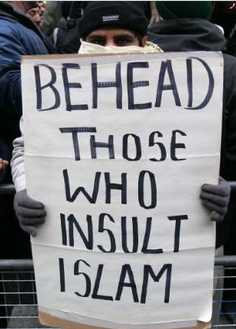
Young British citizens, as you study the teachings of the Prophet (pbuh), who inspired so much that went to make up our British legal system, you may occasionally encounter a mullah who seems different from the overwhelming majority of peace-loving Muslim servants of Allah. Perhaps he will say some surprising things in view of the fact that Islam is the Religion of Peace, or attend demonstrations displaying a sign such as this:

behead

Now, you should understand that he is carrying on with a great tradition of this country, which derives from shari'a law, of being able to speak one's mind without fear of reprisal. It is something we can all be proud of, and does honour to the Prophet (pbuh).

You should not take at face value the content of the message, and others you may hear in connection with jihad (that is, a peaceful inner struggle). While it is true that in Great Britain many who were thought dangerous (Sir Walter Raleigh, for example) have been beheaded in harmony with Islamic values, this sort of thing is frowned on today by many in the community. You might want to suggest to imams and others who use such language that, in deference to the feelings of some fellow Britons, they express themselves in this way only in an appropriate setting, such as a mosque.

The Department of Communities and Local Government completely understands the anger of those whom some infidels describe as "extremists," in view of our country's shameful collaboration with the Great Satan in invading Muslim countries and attempting to support the worldwide Zionist conspiracy by formerly teaching about an imaginary historical event called the Holocaust.

Nevertheless, if you happen to work in a shop and some of these so-called extremists want to purchase a load of fertilizer that can be used in making a bomb, you might want to remind them that through immigration and reproductive rates alone, the United Kingdom will soon have a Muslim majority and the infidels who do not convert to the Crescent will live as dhimmis. Therefore, trying to hurry the process along through the means of explosives might only result in more British expressing disrespect for the Prophet (pbuh) meanwhile.

Better to study the Holy Qur'an, so that when you are grown up you will know exactly how to apply it to any situation as a member of the ruling class responsible for seeing to it that no offence against the strict laws of shari'a will be tolerated, which traditional Muslim scholarship notes is fully compatible with the British legal system.

Allahu Akbar!